
The Impact of SwimFin on Fear of Water & Competence
By the end of Key Stage 2, the National Curriculum expects children to swim 25 metres, use a range of strokes, and perform safe self-rescue. However, recent data indicate that only 59% of children in the UK can swim 25 metres unaided, with a steady decline in swimming competence over the past 5–6 years (Sport England, 2023). These figures also mask broader inequalities: children from minority ethnic backgrounds and/or less affluent areas often experience lower outcomes in swimming and water safety (Ofsted, 2024).
The Covid-19 pandemic exacerbated this decline, limiting access to swimming through leisure industry closures. However, low swimming competence predates Covid, with historic inequalities noted more than 20 years ago (Lodewijk, 2003). For many children, school swimming lessons provide their first—and sometimes only—opportunity to engage in formal swimming instruction. Consequently, swimming providers play a crucial role in ensuring that school programmes are inclusive, effective, and provide a positive experience for all children.
Learning to swim extends beyond stroke development; fundamental aquatic skills such as floating and breath control are central to effective drowning prevention (WHO, 2014). One major barrier to learning is fear of water. Misimi et al. (2020) note that some learners struggle because they cannot sufficiently relax to facilitate floating or swimming. Buoyancy aids are commonly used to alleviate fear, with a variety of handheld and body-worn devices deployed to scaffold learning.
The effectiveness of buoyancy aids remains debated. Supporters highlight their safety benefits, ability to boost confidence, and increased learner engagement, particularly in large groups. Critics argue that they can create a false sense of security, inhibit independent swimming, and alter buoyancy, leading to unnatural positions (Van Duijn et al., 2021). Research on the use of assistive equipment in teaching aquatic skills is limited, with few studies providing strong evidence in favour of buoyancy aids.
Given the complex demands of aquatic learning, practitioners must adopt a learner-centred approach, tailoring the use of aids to individual needs and educational goals (Van Duijn et al., 2021). Ideally, decisions should be evidence-informed; however, the mixed literature highlights the need for further investigation into the role buoyancy aids play in developing swimming competence and confidence. This study aimed to address this gap by examining a novel teaching aid, the SwimFin, which has not previously been included in empirical research.
The SwimFin
The SwimFin has been used in swim schools worldwide for 18 years However, its use in National Curriculum school swimming lessons is extremely limited. Unlike traditional aids (e.g., armbands/discs pool noodles, kickboards), the SwimFin is positioned on the back, leaving the arms free. It is also more streamlined than other body-worn aids (e.g., swim vests and back packs), covering only part of the torso.
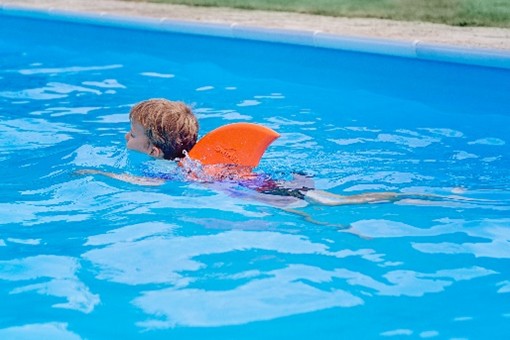
Photo by SwimFin
A key feature of the SwimFin is its adaptive buoyancy meaning it provides support when a swimmer is vertical or less stable and reduces support as they adopt a horizontal position. This addresses common criticisms of buoyancy aids, such as inhibiting independent swimming, altering centre of buoyancy, and fostering over-reliance. Fear of water remains a significant barrier to learning. The SwimFin’s self adjustable buoyancy has the potential to support beginners by promoting safety while allowing authentic engagement with the water. Given the historic and ongoing decline in school swimming competence in the UK, the authors argue that school swimming providers should consider all available tools to scaffold learning. However, no empirical research has examined the SwimFin in school swimming contexts. Research on school swimming within the National Curriculum has been limited, with notable contributions from Roscoe and Sinclair (2023) highlighting the need for further investigation. Beyond enhancing swimming competence, incorporating the SwimFin into school curricula may have broader public health implications. By improving water confidence and reducing fear associated with swimming, such initiatives could decrease the number of non-swimmers entering adolescence and adulthood, thereby promoting lifelong water safety and physical activity.
Therefore, this study’s main aim was to:
Examine the impact of the SwimFin on aquatic competency and confidence for primary-aged children.
Ethics
Ethical approval was obtained from the University of East London. Headteachers provided consent, and parents were informed of the study’s purpose and procedures, with the option to withdraw their child at any time. While swimming lessons are mandatory, child assent was obtained, and all participants were informed they could withdraw at any stage.
Participants
Sixty students from schools in the London Borough of Greenwich initially took part (30 Year 4, 30 Year 5). After assessment, eight children were deemed competent swimmers (Stage 3 or above) and were excluded. Twenty-four beginners (Stage 1) were allocated to the SwimFin group, with the remaining 28 classified as “improvers.” Only data from the SwimFin group are presented here; a full cohort analysis will be reported in future publications.
Swimming Programme
Sessions were conducted at a local pool (20m x 3m x 8m; depth 1–1.1m; 30°C) from September to December. Twelve 30-minute lessons were delivered in the morning by two STA-qualified teachers, following the Swim England Learn to Swim programme. Before sessions took place all swim teachers completed a SwimFin CPD course, accredited by Swim England Qualifications and recognised with CIMPSA . Sessions 1–2 were used for initial assessment and sessions 11–12 for post-assessment. All schools also received a classroom-based water safety session delivered by UEL students to ensure all components of the National Curriculum were covered.
Data Collection
Participants were assessed at the start and end of the programme using the Actual Aquatic Skills Test (AAST) (D’Hondt et al., 2021). Fear of water was assessed using the Fear of Water Assessment Questionnaire (FWAQ) (Misimi et al., 2020), focusing on water environment contact and natural force of water. Follow-up discussions with children and teachers provided qualitative insights.
Participants were assessed across six aquatic competencies, scored 1–3 (1 = not able; 2 = in progress; 3 = able):
- Blowing bubbles
- Floating – back star
- Floating – front star
- Leg propulsion – back
- Leg propulsion – front
- Exiting deep water
The fear of water questionnaire was administered after the programme and included questions such as:
“When I am in a pool, I am afraid when I am not in contact with floor”
“I am afraid when the water is deep”
“When I am in the pool, I am afraid to see how far the finish edge is”.
Results
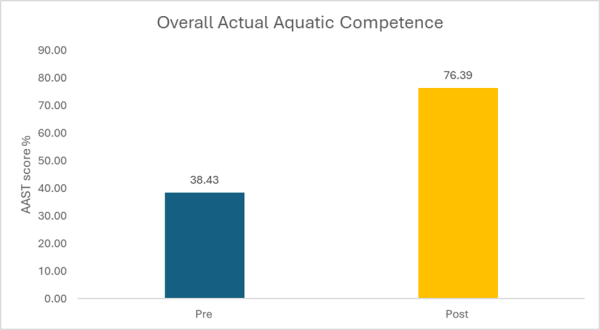
Image by The University of East London
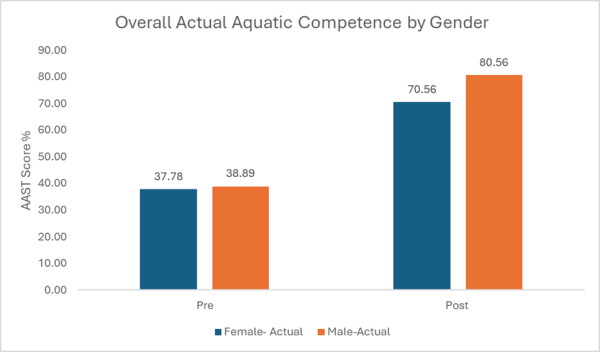
Image by The University of East London
Findings
Aquatic Competence
Participants in the SwimFin group demonstrated measurable progress across all six aquatic competencies. As shown in Graph 1, children moved from “not able” at baseline to “in progress” or “able” by the end of the 12-week programme, achieving an average score of 76%.
Graph 2 indicates that both boys and girls improved from pre- to post-intervention, with boys performing slightly better than girls although it must be mentioned that this was not statistically significant. This suggests that the SwimFin may support an equitable approach to swimming skill development.
Fear of water
Fear of water scores averaged 2.70 on a 5-point scale, indicating that while some apprehension remained, it was generally manageable and did not prevent skill acquisition. Teachers noted growing confidence in participants, who became increasingly willing to attempt unfamiliar skills.
Qualitative feedback further highlighted the SwimFin’s role in engagement and motivation. Children reported enjoying being part of the “shark fin group” and stated that it helped them feel more confident to try new activities and acquire new skills. These findings suggest that the SwimFin supports both the technical and psychological aspects of swimming.
As with any study, there are limitations, most notably the absence of a control group. While this limits causal claims, the observed trends in aquatic performance, alongside feedback from staff and participants, underscore the SwimFin’s potential as a supportive tool in school swimming programmes.
Overall, the results indicate that the SwimFin can enhance swimming competence and confidence in school settings.
References
- Misimi, F., Kajtna, T., Misimi, S. and Kapus, J. (2020) ‘Development and validity of the Fear of Water Assessment Questionnaire’, Frontiers in Psychology, 11, p.969. https://doi.org/10.3389/fpsyg.2020.00969
- Ofsted (2024) Levelling the playing field: The physical education subject report
- Sinclair, L. and Roscoe, C.M.P. (2023) ‘The impact of swimming on fundamental movement skill development in children (3–11 years): A systematic literature review’, Children, 10(8), pp. 1411
- Sport England (2023). Active Lives Children and Young People Survey: 2022 Report
- World Health Organization (2022). Preventing drowning: Practical guidance for the provision of day-care, basic swimming and water safety skills, and safe rescue and resuscitation training
Main – Photo by Sunshine Design
About the Author: Kev Moseley