

Movement & Dance in Clinical Practice (Part 4): Rethinking Embodiment, Agency & Sustainability
There is a certain kind of exhaustion that therapists, especially, know well. But you don’t always see it yourself. It creeps in slowly, session by session, year after year — a quiet erosion that happens not because you have stopped caring, but actually because you never stopped. You have sat with grief. Held space for rage, despair, confusion and loss. Shown up again and again, not knowing what might walk through the door that day, and your body already holding a subtle, tense anticipation for whatever might come.
This is the reality of therapeutic work. And whether we acknowledge it or not, it is a deeply embodied experience.
We talk about compassion fatigue mostly in emotional terms, which of course it is [1]. But less often do we talk about how it affects us in the body. The chronic low-level alertness. The shoulders that stay slightly raised after a session. The subtle but persistent sense of holding onto something that has nowhere to go. Research into secondary traumatic stress and burnout consistently points to somatic dysregulation as one of its earliest signs – the nervous system running away on slow alert in the background, long after the working day ends [2].
This continuous giving, holding and receiving, without giving ourselves permission for an outlet in our own inner life, slowly wears us down, beyond our conscious awareness.

The Self Beneath the Role
Something that is perhaps less discussed around compassion fatigue is this: over months and years, the role of being a therapist can begin to eclipse the person inside. We become so skilled at being present for others that we gradually lose the thread of what it feels like to simply be ourselves — not the professional self, not the compassionate witness, but the living, feeling, desiring human beneath all of that.
There’s a particular loss that happens quietly in this work. Not burnout exactly — you can still function, still show up, still care. It’s more that somewhere along the way, you stopped being a person who happens to be a therapist, and became a therapist who occasionally remembers being a person.
This is where boundaries become genuinely difficult. Because boundaries aren’t primarily an intellectual exercise — they’re a felt experience. They require a stable, inhabited sense of self. Something you can return to when the work pulls you outward. Without that inner ground, boundaries become rules rather than felt textures and rhythms. And rules, as we humans fundamentally know, can be much harder to sustain than genuine inner knowing.
So how do we restore that ground? How do we ‘come home to ourselves’? Not in a conceptual way, but physically, somatically, in a felt sense?
Embodied Support: More Than Physical
Movement is part of the answer. But not movement as we usually mean it — not the gym, the structured workout, or even formal yoga, though these have their place. What I’m pointing to is something more open, more improvisational, more fundamentally alive.
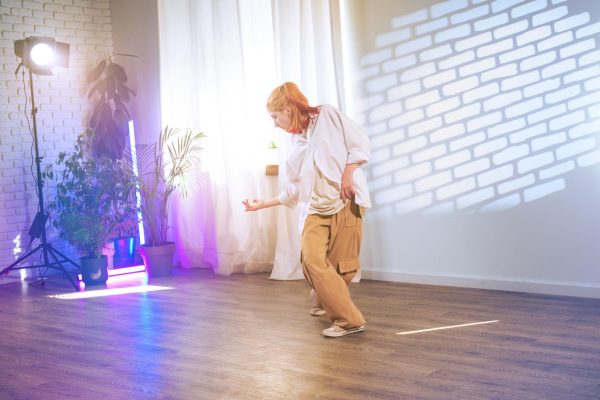
When we allow ourselves to move freely — letting the body find its own shape and rhythm rather than following someone else’s choreography — we access something that more structured practices elude. On a physical level, moving with more freedom restores a sense of embodied agency. Posture shifts. Breathing deepens. The body starts to feel less like a container under pressure and more like a living, self-organising intelligence. A grounded, fluid quality returns — an inner support that is flexible and responsive.
On a mental level, free movement offers what I often call a vacation for the brain. When we drop below the analytical, problem-solving mind — stepping out of the beta brainwave activity of the frontal cortex — the nervous system genuinely recalibrates. The sustained and ultimately debilitating effort of holding everything together begins to soften. We become, paradoxically, more mentally resilient because we’ve exhaled, released, allowed ourselves to let go.
Also, very importantly, moving this way supports us emotionally, it keeps us connected to our own hearts. It creates space for our own experience — not to be analysed or processed intellectually, but simply moved through. For therapists who spend their professional lives facilitating this very process for others, giving yourself this same permission can be a deep, powerful process.
The Visionary Body
There’s another dimension that is very important in how I work. I call it the visionary body.
We tend to think of the somatic body as our physical, breathing, sensing self — bones, muscles, fascia, breath. And of course it is all of that. But when we drop into deep, free, improvisational movement; when we enter that alpha-theta state just below ordinary waking consciousness, we access something more expansive [3]. A part of ourselves that can imagine, dream and perceive beyond our everyday. The part that carries hope, to create a new and rich future.
This isn’t a mystical claim. Neuroscience has long recognised that states of open, relaxed awareness associated with alpha and theta brainwave activity, are linked to greater creativity [3]. Researchers call it the default mode network: the part of the brain involved in imagination, self-reflection and envisioning the future [4]. By moving freely, without agenda, we give ourselves permission to enter this more dream like state, where we also connect to our emotions in a more understanding and spacious way.
For therapists, this gives support. There will be sessions — perhaps many — where what a client is navigating is genuinely difficult.
There may be no quick resolution. No clear way out. Where the most honest thing you can offer is your steady, compassionate presence in the middle of something prolonged and possibly bleak. In those moments, what sustains you isn’t strategy or technique. It’s access to something beyond the here and now. A felt sense that there is always more than what is visible to our seeing eye. Yes a challenge perhaps to those of a strictly scientific bent, but then if you know your science, you know that even Einstein openly admitted to things that were inexplicable and ‘spooky’. Life is movement, even in the hardest moments, and we have a visionary body that travels beyond ‘the seen’.
Moving Through
I often say I’ve lived several lives already. There have been seasons in my own life where I couldn’t see a clear way forward, when logic just didn’t give any comfort. What I know from those times is that movement wasn’t just a metaphor. It was a literal practice of moving through. Not because it necessarily gives you all the immediate answers, but because it reminds your whole system — body, nervous system, imagination — that you are not fixed. That fluidity is possible, and that there is scope beyond that present moment.
Ultimately this is what we’re offering to our clients. And it’s what we also owe ourselves.
For therapists, a regular somatic movement practice that is open, improvisational and genuinely expressive isn’t a luxury. It’s how you refill your own cup. How you decompress after sessions that have taken something from you, diffuse what you’ve absorbed, and find your way back to yourself. Because the real danger of this work, over time, is that we forget who we are beneath the role. We become so good at being the therapist that the person inside slowly disappears. Movement brings that person back.
It gives you a direct, unfiltered experience of yourself — not your role, not your skills, not what you can hold for others. Just you, moving, alive, present to your own inner world.
Resilience That Is Alive
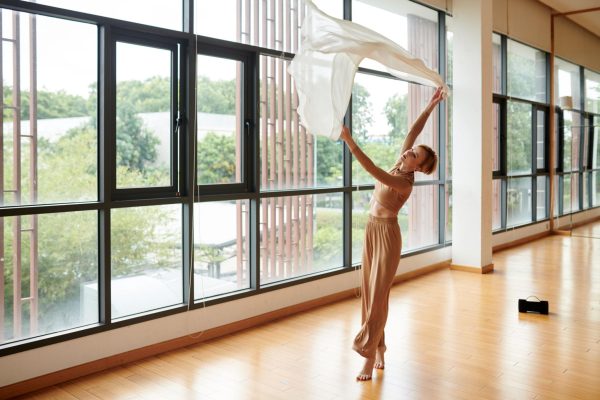
There’s a particular kind of resilience that movement builds — and I don’t find it available in more structured physical practices. It’s not the resilience of endurance, the capacity to take more. It’s the resilience of fluidity — the capacity to keep moving. To bend without breaking. To feel the full range of what you’re carrying without it engulfing you. This is where I feel my ancestral Chinese roots and the flow of the Tao.
That is what therapists need. Not more reinforced armour. More aliveness.
If this resonates and you’re curious about what this kind of practice could look like for you, I’d love to hear from you.
Next in the series: Part Five — Joy as Medicine. In the final part of this series we will be exploring the other side of everything we’ve been discussing: the profound ability of movement and dance to restore not only regulation and resilience, but to offer new hope, peace and lightness of being.
Because isn’t that, ultimately, what we’re all trying to find our way back to?

References
All images created using Ai
About the Author: Helene Su