
Welcome, to Health & Wellbeing Magazine’s Spirit Keeper monthly column. This is the place where you will discover tips and practices for creating, developing and maintaining a personalised self-care practice as a Spirit Keeper.
As we enter the third year of this column, I am going to shift the focus to the development of specific characteristics using mindfulness techniques and rituals. A Spirit Keeper has characteristics which can be described as soulful, spiritual, mindful and masterful. A true integration between mind, body, spirit and soul.
These characteristics are mastered and embodied through reflective inner work and action practice in the outer world. I will be using the chakras as a guide. By learning to embrace the positive and negative archetypal force of the characteristic, one can walk the middle road and have one foot in the world of spirit, and one firmly planted on Mother Earth. As Gregg Braden describes it, walking between the worlds.
The specific characteristics are:
- Self-reliance
- Self-Care
- Self-Worth
- Self-Appreciation
- Self-Expression
- Self-Exploration
- Selflessness
These characteristics to me are sovereign powers which form the backbone to the personality of a Spirit Keeper and healing facilitator. One of the principles of moving from the wounded healer to the integrated healer is to come from a place of personal integrity. One needs to be walking the talk and talking the walk. What Ghandi referred to as ‘becoming the change you wish to see in the world’.
This month, August 2026, I will focus on the characteristic of self-care and how this can be developed as a key characteristic of being a healing facilitator and Spirit Keeper.

Metaphorical Story : The Qualities & Characteristics of Self-Care
The mist clung to the path of whispers like a heavy silken veil as Yasmina climbed it to the forest glade on the mountain side where the sages Dhrona and Mother Sela lived. By the time she reached the glade her breath was shallow, and her spirit felt like a frayed rope.
In the centre of the forest glade sat four ancient moss-covered stones, surrounding a fire pit where the flames danced in a steady, rhythmic pulse. Dhrona sat as still as the mountain itself on one of the stones, while Mother Sela tended a pot of green tea.
“You have arrived exhausted, little bird,” Mother Sela said, her eyes kind but piercing. “How can you heal the valley if you are a drought-stricken well?”
Yasmina sat upon one of the mossy stones. Yasmina sighed as she sat down and said, “I thought being a healing facilitator was a vessel which never emptied.”
“A vessel which never empties is a myth,” Dhrona countered, his deep resonant voice sounding like grinding gravel. “A healer is a conduit. To keep the spirit flowing, you must first keep the self. Let us look to the elements of healthy and practical self-care for being a clear, grounded, centred and aligned healing conduit and spirit keeper.”
The Mind: The Garden of Gated Waters
Dhrona pointed to the small stream at the edge of the forest glade diverted by a wooden sluice gate.
“Your mind and emotional states are like this stream, Yasmina. If you allow every fallen leaf and bit of mountain debris to clog the stream, the water will eventually turn stagnant. This is why you must practice removing the debris from the stream daily. Like weeding a garden, knowing which leaves, stones and sticks you are to move and which belong to the riverbed, help to keep the river in flow. In healing to keep the mind-body conduit in flow, one needs to develop emotional literacy. To create and develop emotional literacy, you need a daily practice of releasing and clearing thought debris and over-reaction to emotional states which become locked in your cellular structure.”
“And the gate?” Yasmina asked.
“That is your boundary,” Dhrona replied. “A healer who cannot say ‘no’ is a garden with no fence. Without a fence creating a boundary the deer will eat the medicinal herbs before they can bloom. You must guard your gates so that your ‘yes’ has the strength of pure water.”
The Body: The Sacred Hearth
Mother Sela handed Yasmina a cup of green tea, then gestured to the fire pit.
“Your body is this hearth,” she whispered. “Many seekers treat their bodies like a rented mule, pushing it until the beast collapses. A spirit keeper knows the body is the temple of the breath, the vehicle of the soul and takes good care of it.”
She tossed a handful of dry cedar bark onto the embers and allowed the smell of cedar to fill the space around them. “If you feed the fire only once a week with giant logs, it will smother. If you never clear the ash, the air cannot reach the flame. Physical self-care is the daily tending of the vessel which carries your soul. To keep your body and spirit grounded, centred and aligned it is important to understand the role of self-care. Like a fire, your mind, body and spirit need to be tended to daily. The small sticks of rest, the steady fuel of movement, and the wisdom to know when the fire needs to dim so the embers can survive the night.”
The Spirit: The Root and the Sky
Finally, Mother Sela placed a hand upon the mossy stone upon which she sat. “Look at these four stones. They do not strive to be the mountain; they simply are the mountain. This is the spirit.”
“To be a healing facilitator and spirit keeper,” Mother Sela continued, “is to have alignment. Like a tree with roots deep in the earth and branches reaching for the sky and the stars. If the tree forgets its roots (its core values) the first storm will topple it. If the tree forgets the sky, it withers in the shade of other trees.”
Mother Sela leaned in closer. “You seek out the sky and stars not to escape the valley, Yasmina, but to remember why the valley is worth healing. A spirit that does not play, or pray, or wonder, is a spirit which has forgotten its own song.”
The Healer’s Covenant
Dhrona stood, his silhouette etched against the early evening skyline.
“Go back along the path of whispers to the valley below, Yasmina, and remember you are not the medicine. You are the apothecary of various healing techniques and information. If the apothecary is broken, the medicine remains locked away. To care for yourself is not an act of selfishness; it is the first act of your healing work and journey. You cannot truly care and help others when you are compromised in your own self.”
“The well that gives everything away without a spring to feed it,” Mother Sela added as a final parting, “becomes nothing but a hole in the dirt. Be the source of the spring, little bird.”
Yasmina looked at the four stones, the steady fire, and the gated stream. She felt her heartbeat slow to match the rhythm of the mountain. Yasmina stood and stretched and thanked Dhrona and Mother Sela for helping her to understand how important it is for a spirit keeper and healing facilitator to be a conduit who is talking the walk and walking the talk. Self-care as a practice and quality were vital for her soul journey and evolution. Only then could she be in a place and space to be of service to others.
Each soul descends to Mother Earth on a quest for expansion and wisdom. Yet, when we fail to remain embodied and grounded, we lose our centre and drift away from our true alignment. Without an internal anchor, life can feel less like a journey and more like being locked in a cage; leaving us at the mercy of socio-political and economic tides which threaten to erode our autonomy. These systems are designed to drain the very essence of our sovereign power: the profound truth that we are, first and foremost, spiritual beings navigating a human experience.
The chakra system acts a wonderful guide for working through the key commands of Know, Love, Heal and Free Yourself. They are also a useful guide for reflective inner work when it comes to acknowledging the archetypal forces which exist within your own mind, body and spirit.
To move from the energy of the Martyr archetype (who feels the need to self-sacrifice) to the Empress/Emperor archetype (who takes care of the self), we can work with the Sacral Chakra (Svadhisthana). The gift of the sacral chakra is self-care. This energy centre is widely considered the seat of creativity, emotions, and sensuality. Located in the lower abdomen (about two inches below the navel), it serves as your energetic centre for how you relate to your feelings and the feelings of others. The connection between your feelings and your physical health isn’t just “in your head”, it is a measurable, biological reality. Science increasingly views the mind and body as a single integrated system, a field of study known as Psychoneuroimmunology (“PNI”).
In the spirit of Yasmina’s journey to learn about self-care, here are some mindfulness techniques and rituals to begin your own inner journey to transmute these energies into the sovereign power of self-care.
Practicing self-care across the mind, body, and spirit isn’t about being “perfect” or spending every weekend at a spa. It is the discipline of self-awareness and boundary-setting both physically and emotionally. A person who masters emotional intelligence usually radiates a certain kind of grounded energy. They are not necessarily the loudest in the room, but they are often the most resilient. Self-care is not something to talk about, it is something you do quietly and allow the results to speak for themselves. Daily small routines will compound into a state of mental, emotional and physical wellbeing. Become addicted to progress instead of instantaneous pleasure.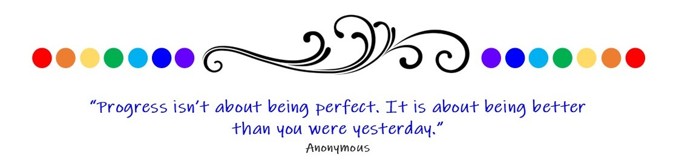 Here is a breakdown of the qualities and characteristics found in those who treat self-care as a progressive lifestyle rather than a luxurious pleasure.
The Mind: Intellectual & Emotional Clarity
Mental self-care is about how a person manages their internal narrative and cognitive load.
- Boundaries as a Default: They understand that “no” is a complete sentence. They protect their time and mental energy from “energy vampires” or unnecessary drama.
- Curiosity over Judgement: When they make a mistake, they approach it with a growth mindset. They ask, “What can I learn from this?” instead of “Why am I like this?”
- Digital Hygiene: They are intentional with technology. They do not let notifications dictate their mood and are comfortable unplugging to avoid “doomscrolling.”
- Emotional Literacy: They can name what they are feeling (e.g., “I am not angry, I am just overwhelmed”) rather than over-reacting impulsively.
The Body: Physical Stewardship
Physical self-care is not about chasing a specific aesthetic; it is about respecting the biological machine which carries you the soul, through life.
- Consistency Over Intensity: They value 20 minutes of daily movement over a gruelling four-hour gym session once a month.
- Intuitive Listening: They eat, sleep, and move based on what their body needs. If they are exhausted, they prioritize a nap over a high-intensity workout.
- Preventative Maintenance: They do not wait for a crisis to see a doctor or therapist. They treat check-ups and rest as non-negotiable appointments.
- Somatic Awareness: They recognise physical cues of stress, like a tight jaw or shallow breathing, and take immediate steps to regulate their nervous system.
The Spirit: Purpose & Connection
Spiritual self-care is less about specific religion (though it can include it) and more about a sense of belonging and “why.”
- Community Contribution: They understand isolation is the enemy of the spirit. They nurture deep, authentic connections and contribute to something larger than themselves.
- Practice of Presence: Whether through meditation, prayer, or gardening, they have a way to “be here now.” They are not constantly living in the past or the imagined future.
- Sense of Awe: They seek out moments which make them feel small in a good way; such as looking at the stars, visiting an art gallery, or walking in nature and searching out beauty.
- Values-Driven Living: They know their core values (e.g., honesty, creativity, service) and make decisions which align with their core values.
Summary Table: The Holistic Practitioner & Spirit Keeper
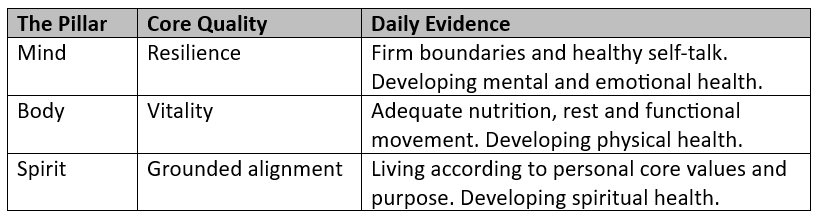
The Key Distinction: A person who practices true self-care doesn’t do it to “escape” their life; they do it, so they don’t need to escape. It is the act of building a life they enjoy inhabiting.

For healing facilitators and spirit keepers, self-care is a personal and professional necessity. This is because you spend your energy holding space for others, your own “vessel” must be replenished using multiple sensory pathways to ensure deep integration.
Here are techniques categorised by sensory type, tailored for those working in the spiritual and healing arts.
Auditory Self-Care Techniques (Sound & Vibration)
Sound is one of the fastest ways to shift the frequency of your nervous system and “clear” the energetic debris of a session.
- Binaural Beats & Solfeggio Frequencies: Listen to 417 Hz (which is associated with the sacral chakra and clearing trauma) or 528 Hz (the “DNA repair” frequency). Use headphones to allow the brain to synchronise its hemispheres.
- The “Sonic Wash”: Use a singing bowl or a loud bell. Instead of just listening, “wash” your ears with the sound, imagining the resonance scrubbing away any heavy stories or “hooks” you may have picked up from clients.
- Vocal Toning & Humming: After a session, use your own voice to create a low, resonant hum. Focus the vibration on your chest or at the sacral chakra. This stimulates the vagus nerve, signalling to your body the “work” is done, and it is safe to relax.
Visual Techniques (Light & Imagery)
Spirit keepers often deal with “visionary” energy; these techniques help ground that vision and protect their internal landscape.
- Colour Bathing (orange spectrum): To nourish the sacral chakra, spend 10 minutes looking at something which has a vibrant orange colour. For example, a sunset, a piece of carnelian, or even orange flowers. Visualise this colour entering your lower abdomen and repairing any leaks in your energy field.
- Externalizing the “Internal Sky”: If your mind feels cluttered with others’ problems, use a mental sky technique. Visualise your thoughts as clouds passing across a vast blue sky. Don’t engage with the clouds; just observe their shapes until they drift out of your visual field.
- The “Golden Shield” Visualization: Before beginning work, visualise a sphere of golden, translucent light surrounding you. It acts as a one-way mirror: your healing light goes out, but others’ heavy emotions hit the mirror and drop to the earth to be composted, never entering your field.
Kinaesthetic Techniques (Touch & Movement)
Since the sacral chakra is the seat of “flow,” kinaesthetic care is vital to prevent emotional stagnation.
- Hydrotherapy (The element of water): Since water is the element of the sacral centre, use it intentionally. A salt bath (Epsom or Sea Salt) isn’t just physical; it acts as an osmotic pump, drawing out energetic “toxins.” Submerge yourself fully to reset your skin’s sensory boundary.
- Somatic Shaking: Stand with your feet hip-width apart and literally shake your body (arms, legs, and torso), for 2–3 minutes. This is a “trauma release” technique used to discharge the adrenaline and cortisol which healers often absorb during intense emotional work.
- Weighted Grounding: Use a weighted blanket or place a heavy stone (like smoky quartz or hematite) on your lower abdomen while lying down. The physical pressure provides proprioceptive input, telling the brain exactly where “you” end and the “outside world” begins.

Self-Care & The Business of Healing
In the business of healing, self-care is often the “silent partner” which determines whether a practice thrives or burns out. When you are the “product” (the healer), your business infrastructure must be designed to protect your energy, not just your bottom line.
Here is how self-care translates into the “mundane” but essential pillars of the business of healing:
Accounting: Financial Safety as Root Chakra Stability
Financial stress is the quickest way to block your creative and intuitive flow. In the business of healing, accounting is an act of grounding the business and self.
- Automation: Using software (like QuickBooks, Xero or Wave) to track expenses is a kinaesthetic relief. It removes the “mental load” of manual tracking from your brain.
- Energetic Pricing: Self-care means pricing your services based on the energy required to deliver them, not just the market average. If a session leaves you drained for three hours, you must price it to cover those three hours of “recovery time.”
- Tax Reserves: Setting aside a percentage of every payment into a separate, untouchable account is an act of self-kindness. It prevents the “survival mode” panic which can occur during tax season, which can cloud your ability to hold space for others.
Marketing: Authentic Expression vs. Performance
Marketing often feels “gross” to healing facilitators because it feels like begging or bragging. Self-care in marketing is about shifting from promotion to resonance.
- Boundaries in Copy: Your marketing should clearly state who you don’t work with. This is “pre-emptive self-care” which prevents you from booking clients whose energy is a mismatch for your skills.
- The “Slow-Content” Rule: Self-care means ignoring the pressure to be on every social platform daily. Choose one medium (auditory like a podcast, or visual like Instagram) which energises you and ignore the rest.
- Visual Storytelling: Instead of “selling” use your visual self-care techniques. Share the orange hues of your workspace or the stones you use. This attracts clients who resonate with your frequency, meaning you will not have to work as hard to “convince” them during sessions.
Sales: Sacred Exchange & Sovereignty
In healing, a “sale” is an energy exchange. If the exchange is uneven, the healer becomes eventually becomes resentful.
- The Discovery Call Boundary: Use auditory cues during sales calls. Listen for the “tone” of the potential client. If their voice triggers a “tightness” in your sacral area, self-care is having the courage to refer them to someone else.
- Non-Negotiable Policies: Having a strict 24-hour cancellation policy is a kinaesthetic boundary. It protects your time and teaches the client your energy has a specific, respected value.
- Tiered Offerings: To avoid trading “hours for dollars” (which leads to physical exhaustion), create passive visual or auditory products (e.g., recorded meditations or e-books). Having a digital platform will allow your business to care for you while you sleep.
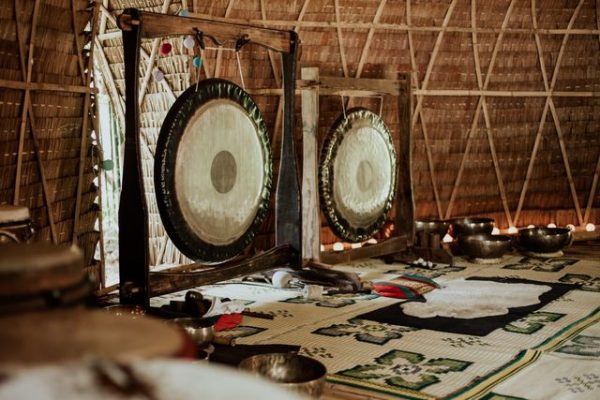
Photo by cottonbro studio
Office Design
Since healing facilitators are often sensitive to their environment, your physical “business” space must be a sanctuary:
- Ergonomics: Investing in a high-quality chair or a standing desk is a kinaesthetic investment in your longevity in being able to focus on administrative tasks for the business of healing.
- Visual Clearing: Keep your “admin” desk separate from your “healing” space. If you do your accounting in the same chair where you do your readings and/or healing sessions, the energies will bleed into each other, making “business time” feel heavy.
If your ‘healing room’ is where you also carry out administrative and record keeping tasks of your business of healing, then ensure you have a separate desk, chair and filing cabinet which is clear of clutter when you are giving treatments to your patients. The visual of a clear desk will give clients confidence in your abilities; the filing cabinet will give clients confidence in your abilities to keep things private and follow GDPR principles. It also helps to create a defined boundary between the business of healing and the healing business.
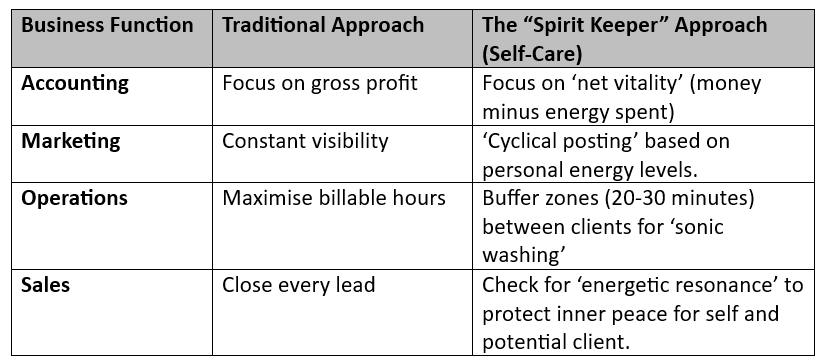
The Business Alignment Matrix
Summary & Conclusion
A final thought: by working with the Sacral Chakra and its gift of self-care, you are not just “thinking” about self-care; you are weaving it into your mind, body and spirit as a way of living and being. It is part of your personal and working life.
Next month…
September 2026 I will be focusing on the characteristic of self-worth and its qualities as a healing facilitator and Spirit Keeper.
Until next month. From one kindred spirit to another – be safe, be well, be authentically you.
In gratitude
Kathleen
All images by Kathleen Ginn
About the Author: Kathleen Ginn