
Welcome, to Health & Wellbeing Magazine’s Spirit Keeper monthly column. This is the place where you will discover tips and practices for creating, developing and maintaining a personalised self-care practice as a Spirit Keeper.
We are now in the third year of this column. I am focusing on the development of specific characteristics using mindfulness techniques and rituals. A Spirit Keeper has characteristics which can be described as soulful, spiritual, mindful and masterful. A true integration between mind, body, spirit and soul.
These characteristics are mastered and embodied through reflective inner work and action practice in the outer world. I will be using the chakras as a guide. By learning to embrace the positive and negative archetypal force of the characteristic, one can walk the middle road and have one foot in the world of spirit, and one firmly planted on Mother Earth. As Gregg Braden describes it, walking between the worlds.
The specific characteristics are:
- Self-reliance
- Self-Care
- Self-Worth
- Self-Appreciation
- Self-Expression
- Self-Exploration
- Selflessness
These characteristics to me are sovereign powers which form the backbone to the personality of a Spirit Keeper. One of the principles of moving from the wounded healer to the integrated healer is to come from a place of personal integrity. One needs to be walking the talk and talking the walk. What Ghandi referred to as ‘becoming the change you wish to see in the world’.
This month, October 2026, I will focus on the characteristic of self-appreciation and how this can be developed as a key characteristic of being a healing facilitator and Spirit Keeper.

Metaphorical Story : Self-Appreciation & Gratitude
The air in the mountain forest glade was thick with the scent of damp pine and crushed juniper. Yasmina’s breath caught in her throat as she stepped out from the path of whispers into the glade. Her hands, seasoned in the arts of spirit keeping and energetic healing, were trembling slightly. She felt stretched thin, like gold beaten so flat it was on the verge of tearing.
Sitting upon two of the moss-covered basalt stones near the crystal-clear spring were the sages, Dhrona and Mother Sela. Dhrona, whose eyes held the quiet expanse of the high forest glade, was carving a piece of wood. Mother Sela, her hair a silver tapestry reflecting the canopy above, was pouring a steaming infusion of wild herbs into three clay cups.
“You carry the weight of a hundred broken lineages on your shoulders today, Yasmina,” Mother Sela said softly, without looking up. “Sit. Drink.”
Yasmina sat on a third moss-covered stone by the babbling stream, cradling the warm clay cup. “I am weary,” she admitted, her voice sounding like dry leaves being crunched underfoot. “I know how to build walls to protect my energy. I know how to price my gifts, so I do not starve. But beneath the business and the boundaries, I feel a hollow ache. I am told I must master self-appreciation to hold sovereign power as a spirit keeper. But what is it, truly? Beyond a tool for survival, what does it mean to embody it?”
Dhrona set down his carving knife. He picked up a small, polished obsidian mirror from the moss beside him and held it out to Yasmina. But before she could take it, he tilted it toward the mountain peak above them, then threw a handful of dirt across its reflective surface.
“Tell me, Spirit Keeper,” Dhrona instructed. “What do you see in the glass?”
“I see the mountain,” Yasmina replied, squinting, “but it is fractured, dark, and covered in dust.”
“This is the mind without self-appreciation,” Dhrona said, his voice deep, gravelly sounding and grounding. “Psychologists speak of the mirror of wholeness. When you do not appreciate your own worth, achievements, and unique strengths, your internal mirror is warped by the dust of survival, comparison, and defence. You are at war within yourself, Yasmina. When a beautiful person walks into your temple, you do not see them; you see your own inadequacy, and it tastes like envy. When you look at the vast cosmos, you do not feel wonder; you feel threatened by its scale, feeling small and insignificant.”
He dipped a cloth into the spring and wiped the obsidian mirror clean until it shone like liquid night, perfectly reflecting the towering ancient pines and the mountain.
“When you sign a peace treaty with your own mind,” Dhrona continued, “the dust clears. True self-appreciation quiets the internal noise of ‘am I enough?’ Because the mirror is whole, you suddenly possess the mental bandwidth to genuinely notice the world outside of yourself. This is what psychologists call the experience of awe. You can look at a massive mountain range or a deeply resilient, wounded soul walking into your healing space and think, ‘This is magnificent, and I am incredibly lucky to exist alongside it.’ You feel safe in the presence of vast beauty, because your own light is no longer up for debate.”
Mother Sela smiled, the wrinkles around her eyes crinkling like map lines. She pointed down toward the crystal spring water and where the water pooled into a flawless, still basin. Deep beneath the surface, the ancient roots of the grandfather trees entwined with the stone, were drinking from the same hidden source.
“Dhrona speaks of the mirror, but philosophy speaks of the resonance,” Mother Sela murmured. “Look into the water, Yasmina. Where do the roots end and the water begin?”
Yasmina leaned over, watching the green moss sway rhythmically in the current. “They are feeding each other. They move as one.”
“Exactly,” Mother Sela said. “In the high halls of philosophy, we learn that appreciating external beauty, whether the wild grace of this forest or the fragile majesty of a human soul, is not separate from self-appreciation. It is a direct extension of it. Eastern sages and existential thinkers have long known the shared thread of being. You are not separate from nature; you are nature. When you appreciate your own life force, you realise that admiring an ancient forest or the profound complexity of a client is simply appreciating the very same life force that moves through you all.”
Mother Sela picked up a wild orchid blooming from a rotting log, its petals a brilliant, and coloured fragile violet. “The philosopher Immanuel Kant spoke of disinterested contemplation,” Mother Sela whispered, turning the flower in her fingers. “It means to appreciate a thing entirely for what it is, not for what it can do for you, how it can serve your ego, or how it makes you look. When a spirit keeper lacks self-appreciation, they treat the world as a transaction. They look at a gorgeous sunset and immediately worry about how to perform their awe for others, or how to use it to validate their title. But when you inhabit your sovereign power, you do not consume the world. You do not pluck the orchid to possess it. You simply sit with it. You allow it to exist, and in doing so, you allow yourself to exist.”
Yasmina closed her eyes. She felt the warmth of the clay cup in her hands, the solid earth beneath her thighs, and the deep, vibrating cadence of the sages’ words. The internal war, the constant, frantic evaluation of whether she had healed enough people, or done enough good, or proven her worth to the spirits, suddenly dropped away like a heavy cloak.
She opened her eyes and looked at Dhrona and Mother Sela. For the first time in years, she wasn’t analysing them as teachers, nor was she comparing her young medicine to their ancient wisdom. She simply saw the beauty of their aging hands, the profound grace of their presence, and felt a sudden, breathtaking wave of gratitude that she was there to witness it.
“I hear and see,” Yasmina whispered, a radiant smile finally breaking across her face. “Self-appreciation is the act of opening the windows within my mind. The war is over within my thinking.”
“Yes,” Mother Sela said, pouring fresh tea into Yasmina’s cup. “And only a facilitator who has opened their own windows can truly show a broken soul how to look at the view.”

Yasmina stood and stretched. She paused and breathed deeply of the fresh mountain air, and she listened to the song of the babbling stream as it made its way over rocks and making its way down into the valley. In that moment she spotted a small emerald, green beetle climbing a grass head at the edge of the stream. So small it was barely visible. As she lent over to take a closer look, she saw beauty within the small creature and how it was important to the cycle of life. The feeling of gratitude and awe overflowed in her heart and mind with that small close encounter.
Yasmina stood up straight and thanked Dhrona and Mother Sela for helping her to understand how important it is for a spirit keeper and healing facilitator to embody self-appreciation personally and professionally. Self-appreciation and gratitude as a practice and quality were vital for her soul journey and evolution. Only then could she be in a place and space to be of service to others and help them to open their own windows and see the view and their connection to the sacred thread of life.
Each soul descends to Mother Earth on a quest for expansion and wisdom. Yet, when we fail to remain embodied and grounded, we lose our centre and drift away from our true alignment. Without an internal anchor, life can feel less like a journey and more like being locked in a cage; leaving us at the mercy of socio-political and economic tides which threaten to erode our autonomy. These systems are designed to drain the very essence of our sovereign power and the profound truth we are, first and foremost, spiritual beings navigating a human experience.
The chakra system acts a wonderful guide for working through the key commands of Know, Love, Heal and Free Yourself. They are also a useful guide for reflective inner work when it comes to acknowledging the archetypal forces which exist within your own mind, body and spirit.
When I first started out on the healing journey, I found I was mixing up the meaning of words and phrases which was keeping me confused and lacking in clarity. I found myself asking what is the difference between self-appreciation and entitlement as a healing facilitator and spirit keeper?
This touches on an important distinction, especially for healing facilitators, therapists, and caregivers who often struggle with the balance of giving versus receiving. At their core, self-appreciation and entitlement thinking look entirely different because they come from two completely opposite emotional states. One comes from wholeness, and the other comes from lack.
Here is how they differ in practice, intent, and expression:
The Core Motivation
- Entitled Thinking (Rooted in Lack): This is an external demand for special treatment, often used as a shield to cover up deep-seated insecurity or a fear of being inadequate. It says: “I am uniquely superior, and others owe me compliance, praise, or exceptions.”
- Self-Appreciation Thinking (Rooted in Worth): This is a grounded, internal recognition of your reality. You understand your time, energy, and skills have objective value, and you treat them with respect. It says: “My well-being and expertise matter just as much as anyone else’s.”
The Relationship with Boundaries
- Entitled Thinking is One-Sided: Entitlement views boundaries as a one-way street. An entitled mindset expects others to bend their rules, schedules, or budgets, but reacts with anger or resentment if asked to compromise in return.
- Self-Appreciation Thinking is Collaborative: When you value your skills as a healer, you set clear boundaries (like firm session times, cancellation policies, or set rates) because you know preserving your energy allows you to show up fully for your clients. You honour your boundaries, and you honour theirs.
How They Express Themselves
The way these two mindsets speak and act in professional settings highlights the starkest contrast:
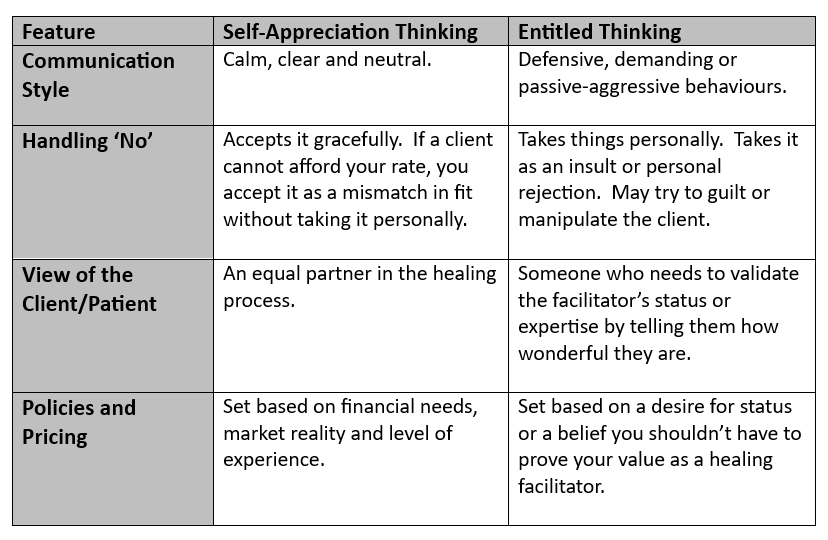
The Litmus Test: Self-appreciation focuses on stewardship. Responsibly managing your limited human resources (energy, time) so you do not burn out as a healing facilitator and spirit keeper. Entitlement focuses on privilege. Believing you are exempt from the standard give-and-take of human relationships.
When you operate from self-appreciation, you don’t need to shout your value or demand people see it. You simply state your terms clearly, let your work speak for itself, and gracefully walk away from situations which require you to compromise your well-being.
Self-appreciation is the practice of recognising and valuing your own achievements, strengths, and worth, fostering a positive self-image and emotional well-being.
Self-Appreciation through the Lens of Philosophy & Psychology
When you shift from looking at self-appreciation as a professional boundary tool to looking at it through the lens of philosophy and psychology, its meaning deepens beautifully.
In these fields, appreciating external beauty, whether in a person or in nature, is not separate from self-appreciation; it is a direct extension of it. When your internal state is grounded in self-appreciation, you are no longer consuming the world or using it to validate your ego. Instead, you develop the capacity for what philosophers’ call ‘disinterested contemplation’ and what psychologists call ‘aesthetic appreciation and awe’.
Here is how the self-appreciation experience shifts when viewed through both disciplines:
The Psychological Perspective: The Mirror of Wholeness
In psychology, particularly within humanistic and positive psychology, your ability to perceive beauty is tied directly to your internal state of security.
- The Experience of Awe: Psychologists study awe as an emotion which occurs when we encounter something so vast it challenges our current understanding of the world. Self-appreciation allows you to experience awe safely. You can look at a massive mountain range or a deeply resilient human soul and think, “This is magnificent, and I am incredibly lucky to exist alongside it,” rather than feeling threatened by its scale or perfection.
- The Psychological Mirror: If you do not appreciate or accept yourself, your mind is constantly occupied with survival, comparison, or defence. You look at a beautiful person and feel envy; you look at a majestic landscape and feel small or distracted. True self-appreciation quietens the internal noise of the mind. Because you feel inherently “enough,” you have the mental bandwidth to genuinely notice the world outside of yourself.
The Philosophical Perspective: Subjective Resonance
Philosophy bridges the gap between the “self” and the “other” through the study of aesthetics (the philosophy of beauty and art).
- The Shared Thread of Being: In Eastern philosophy and existential thought, self-appreciation is the realisation you are not separate from nature; you are Appreciating an ancient forest or the profound complexity of a human being is just appreciating the same life-force which moves through you.
- The Transcendence of the Ego: Immanuel Kant argued true appreciation of beauty must be “disinterested”. Meaning you appreciate the thing for what it is, not for what it can do for you or how it makes you look. When you possess self-appreciation, you do not look at a gorgeous sunset and immediately worry about capturing it perfectly for social media validation. You simply sit with it and capture it on your phone or camera because it takes your breathe away and leaves you in awe.
How Self-Appreciation Changes the Way You “Hear” & “See”
When self-appreciation is your baseline, your relationship with external beauty transforms from a transaction into a relationship.
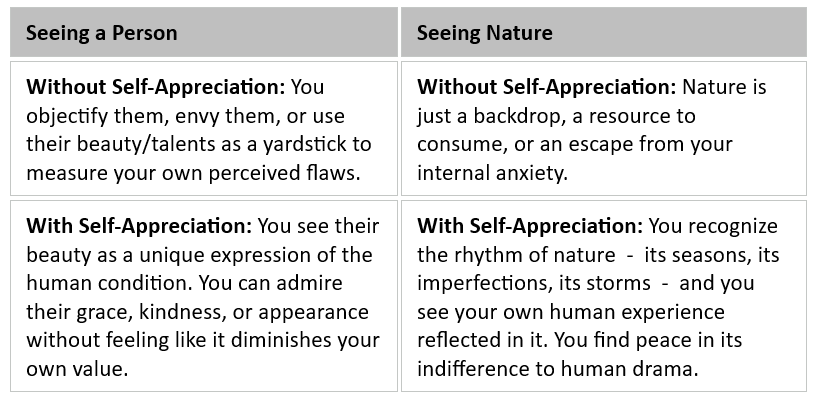
The Underlying Truth: You cannot truly appreciate the depth of the world you live in if you are constantly warring with yourself in thought, word and deed. Self-appreciation is the act of signing a peace treaty with your own mind. Once that war is over, you can finally open the windows and admire the view.
In the spirit of Yasmina’s journey to learn about self-appreciation, here are some mindfulness techniques and rituals to begin your own inner journey to embody the sovereign power of self-appreciation and gratitude.
For a healing practitioner and spirit keeper, a daily ritual focused on self-appreciation, awe, and beauty is not a luxury, it is essential maintenance. Because practitioners spend so much time holding space for suffering, injustice, and pain in others, the brain can easily default to a state of hyper-vigilance or compassion fatigue.
By actively engaging your auditory, visual, and kinaesthetic senses (“AVK”), you can interrupt the stress response and deliberately rewire your nervous system to perceive the inherent beauty in yourself, others, and the natural world.
Here is a blueprint for a daily sensory ritual, structured into morning, midday, and evening practices.
Morning: Cultivating Self-Appreciation & Internal Beauty
The focus here is inward, building a strong baseline of self-value before you give to others.
- Auditory (The “I Am” Hum): Take a deep breath and, as you exhale, create a low, vibrating hum (Voo sound) which resonates in your chest. Let the sound carry the frequency of peace. Follow it by speaking an explicit acknowledgment of your skills aloud, such as: “My energy is valuable, my skills are a gift, and I choose to protect them today.”
- Visual (Mirror Recognition): When you look in the mirror, bypass the instinct to evaluate your appearance. Look directly into your own eyes. Offer yourself a soft, appreciative smile, as you would to a dear friend. Mentally note: “I see the depth, wisdom, and capacity for healing inside you.”
- Kinaesthetic (The Somatic Anchor): Before getting out of bed, place both hands over your heart or wrap your arms around yourself in a gentle hug. Feel the warmth of your skin and the rhythmic rise and fall of your chest. Send a wave of gratitude to your body for waking up, breathing, and keeping you alive. Intent: Grounding your worth in your mere existence, not your productivity.
Midday / Between Sessions: Awakening Wonder & Perception of Others
The focus here is moving out of “clinical/problem-solving mode” and into “wonder mode,” allowing you to see the beauty in humanity without absorbing their trauma.
- Auditory (The Symphony of Presence): Close your eyes for 60 seconds. Strip away the meaning of the words people are saying and just listen to the texture of human sounds around you – the cadence of a voice, the sound of laughter, footfalls, or breathing. Treat it like an avant-garde orchestra.
- Visual (Soft-Focus Appreciation): Before a session begins, or when observing people in a public space, transition your eyes into “panoramic vision” (softening your gaze to take in the periphery). Look at the person not as a patient or a stranger, but as a living canvas. Notice the curve of their hands, the spark of life in their eyes, or the profound resilience it takes for them to simply exist.
- Kinaesthetic (Interceptive Grounding): Press your feet firmly into the floor and rub your palms together until they create heat. Separate them slightly to feel the tingling energy (qi/prana) between your hands. Recognise this vital life force is the exact same energy animating the person sitting across from you.
Evening: Merging with Nature & Experiencing Awe
The focus here is shedding the human stories of the day and dissolving into the vast, effortless beauty of nature.
- Auditory (The Silence Beneath Sound): Listen to the evening sounds – birds settling, wind rustling the leaves, or cricket songs. Then, strain your ears to listen to the space between the sounds. This auditory spaciousness triggers the parasympathetic nervous system, expanding your consciousness into a state of deep peace and cosmic awe.
- Visual (The “First Time” Gaze): Go outside or look out a window during twilight. Pick one natural object – a single leaf, a patch of moss, or the gradient of the evening sky. Look at it as if you are an alien who has never seen Earth before. Notice the micro-patterns, fractures, and shadows. Let the sheer complexity of it spark a sense of wonder.
- Kinaesthetic (Elemental Integration): Physically touch nature. Lean your back against a tree, walk barefoot on grass, or plunge your hands into cool water. Feel the texture, the temperature, and the weight. Consciously exchange energy: breathe out the day’s residual client energy into the earth, and breathe in the steady, unbothered stability of nature.
How to Structure these Techniques as a Sustainable Ritual & Exercise
To prevent this from feeling like a chore, use the “One-Minute Rule.” You do not need an hour of meditation. Instead, pick one sensory channel each day and commit to 60 seconds of radical presence with each technique chosen to develop your senses and sensory intelligence.
- Monday: Auditory focus (listening for the music of life).
- Tuesday: Visual focus (seeking out hidden beauty).
- Wednesday: Kinaesthetic focus (feeling your own vitality and boundaries).
Over time, these micro-moments of sensory awareness will naturally coalesce into a protective barrier of self-appreciation, ensuring you facilitate healing from a place of overflowing abundance rather than depletion.
The Self-Appreciation & Gratitude Ritual
This ritual is designed to shift gratitude from an intellectual concept (“I should be grateful for…”) into a full-body, somatic experience. When you embody self-appreciation, you are training your nervous system to accept your own worth without needing outside proof. This exercise helps to strengthen your heart chakra.
Set aside 5 to 10 minutes at the beginning or end of your day. Treat this as a sacred boundary, a time where you are entirely unavailable to the demands of the world.
Phase 1: Kinaesthetic — The Somatic Anchor
The body is the storehouse of our lived experiences. We begin here to physically signal safety and self-acceptance to the nervous system.
- The Double-Hand Touch: Sit comfortably. Place your right hand over your centre chest (heart space) and your left hand over your low belly.
- The Pressure Check: Apply just enough gentle pressure so you can feel the distinct warmth and weight of your own hands. Notice how your body automatically shifts underneath this touch.
- The Breath Sync: Inhale deeply, focusing on expanding your chest into your right hand and your belly into your left hand. As you exhale, let your shoulders drop. Repeat this for three breath cycles, mentally acknowledging: “Right here, in this body, I am completely present with myself.”
Phase 2: Visual — Internal Mirroring & Light
This step uses your internal visual field to change how you look at your own history and skills.
- The Eye-Level Focus: Close your eyes and recall a recent moment where you felt aligned, resilient, or deeply compassionate. It could be a moment you held space for a client, handled a tough situation gracefully, or simply chose rest over burnout.
- The Mental Spotlight: Visualise that version of yourself as if they are standing right in front of you. Do not look at them critically. Instead, scan them with a “lens of appreciation.” Notice the expression of focus or peace on their face.
- The Colour Infusion: Imagine a warm, golden or soft green light emanating from your heart space and wrapping completely around this image of you. Hold this image for a few moments, silently watching yourself receive your own warmth.
Phase 3: Auditory — The Vocal Resonance
Speaking your appreciation aloud transforms vague thoughts into physical sound waves that vibrate through your bones, reinforcing your value.
- The Low Hum: Keep your hands on your chest and belly. Take a deep breath and emit a low, steady humming sound (Mmm or Voo) on the exhale. Feel your chest cavity vibrate beneath your palm. This physically stimulates your vagus nerve, calming any residual anxiety or guilt.
- The Spoken Acknowledgment: Speak three distinct, aloud expressions of gratitude directed solely at yourself. Use your own name to deepen the psychological impact.
- Example: “[Name], I am so grateful for your steady heart and how you protected your energy today.”
- Example: “[Name], thank you for showing up for your skills and trusting your intuition.”
- Example: “[Name], I appreciate your willingness to grow, even when it feels heavy.”
- The Echo: After each statement, pause for one full breath to let the sound waves settle and allow your body to absorb the praise.
The Takeaway: Closing the Loop
To finish the ritual, gently rub your palms together to generate a little physical heat, then place them over your eyes for a moment before opening them. Think of three things you are grateful for which have happened to you during your day or in recent days.
By engaging what you feel, what you see, and what you hear, you bridge the gap between knowing you are valuable and feeling valuable. If you practice this daily, it ceases to be an exercise and becomes your default state of being.
Top Tip: Develop a Hobby
I have found by having photography as a hobby, I am able to access levels of mindfulness, awe and being present in ways I never achieved during a sitting meditation. Walking in nature and intentionally looking for beauty and then taking a photo of what has touched, moved and inspired me, has become my contemplation and meditation practice. When I am out walking in nature intentionally looking for beauty is the way I can access self-appreciation and gratitude daily.
Develop a hobby which you become passionate about because it will help you to transcend from the ordinary into the extraordinary though being present and seeing the beauty of life which naturally leads to appreciation and gratitude.

Photo by Darius Bashar on Unsplash
Self-Appreciation & The Business of Healing
In the spiritual and healing arts, practitioners often treat the business of healing as a separate, colder reality from their healing practice. But in truth, your business architecture is the physical crystallisation of your self-worth and self-appreciation.
When a healing practitioner runs a business, self-appreciation acts as the literal scaffolding of the company. Without it, the business of healing is often built on guilt, over-delivery, and chronic undercharging which is a recipe for rapid burnout.
When you deeply value your own time, energy, and skills, “business” stops feeling like a dirty word or a necessary evil. Instead, it becomes an ecosystem which protects your gift of knowledge, healing techniques and wisdom.
The Operational Architecture
Here is how self-appreciation reshapes the core pillars of the business of healing, creating an unshakeable architecture, and ultimately deepens client connection.

Accounting: Pricing for Sustainability, Not Guilt
- The Architecture: Self-appreciation means treating your business finances like an act of self-care. Your pricing is not based on what you think people can afford; it is calculated backward from what you need to live abundantly, pay your taxes, invest in continuing education, and fund your own rest.
- The Look: You have a clear profit-and-loss sheet. You pay yourself a competitive salary. You do not offer sliding scales which compromise your ability to pay your own rent or mortgage.
Marketing: Attracting via Resonance, Not Convincing
- The Architecture: When you appreciate your unique skills, your marketing shifts from desperate chasing to calm broadcasting. You stop trying to appeal to everyone. Your marketing explicitly states who you are, what you do, and who you do it for.
- The Look: Copywriting which is transparent and grounded. You do not use high-pressure fear tactics or over-hype your results. You show up authentically because you know your work is excellent. You do not need to dress it up.
Sales: Clean Matching Over Persuasion
- The Architecture: In self-appreciation, a sales call or consultation is a mutual interview, not a plea for a client. You are evaluating if they are a match for your expertise just as much as they are evaluating you.
- The Look: If a prospective client displays red flags (e.g., demanding exceptions, disrespecting your time, or wanting a quick fix you do not offer), self-appreciation allows you to say: “I don’t think I am the best fit for your needs right now, but let me refer you to someone who might be.” You let go of the sale to protect your future peace.
Customer Service: Boundaries as Client Care
- The Architecture: Your customer service structures (intake forms, cancellation policies, communication channels) are crystal clear. You do not answer client emails at 11:00 PM because you respect your off-hours.
- The Look: Firm, automated boundaries. Clients know exactly how to reach you and when to expect a response. If a client violates a boundary (like a late cancellation), you enforce the policy calmly, without offering a defensive paragraph of excuses.
How Self-Appreciation Connects You Deeply with Clients
It sounds paradoxical, but the more fiercely you value yourself, the safer your clients feel. Here is why this architecture enhances the healing relationship:
- You Eliminate Subconscious Resentment: When practitioners undercharge or allow clients to walk over their boundaries, they secretly begin to resent those clients. Self-appreciation ensures you are highly compensated and well-rested, meaning when you are with a client, you are 100% clean, resent-free, and present.
- You Model the Healing: Healing clients are often struggling with their own worth and boundaries. When they see you, their practitioner, calmly enforce a cancellation policy, charge a premium rate with zero apology, and fiercely protect your peace, you are giving them a living, breathing demonstration of what self-appreciation looks like in the real world.
- It Filters for Committed Clients: When your business architecture requires a real financial and energetic investment from the client, it automatically filters out people looking for a passive rescue. You attract clients who value themselves enough to match your investment, resulting in vastly better healing outcomes.
The Structural Reality: A broken business model cannot hold space for a broken human being. By appreciating your skills enough to build an unshakeable business structure, you ensure the business of healing is a fortress, not a house of cards.
Summary & Conclusion
A final thought: by working with the heart chakra and its gift of self-appreciation, you are not just “thinking” about self-appreciation; you are weaving it into your mind, body and spirit as a way of living and being. It is part of your personal and working life and helps to create gratitude, magic, wonder and awe to everyday living.
Next month …
November 2026 I will be focusing on the characteristic of self-expression and its qualities as a healing facilitator and Spirit Keeper.
Until next month. From one kindred spirit to another – be safe, be well, be authentically you.
In gratitude
Kathleen
About the Author: Kathleen Ginn