

When Does It Become Unsustainable
Long-term sickness absence is one of the most difficult employee situations an owner-managed business can face. Unlike a conduct issue, where you have a clear event to respond to, absence creeps up on you. A few days here, a few weeks there, and then suddenly you are six months in, the role is being covered by everyone else, and you have no idea how to move things forward without doing something wrong.
The question most business owners ask me is: “At what point can I do something about it?” The answer is always the same: sooner than you think, and more carefully than you might expect.
Why Sickness Absence Feels Different
Most business owners are compassionate. When someone is genuinely unwell, the instinct is to give them space and not add pressure. That is not wrong. But there is a difference between giving someone space to recover and allowing a situation to become unmanageable because you are worried about saying the wrong thing.
I worked with a bodyshop owner in the south of England whose technician had been off with a back injury for four months. The owner had stayed in regular contact, paid statutory sick pay, and assumed things would resolve themselves. They did not. The employee came back part-time, then went off again, and by month eight the owner was facing a second absence with no process in place and a team that had quietly started to resent carrying the extra load.
By the time we got involved, the situation was salvageable but significantly more complex than it needed to be. Earlier, structured management would have given everyone more options.
What Does a Managed Absence Process Look Like?
Managing sickness absence does not mean pressuring people to come back before they are ready. It means staying engaged, gathering information, and making informed decisions about how long the business can reasonably sustain the situation.
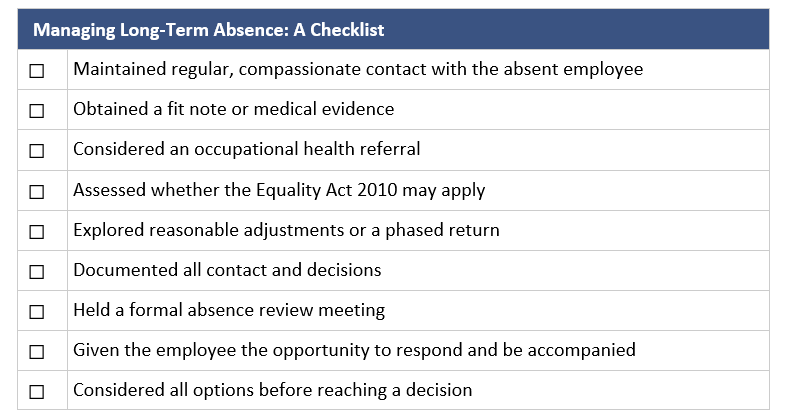
A structured approach includes: maintaining regular, sensitive contact during absence, obtaining a clear medical picture (including an occupational health referral where appropriate), understanding any underlying conditions that may be covered by the Equality Act 2010, exploring reasonable adjustments or a phased return, and having honest conversations about the timeline for return.
None of that is unreasonable. All of it is defensible.

The Equality Act: What Employers Need to Know
This is where business owners often get nervous, and rightly so. If an employee has a condition that amounts to a disability under the Equality Act 2010, employers have a duty to make reasonable adjustments. Dismissing someone without exploring those adjustments first creates significant legal risk.
A condition is likely to be covered if it has a substantial and long-term adverse effect on someone’s ability to carry out normal day-to-day activities. That covers a wide range of conditions, from physical injuries to mental health conditions, and the threshold is lower than many people assume.
Understanding whether the Equality Act applies to your situation is not optional. It is a fundamental part of managing absence properly.

When Can You Dismiss for Absence?
Dismissal for long-term sickness absence can be fair, but only after a fair process has been followed. That means: a genuine attempt to understand the medical position, consideration of reasonable adjustments, a fair hearing, and a reasonable conclusion that the employment relationship can no longer continue.
It is also worth understanding that the process is almost always gradual. There is rarely a moment where dismissal suddenly becomes appropriate without the groundwork having been laid over weeks or months.
Short-Term Persistent Absence
Not all absence is long-term. Some employees are frequently off for short periods: a day or two here and there that individually seem minor but collectively add up to a significant disruption.
This type of absence is often harder to manage because there is rarely a single medical explanation. An absence management policy with clearly defined trigger points, coupled with return-to-work conversations after every absence, is the most effective way to address it early and fairly.
Getting Support
If you are dealing with a sickness absence situation that is starting to feel unmanageable, the Employee Situation Check at Magenta HR Consulting is a good first step. It will help you understand where you stand and what your options are.
Samantha Newton FCIPD provides practical, commercially focused employee relations support for owner-managed businesses across Oxfordshire, Berkshire, Wiltshire, Gloucestershire and Hampshire.
Frequently Asked Questions
Q: How long do I have to wait before taking action on long-term absence?
A: There is no fixed period, but action should be gradual and evidence-based. For most businesses, a review at four to six weeks is a reasonable starting point, with a formal absence review if the situation is not resolving.
Q: Do I have to pay full pay during sickness absence?
A: Not unless your contract says so. Statutory Sick Pay (SSP) is the legal minimum. Your contractual obligations will depend on what is written in the employment contract.
Q: Can I dismiss someone who has been off sick for six months?
A: Potentially yes, but only after following a proper process including medical evidence, consideration of the Equality Act, and a fair hearing. Taking advice before acting is strongly recommended.
Q: What is a reasonable adjustment?
A: A change to the role, working hours, environment or equipment that removes or reduces the disadvantage the employee faces because of their condition. What is reasonable depends on the size and resources of the business.
All images created using Ai
About the Author: Samantha Newton