
Most business owners prefer to deal with things informally. A quiet word, a direct conversation, an expectation that the issue will resolve itself. And in many cases, that approach works well. Small businesses often run on relationships, and a conversation that would feel formal and uncomfortable in a large organisation is simply the way things get done.
But there comes a point, in every problematic employment situation, when informal conversations are no longer enough. Recognising that point is one of the most important skills an employer can develop, and acting on it promptly is what separates businesses that handle employee issues well from those that end up in tribunal.
Why Informal First Is Usually Right
Jumping straight to a formal process is rarely the right instinct. Formal processes are time-consuming, stressful for everyone involved, and can damage working relationships that might otherwise be salvageable. Most performance or conduct issues should be addressed informally first: a clear conversation, a statement of expectations, and an opportunity to put things right.
The ACAS Code of Practice reflects this. It encourages employers to deal with issues informally where possible and to reserve formal processes for situations where informal attempts have not worked or are unlikely to work.

The Signs That Informal Is No Longer Enough
The difficulty is knowing when you have reached the limit of what informal management can achieve. There are some clear signals:
- The same issue keeps recurring despite informal conversations
- The employee is denying there is a problem despite clear evidence
- The behaviour or performance is affecting the wider team
- The employee is starting to push back in a way that suggests they may later dispute what was discussed
- You have already had several informal conversations without improvement
- The situation is serious enough that a warning, or ultimately dismissal, may be the outcome
- The employee has raised a grievance about being managed informally
When any of these apply, continuing informally is not just ineffective. It can actively undermine your position. Informal conversations that are not documented, not followed up in writing, and not escalated when they do not work create the impression that the employer did not take the issue seriously.

What Moving to Formal Actually Means
Formal does not mean aggressive, confrontational, or punitive. It means following a structured process: a written invitation to a meeting, a clear explanation of the concerns, the right to be accompanied, a documented outcome, and a clear statement of what needs to change and what will happen if it does not.
For most employers, the first formal step is issuing a first written warning. That warning should set out the concern, the required improvement, the timeframe, and the consequence of not improving. It is not a threat. It is a clarity tool.
A Real-World Example
A healthcare organisation I worked with had a team member whose attitude had become a persistent problem. The manager had several conversations, all informal, all constructive, all undocumented. Each time, things improved briefly and then reverted. After six months, the situation had deteriorated to the point where the team member was affecting patient-facing service.
When we reviewed the situation, there was no documented evidence of any prior conversation. We had to start a formal capability process from the beginning, which added months to the timeline and significant management pressure. Had the informal conversations been documented and a formal written warning issued at the three-month mark, the situation would have been resolved much earlier, with better options for everyone involved.
Bridging the Gap: The Written Follow-Up
One of the most practical steps an employer can take is to send a brief written summary after any significant informal conversation. Not a formal letter, not a warning, just a factual email: “Following our conversation today, I wanted to confirm that we discussed X and Y. I hope we have reached a shared understanding and that we will see improvement in Z going forward.”
That single habit, applied consistently, creates a record without escalating the tone. It also signals to the employee that the business is taking the matter seriously, which is often enough on its own to prompt change.
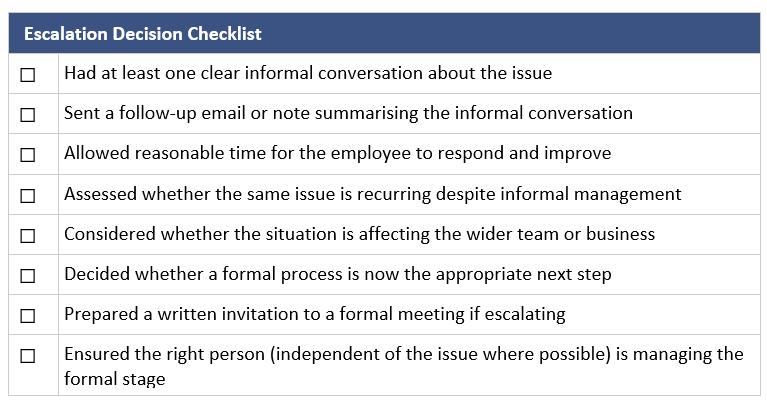
If you are unsure whether your current situation has reached the point where formal action is needed, the Employee Situation Check at Magenta HR Consulting will help you assess where you stand and what to do next.
Samantha Newton FCIPD provides specialist employee relations support for owner-managed SMEs across Oxfordshire, Berkshire, Wiltshire and the wider region.
Frequently Asked Questions
Q: How many informal conversations should I have before going formal?
A: There is no fixed number, but two or three clear conversations with follow-up documentation, without improvement, is usually sufficient to justify moving to a formal process.
Q: Does an employee have the right to be accompanied at an informal meeting?
A: Not automatically, although some employers allow it as good practice. The right to be accompanied applies to formal disciplinary and grievance hearings.
Q: What if the employee says the informal conversations never happened?
A: This is exactly why written follow-ups matter. Without any written record, it is your word against theirs. That is a very weak starting position in any formal or legal process.
Q: Can I go straight to a formal process without any informal stage?
A: Yes, in some circumstances. Where the behaviour is serious, where previous informal management has been ineffective, or where the Situation is significant enough to warrant it, a formal process can be appropriate from the outset.
All images created using Ai
About the Author: Samantha Newton