
There is a particular kind of stress that business owners carry when they know a conversation needs to happen and they keep finding reasons to delay it. The underperforming employee who has been given one more chance, again. The attendance issue that has been mentioned informally but never formally addressed. The team conflict that everyone can feel but nobody has named.
Avoiding difficult conversations is understandable. Most of us are not trained to have them, and the potential for things to go wrong can feel greater than the discomfort of the current situation. But the cost of avoidance is almost always higher than the cost of action, and it accumulates in ways that are easy to miss until the damage is significant.
What Avoidance Actually Costs
The most obvious cost is the one you can see directly: the underperforming employee who is still not performing six months after the first conversation you did not have, the absent team member whose absence is now affecting everyone else, the workplace relationship that has curdled and is poisoning the atmosphere for the whole team.
But avoidance also has indirect costs that business owners often underestimate. High-performing employees notice when standards are not being enforced. They draw their own conclusions about what the business values and whether it is worth their commitment. The best people in a small business often have options. If the culture of the business signals that difficult situations are managed by ignoring them, the people you most want to keep are often the ones most likely to leave.

Why Business Owners Avoid Difficult Conversations
In most cases, avoidance is not about not caring. It is about not being confident in how to handle the conversation, fear of the legal consequences of saying the wrong thing, concern about damaging a relationship that has otherwise been positive, or a genuine belief that things might improve on their own.
Some of those concerns are valid. Some conversations do need careful handling. Some situations do benefit from a period of monitoring before action is taken. But most situations that are being avoided are not being avoided for those reasons. They are being avoided because difficult conversations are uncomfortable, and the consequences of avoidance feel more distant than the discomfort of action.
 The Team Impact
I worked with a small engineering business in Oxfordshire where a senior technician had been visibly underperforming for the best part of a year. The owner had mentioned it informally twice but had not taken it further because the technician was long-serving and had been an asset in the past. What the owner had not fully registered was the effect on the rest of the team.
During a team conversation we facilitated as part of a wider review, it became clear that three other technicians had been informally carrying work they knew the senior team member should be doing. They had not said anything because it was not their place to, but the resentment was there and was starting to affect their own performance and engagement.
The conversation the owner had been avoiding for a year was costing him, conservatively, in lost productivity across four people, not one.
How to Have the Conversation Without Making It Worse
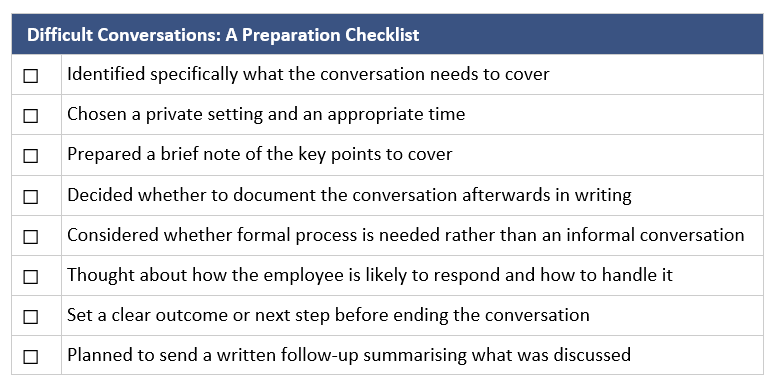
Difficult conversations do not need to be confrontational to be effective. The most productive ones are: specific (about a particular behaviour or outcome, not a character assessment), timely (as close to the relevant event as possible), private, calm in tone, and clear about what needs to change and by when.
In an earlier article in this series on how to have hard conversations without drama, we covered the practical structure for these conversations in detail. The short version is: describe what you have observed, explain the impact, state what needs to change, and ask the employee for their response.
What makes difficult conversations difficult is rarely the content. It is the absence of a framework and the fear of the unknown. Having a clear structure reduces both.
When You Cannot Have the Conversation Yourself
Sometimes the business owner is too close to the situation, too involved emotionally, or has tried to have the conversation and it has not landed. In those cases, having an experienced HR consultant in the room, or facilitating the conversation, can make a significant difference.
It is not a sign of weakness. It is a recognition that some conversations carry enough commercial and legal weight to be worth doing properly.
The Closing Thought for This Series
Over the past ten articles, we have covered dismissal, sickness absence, performance, conduct, grievances, documentation, formal escalation, redundancy, settlement agreements, and the value of early support. The common thread running through all of them is the same: employee issues rarely improve by themselves, the earlier they are addressed the more options you have, and fair process protects both the business and the employee.
Good HR is not red tape. It is risk management. And the cost of getting it wrong, in time, money, legal exposure, and team morale, is almost always higher than the cost of getting it right.
Working With Magenta HR Consulting
Magenta HR Consulting is a specialist employee relations consultancy working with owner-managed businesses across Oxfordshire, Berkshire, Wiltshire, Gloucestershire and Hampshire. We are not a generalist HR function, not a solicitor, and not a call centre. We are experienced ER specialists who help business owners navigate difficult employee situations with clarity, commercially focused advice, and process that protects the business.
The starting point for most of our clients is the Employee Situation Check: a short diagnostic that takes a few minutes and gives you a clear picture of where you stand. From there, we offer a fixed-fee consultation session where we work through the situation with you and agree a practical way forward.
Visit Magenta HR Consulting to find out more, or connect with
Frequently Asked Questions
Q: What if the employee reacts badly to a difficult conversation?
A: Prepare for it. Think through likely reactions in advance and have a calm, consistent response ready. If the reaction is aggressive or threatening, end the meeting and document what happened. If the reaction is emotional, give the employee time and space before continuing.
Q: Should I have a witness in the room for a difficult conversation?
A: For formal meetings, yes. For informal conversations, it is not always necessary but can be useful. If you have a manager or HR contact who can be present, it adds a second perspective and strengthens your position if the conversation is later disputed.
Q: What if I have been avoiding a conversation for months and things have escalated?
A: Start from where you are. The fact that you did not act earlier does not mean you cannot act now. Take advice on the appropriate starting point given the history and proceed from there.
Q: Can Magenta HR help me prepare for a specific conversation?
A: Yes. Conversation preparation and coaching is one of the things we do regularly with clients. Knowing what to say, how to say it, and how to handle likely responses makes a significant difference to the outcome.
All images created using Ai
About the Author: Samantha Newton