
Why Expanding Your Credentials Matters
The landscape of healthcare and wellness is undergoing a monumental paradigm shift. For decades, the conventional, allopathic medical model stood largely separate from the practices of holistic, alternative, and complementary medicine. Today, however, we are witnessing a profound convergence. Patients and clients are no longer satisfied with symptomatic treatment; they are actively seeking out comprehensive, whole-person care that addresses the intricate connections between the mind, body, and spirit. As this demand for integrative care skyrockets, the responsibility placed upon holistic and alternative medicine practitioners is greater than ever before. To meet the complex, multifaceted needs of today’s clients—and to thrive in an increasingly competitive professional landscape—practitioners must prioritise upskilling and the continuous expansion of their credentials.
In this comprehensive exploration, we will delve into the profound value of continuing education, the critical importance of specialized credentialing, and how elevating your professional portfolio can empower you to better serve diverse populations, particularly marginalised communities who are often left behind by traditional healthcare systems.

The Evolving Paradigm of Integrative & Holistic Healthcare
To understand the necessity of upskilling, we must first look at the shifting landscape of global health. According to the World Health Organisation (2019), there is a universally recognised need to integrate traditional and complementary medicine into national health systems to achieve optimal health outcomes. People across the globe are turning to holistic practices—such as naturopathy, restorative healing, spiritual advising, and mind-body therapies—not merely as a last resort, but as a primary modality for achieving sustained wellness.
However, with this increased mainstream acceptance comes an increased demand for rigorous standards, evidence-based practices, and demonstrable professional competency. The days when a holistic practitioner could rely solely on an introductory certification or informal training are rapidly fading. Today’s wellness consumers are highly educated, discerning, and vigilant. They are looking for practitioners who possess a deep, layered understanding of human health, which includes a firm grasp of trauma-informed care, psycho-spiritual dynamics, and the socio-cultural factors that influence wellbeing.
Upskilling is the deliberate process of acquiring new, advanced, or supplementary skills to enhance your existing practice. For the alternative medicine practitioner, this means moving beyond your baseline modality. If you are an herbalist, upskilling might involve studying integrative spiritual guidance. If you are a massage therapist, it might mean pursuing a credential in wellbeing-based leadership or restorative healing. Expanding your credentials demonstrates a commitment to the philosophy of lifelong learning—a core tenet of anyone dedicated to the healing arts.
Building Trust, Credibility & Interprofessional Collaboration
One of the most significant barriers that alternative and holistic practitioners face is the lingering skepticism from both the public and the conventional medical establishment. While public acceptance is at an all-time high, building absolute trust requires tangible proof of your expertise. Credentials serve as the bridge of trust between you and your prospective clients.
When a client steps into your healing space, they are entrusting you with their physical, emotional, and often spiritual vulnerability. A robust portfolio of accredited certifications communicates to the client that you have undergone rigorous evaluation, that you are bound by ethical standards, and that you have mastered specialized domains of care. It signals that you are not merely practicing based on intuition, but that your intuition is guided by structured, validated, and professional education.
Furthermore, expanding your credentials opens the door to interprofessional collaboration. As integrative medicine becomes the gold standard, conventional doctors, psychotherapists, and clinical social workers are increasingly seeking holistic practitioners to whom they can refer their patients. However, these clinical professionals are bound by strict ethical and liability constraints; they will only refer patients to alternative practitioners who possess recognized, accredited certifications (Foley & Steel, 2017). By acquiring board certifications and continuing professional development (CPD) credits, you translate your holistic expertise into a language that the conventional medical community respects and understands. This not only broadens your network but fundamentally expands the scope of your impact.
Broadening Your Scope to Serve Marginalised Populations
While holistic medicine focuses on the whole person, we must also acknowledge that “the whole person” exists within a broader societal context. One of the most critical reasons for upskilling in today’s climate is to better equip yourself to serve marginalised and underserved communities. Traditional healthcare systems have a long, documented history of implicit bias, systemic inequality, and failure to adequately address the unique health disparities faced by marginalised societies (Ventola, 2010).
As holistic practitioners, we have a profound ethical obligation to step into this gap. However, treating trauma, chronic stress, and complex health issues stemming from systemic marginalization requires specialized knowledge. It requires an understanding of how systemic oppression manifests biologically and psychologically. Upskilling allows you to become a trauma-informed, culturally competent advocate for humanity. It transitions you from being a practitioner who merely treats a physical symptom to a practitioner who understands the socio-spiritual weight their client carries.
By pursuing advanced credentials focused on restorative healing, humanity advocacy, and whole-person provision, you align your practice with the principles of social justice. You become a safe harbor for those who have been alienated by conventional systems, providing a profoundly restorative environment where true, integrative healing can occur.
The Financial & Professional Benefits of Expanding Your Credentials
Beyond the ethical and clinical imperatives, there is a tangible, professional advantage to upskilling. The holistic wellness industry is booming, which inherently means it is becoming more saturated. Standing out in a crowded market requires differentiation.
When you expand your credentials, you intrinsically expand your service offerings. A practitioner who is dual-certified in both Whole-Person Provision and Integrative Spiritual Advising can offer comprehensive packages that address a wider array of client needs. This versatility leads to improved client retention, as clients do not need to seek out multiple different practitioners for their holistic needs; they can find a multidimensional healing experience with you.
Moreover, accredited certifications allow you to confidently command higher, premium rates for your services. Clients are willing to invest in practitioners who invest in themselves. When you hold recognized board certifications, you are no longer competing on price; you are competing on value, expertise, and authority. It also opens avenues for alternative income streams, such as corporate wellness consulting, educational workshops, wellness program leadership, and public speaking.
Take the Next Step: Elevate Your Practice with The Holistic Healing Source for Marginalised Society
As we reflect on the profound necessity of upskilling, expanding your professional capacity, and providing safe, trauma-informed care, I want to personally introduce you to our organisation that is pioneering this movement in the alternative health space. It is with great pride that I highlight the incredible work and educational opportunities provided by The Holistic Healing Source for Marginalised Society.
The Holistic Healing Source for Marginalized Society is a revolutionary institution dedicated to equipping, empowering, and elevating alternative practitioners who are committed to making a profound impact. We understand that to heal the world, we must provide our healers with the highest standard of accessible, rigorous, and relevant education. To that end, we offer an array of esteemed, specialised designations designed to set you apart as an elite practitioner in your field.
For practitioners ready to elevate their authority and broaden their scope, The Holistic Healing Source for Marginalised Society offers the following globally accredited, Continuing Professional Development (CPD) approved, lifetime board certifications:
Board Certified Whole-Person Provider (W.P.P.-Bc)™
Designed for the practitioner who is committed to true integrative care. It signifies that you have mastered the foundational and advanced concepts of treating the individual not as a collection of symptoms, but as a dynamic interplay of physical, mental, emotional, and energetic systems.
Board Certified Wellbeing-Based Leader (W.B.L.-Bc)™
Ideal for those who lead organisations, community groups, or corporate wellness initiatives. This credential establishes you as a visionary leader who prioritises holistic wellbeing in team dynamics, organisational culture, and community advocacy, proving your capability to guide others toward collective wellness.
Board Certified Integrative Spiritual Advisor (I.SPIRIT-bc) ™
Healing without addressing the spirit is an incomplete process. This board certification validates your expertise in navigating the psycho-spiritual dimensions of healing. It empowers you to guide clients through spiritual awakenings, existential transitions, and the deeper energetic blockages that hinder physical and emotional recovery.
Board Certified Holistic Humanity Advocate (H.Hum.Ad-Bc)™
This deeply impactful certification is for the practitioner fiercely dedicated to social justice and health equity. It signifies your specialized competency in addressing the unique traumas and holistic needs of marginalized groups, establishing you as a safe, competent, and fierce advocate for equitable healing.
Board Certified Master Restorative Healing Specialist (M.R.Heal.-Bc)™
For the seasoned practitioner, this master-level certification validates your high-level proficiency in restorative practices. It showcases your ability to facilitate profound recovery and rejuvenation in clients suffering from chronic depletion, trauma, and systemic burnout.
The Lifetime Advantage and Exclusive Foyht Member Discounts
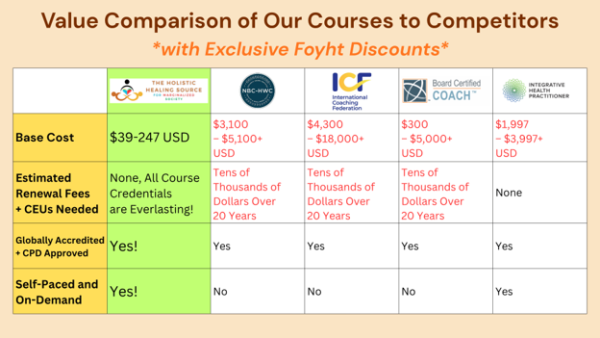
The brilliance of these certifications lies in their unparalleled structure: they are globally accredited, entirely CPD approved, and, exceptionally, they are lifetime board certifications. Once you earn your designation, you hold it for life. You do not have to worry about exorbitant, recurring renewal fees or the bureaucratic red tape that often plagues professional credentialing. You earn your title, and it remains a permanent testament to your expertise.
Furthermore, we believe that world-class continuing education should be accessible, not a financial burden. For our dedicated Foyht members, we are thrilled to offer exclusive discounts on these already low-cost programs. By utilizing the following exclusive promotional codes, you can dramatically reduce your investment in your professional future:
- $77 with 20OFF coupon code
- $97 with 200OFF coupon code
- $247 with 200OFF coupon code
Do not let this opportunity to revolutionize your practice pass you by. Upskilling is the ultimate investment in yourself, your clients, and the diverse communities you serve. By earning a globally recognized lifetime credential, you position yourself at the absolute forefront of the holistic and integrative health movement.
Step into your power. Expand your credentials. Heal the whole person.
References
- Foley, H., & Steel, A. (2017). The nexus between patient-centered care and complementary medicine: A review. Complementary Therapies in Clinical Practice, 29, 68-72.
- Ventola, C. L. (2010). Current issues regarding complementary and alternative medicine (CAM) in the United States: Part 1: The widespread use of CAM and the need for better-informed health care professionals to provide patient counseling. Pharmacy and Therapeutics, 35(8), 461–468.
- World Health Organisation. (2019). WHO global report on traditional and complementary medicine 2019. World Health Organisation.
Images created by Calynn Lawrence
About the Author: Calynn Lawrence