

You walk into the kitchen. You are not particularly hungry. You see something familiar — biscuits, bread, chocolate, perhaps a food you have eaten hundreds of times before. A few moments later, you are eating it. Why?
The obvious answer is hunger. But everyday food choices are not always driven by physical hunger alone.
What we eat can also be influenced by context, learned associations, previous experiences and emotional states. Research on habit formation shows that repeated behaviours can become linked to recurring situations and cues. Over time, the context itself can help trigger the behaviour, sometimes with surprisingly little deliberate thought [1].
This suggests a useful shift in the question. Instead of asking only, “Why did I eat that?”, we might also ask, “What happened just before I wanted it?”
The kitchen is not neutral
Imagine that every evening you sit on the same sofa, turn on the television and eat something sweet. At first, you may have chosen the food deliberately. But repeat the sequence often enough and parts of the situation — the time of day, the sofa, television, finishing dinner — can become associated with the behaviour.
Habit research describes this basic process: behaviours repeated in stable contexts can become increasingly responsive to contextual cues [1].
Food research adds another layer. Food-related cues can acquire learned associations with eating and reward, and cue reactivity and craving have been associated with subsequent eating behaviour. A meta-analysis covering 45 published reports and 3,292 participants found an overall relationship between food-cue reactivity or craving and eating- and weight-related outcomes [2].
So sometimes the sequence may be less ‘hunger → food’ and more ‘cue → expectation → desire → food’. That distinction can be useful when we are trying to understand a repeated choice.

Photo by KATRIN BOLOVTSOVA
Memory may be sitting at the table too
Food is unusual because we experience it repeatedly and often in emotionally meaningful settings: birthday cakes, Sunday lunches, a dish made by a grandparent, ice cream after a difficult day, or a particular meal shared during a happy period of life.
The scientific literature does not support the simplistic claim that every food preference hides an emotional memory. It does, however, show that memory and learned associations participate in eating behaviour. A review of the cognitive control of eating describes memory as an important part of appetite and eating, including the way remembered eating experiences can influence later intake [3].
There is also experimental evidence that internal emotional states can become relevant cues. In one study, participants learned associations between a negative emotional state and eating chocolate; conditioned effects were found for expectancy and desire to eat [4]. This does not mean that sadness automatically causes eating. It means that a present response can sometimes reflect something learned through previous experience.
Why knowing what to eat may not be enough
Many of us already possess a considerable amount of nutrition information. Yet information and behaviour are not the same thing. Habits, cues, memory and learned expectations can all participate in what happens in the few moments before a choice [1–4].
That may help explain a familiar frustration: “I know what I want to do. Why don’t I do it?” Sometimes the missing information is not another fact about food. It is information about the moment in which the choice happens.
Try five seconds
Here is a small observation exercise. It is not a diet, a treatment or a test of willpower. The next time you find yourself reaching automatically for food, wait five seconds before the first bite — not five minutes, just five seconds.
Notice what happened immediately before you reached for it. What are you feeling right now? Are you physically hungry, or is something else also present? Then eat it if you still want it.
There is no correct answer. The purpose of the pause is simply to make the moment before the choice more visible. It should not be treated as therapy or as a weight-loss technique.
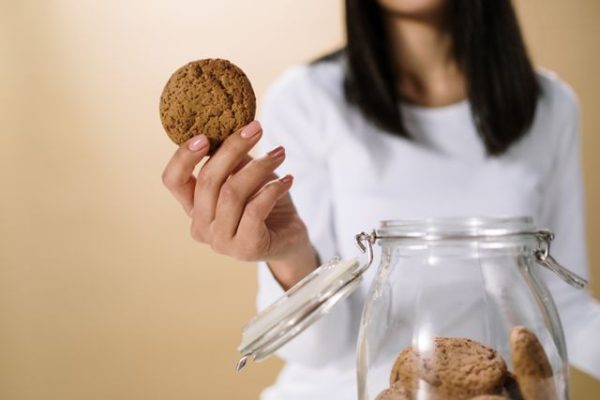
Photo by cottonbro studio
From automatic to visible
Perhaps you discover that you were simply hungry. Or perhaps you notice something else: the biscuit appears every afternoon when work becomes difficult; the snack arrives with the television; a particular food becomes especially attractive when you feel lonely; or a familiar taste carries a feeling of home, safety or celebration.
None of those observations tells you what you should eat. They tell you something different: what may be participating in the choice. And once an automatic pattern becomes visible, there is more room to make a deliberate decision.
That is why one useful question around food is not always, “What should I eat?” Sometimes it is, “What happened just before I wanted to eat?”
Notice first. Decide later.
Further reading
[1] Wood W, Rünger D. Psychology of Habit. Annual Review of Psychology, 2016.
[2] Boswell RG, Kober H. Food cue reactivity and craving predict eating and weight gain: a meta-analytic review. Obesity Reviews, 2016.
[3] Higgs S, Spetter MS. Cognitive Control of Eating: the Role of Memory in Appetite and Weight Gain. Current Obesity Reports, 2018.
[4] Bongers P, Jansen A. Emotional eating and Pavlovian learning: evidence for conditioned appetitive responding to negative emotional states. Cognition and Emotion, 2017.
Main – Photo by Kevin Malik
About the Author: Bonifacio Sulprizio