

Why Lasting Hypnotherapeutic Change Demands Repetition
Popular portrayals of hypnotherapy often rely on the trope of an instantaneous fix—a single session, a snap of the fingers, and decades of smoking, anxiety, or compulsive habits evaporate. While clinical hypnotherapy frequently produces immediate emotional catharsis, neuroscience reveals why a single breakthrough is rarely sufficient for lasting behavioral transformation.
A solitary session can uncover root causes and introduce a powerful alternative narrative, but enduring subconscious reorganisation requires deliberate, structured repetition.
The Architecture of Habit: Hebbian Learning & Neuroplasticity
At the root of our habitual thoughts, automated emotional reactions, and coping behaviors lies neuroplasticity—the brain’s capacity to structurally reorganise itself by forming new neural connections over time.
When an emotional reflex or behaviour has been rehearsed for years, the brain forms dense, heavily myelinated neural pathways. Under high stress or fatigue, the brain naturally defaults to these well-worn cognitive highways because they require the least metabolic energy.
In 1949, neuropsychologist Donald Hebb introduced a fundamental rule of synaptic plasticity, commonly summarised as: cells that fire together, wire together. When two neurons are repeatedly activated in synchrony, their synaptic efficacy increases through a process known as Long-Term Potentiation (LTP). (Wikipedia)
- The Initial Hypnotherapy Session: Weakens the automated response by bypassing conscious critical faculties and mapping a new associative pathway.
- The Follow-Through: Requires recurrent activation. Without repeated firing of that newly mapped pathway, synaptic connections rapidly decay, and the brain defaults back to its preexisting neural network.
(Veresies Medical Center)

Image created using AI
Why Personalised Pre-Recordings Outperform Generic Audio
To systematically induce Long-Term Potentiation outside the clinic, modern clinical hypnotherapists provide clients with custom-tailored audio recordings of their session work.
- Voice Continuity & Nervous System Conditioning: Trance is an autonomic state marked by parasympathetic dominance. Returning to the exact cadence, vocal timbre, and pacing of the certified practitioner acts as an auditory conditioned stimulus, rapidly downregulating the nervous system back into that receptive state.
- Idiosyncratic Language: Commercial meditation apps use generic, non-specific affirmations. A personalized recording incorporates the client’s exact metaphors, emotional anchors, and specific positive phrasing developed during their intake. Because the subconscious decodes self-referential meaning faster than generalised concepts, personalised cues yield higher emotional resonance.
- Leveraging Theta & Hypnagogic Windows: Daily listening—particularly during hypnagogic (pre-sleep) and hypnopompic (waking) transitions—takes advantage of dominant alpha and theta brainwave rhythms (4–8 Hz). In these states, the brain’s dorsolateral prefrontal cortex shows reduced activity, allowing supportive suggestions to bypass analytical skepticism and integrate directly into subconscious processing networks.
Dual-Channel Reinforcement: Integrating Written Mantras
While listening to audio harnesses passive subconscious absorption during resting states, pairing that audio with identical, written mantras engages the waking mind through active cognitive rehearsal.
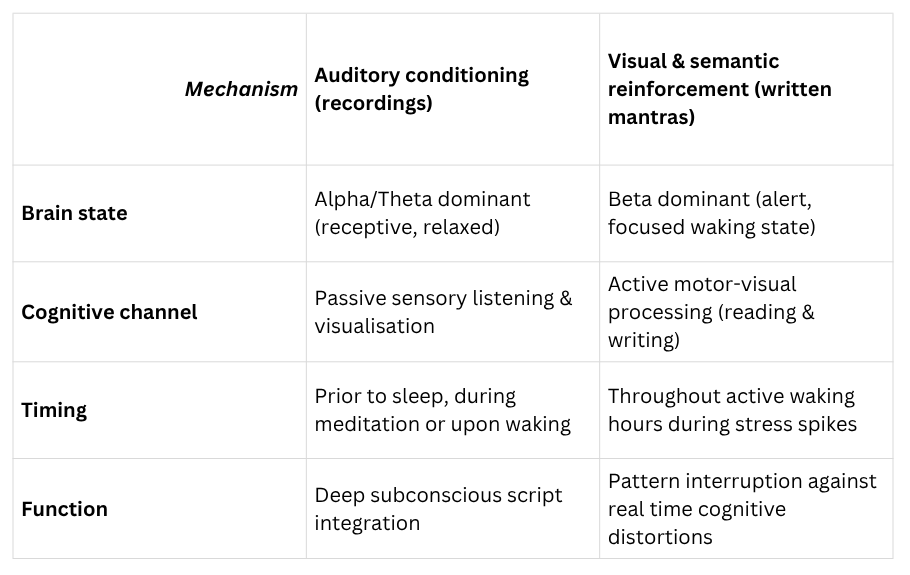
When written affirmations exactly match the verbal phrasing on the audio track, the brain forms cross-modal associations. Reading the phrase on a desk note or phone lock screen immediately reactivates the calm, grounded neurochemical state experienced during the hypnotic audio session.
A single hypnotherapy appointment should not be treated as a completed cure, but as the initial catalyst for deliberate neurobiological conditioning. Sustained emotional freedom and behavioural change occur when the practitioner’s targeted messaging is systematically reinforced through daily audio immersion and waking visual reminders until the new response becomes second nature.
Ultimately, hypnotherapy does not rewrite your story in a single afternoon—it gives you the exact script to practice until it becomes who you are.
Main – Photo by Eren Li
About the Author: Amy Trione