
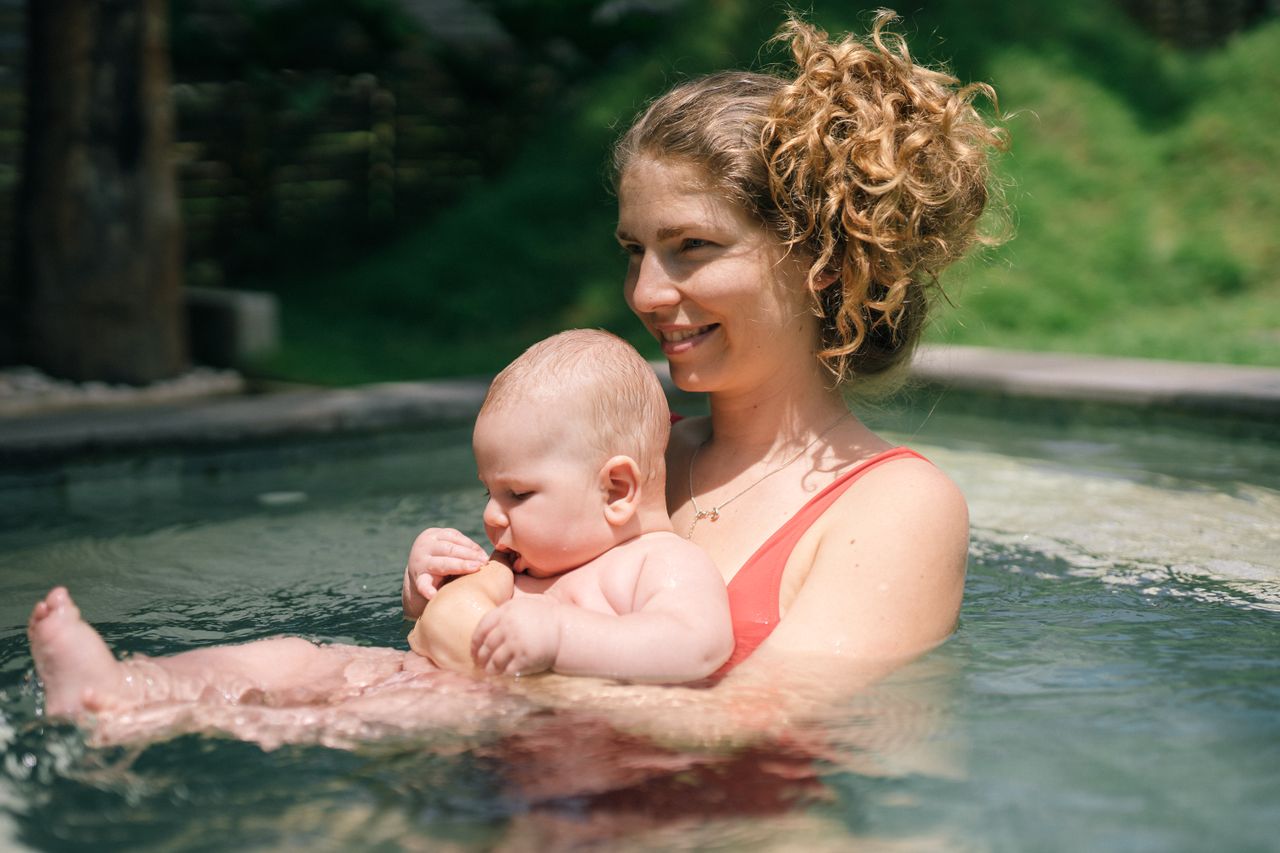
Baby swimming can be a wonderful opportunity for development—and a very special universe!
I started in the year 2000, and today many people ask if I won’t soon get tired of teaching baby and child swimming. It must be a resounding “No” from here! There are always areas of baby and child swimming to develop and challenge.
When your baby and child swimming looks easy, and you see the learning you want to happen actually happening, it’s because you are sharp and have an eye for the basics.
If you see children and parents feeling safe in the water, children playing with body awareness in water, and good interaction between child and parent, that’s the tip of the iceberg. Only you know what it takes for that picture to emerge.
Taking Care of the Parents
Baby swimming is about us teaching parents how to help their children be in the water and swim. The parents are the focal point for us to get the baby swimming we want.
Parents must feel safe in the water. Children pick up on their parents’ emotions and react to them. Parents’ insecurity confuses the child: “You think it’s dangerous, but you do it anyway!”
It usually ends with crying and insecure children, so a very important foundation for security is that we, as instructors, take care of the parents.
Learning Happens in the Relationship
The relationship between parents and children is important in relation to learning—it is in the relationship that learning happens.
A good relationship is created when the child is seen, heard and understood. The parents’ position becomes important here, as we want them at eye and water level to read where the child is looking.
If we are out catching balls, see which ball the child has their eye on. Follow their interest with your words and movement towards the ball, showing the child they are understood.
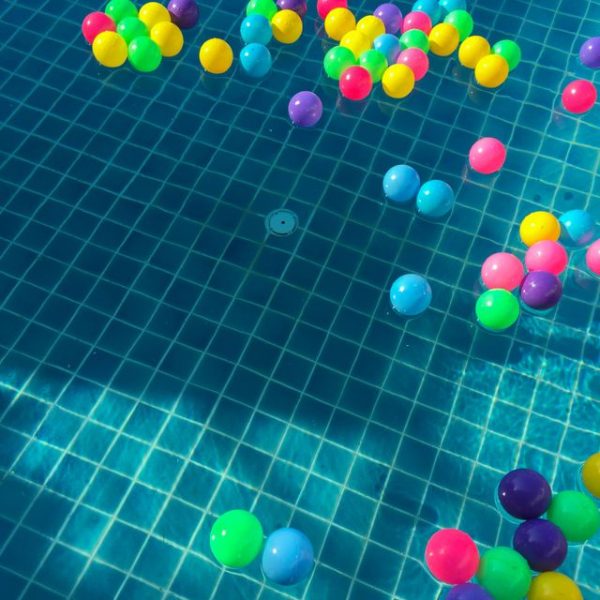
Photo by Tirachard Kumtanom
As instructors, we can get ahead of conflicts between children and parents by guiding the parents.
A little boy of two was encouraged to jump into the water towards his mother and swim a little towards her as part of a game. The boy jumped diagonally away from his mother, and she began to get annoyed with him.
I told Mum that I thought she should step back a few steps so the boy had more space. She did, and the boy jumped towards her. Mum exclaimed, “It worked!”
Children that age don’t verbalise when something is not right; they respond through their actions. What the boy here was trying to say was, “Mum, I can jump and swim further than that.”
This situation could have created friction between mother and child. When we, as instructors, read the child’s behaviour and can guide parents, there is a greater chance that we will maintain a good relationship and joy in the water for the whole family.
Playing & Exploring the Water
When we play games, motivation and security are at the centre while we play and explore the element of water with our bodies.
We have knowledge of what interests children at the appropriate age. However, we must be curious about the group of children we are with. Many babies are very interested in their parents, their own reflection and the colours of balls.
If you have two-, three- and four-year-olds, you can create a universe with PAW Patrol, unicorns, pirates or whatever interests the children. New universes are constantly being created that children are interested in.
At the same time, it is important to play with the properties of water so that you get the right body sensation in the water.
Our bodies behave differently in water because of buoyancy. As we move and float, we experience balance, movement and body positioning in new ways, helping us develop greater awareness of how our bodies move through water.
Further Reading: Why Young Children Should Learn to Swim (forthcoming publication).
Body Awareness & the Child’s Readiness
During closely supervised swimming lessons, exploring movement without buoyancy aids can help children develop a more natural awareness of their bodies in the water. Activities should always be appropriate to each child’s abilities, with parents or instructors providing continuous, hands-on support.
From the age of six months, the child can sit on the parent’s hands and move through the water towards the other parent. However, it is important that the parents do not tip the child into the water. Instead, the child leans forward when they are ready and says, “Yes, please.”
When the child is a little older and can grab the edge, you can play with the distance towards the edge. When does the child say, “Yes, please”?
We play with something that provides the right learning for both security and body awareness, instead of leading the children around the pool. In that scenario, the learning we want does not happen.
Listening When a Child Says No
When the child sits on the edge, we also give a signal that they can now jump in—maybe “1, 2, 3, now!” However, it is our signal that they are now allowed to jump. The child also has the opportunity to “say” no.
The point is that there is mutual dialogue and respect, so that we listen to the child.
Children from seven or eight months can quietly turn their heads and become busy with something else as a gentle attempt to say, “No, thanks.”
Here, it can be our role as an instructor to notice this so that it does not end in crying. Parents are often focused on doing well and ensuring their children do what the instructor says. Be clear about giving the power back to the parents and supporting their leadership.
Baby swimming is on the child’s terms, and there are many facets we need to explore so that the child experiences it as equal and on their terms.
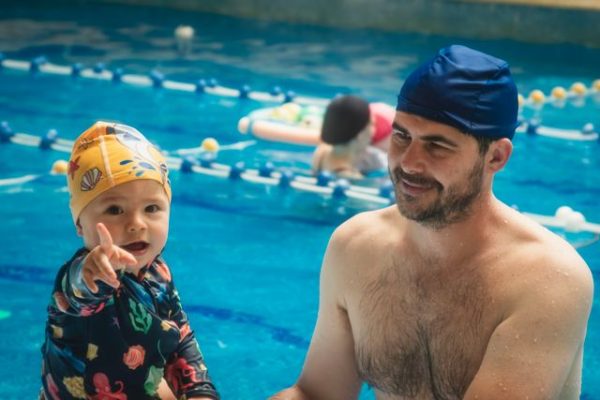
Photo by Sandra Mosconi
The Foundation Beneath the Iceberg
When children feel safe and their nervous systems are calm, they are often better able to engage, explore and learn. When a child feels frightened or overwhelmed, it can become much harder for them to focus on learning.
Making baby swimming safe and joyful, while having the right learning in mind, is like an iceberg: it requires a good foundation of knowledge and passion to show a safe top.
Research led by Professor Robyn Jorgensen at Griffith University has explored the relationship between early swimming lessons and children’s development. Preliminary findings suggested potential benefits across motor, social, cognitive and language development, although further research was needed to establish the strength of these associations. Source: Early Years Swimming Research – Annual Report 2009/2010
Research & Further Reading
- Early Years Swimming Research – Annual Report 2009/2010
- Why Young Children Should Learn to Swim — Robyn Jorgensen (forthcoming, November 2026).
Find Out More
You are very welcome to contact me for further information. I am also happy to come to your swim school to provide training.
Main – Photo by Yan Krukau
About the Author: Majbritt Mork