

Five Questions Every Employer Should Ask First
It is one of the most common questions I hear from business owners across Oxfordshire and the wider region: “Can I just sack them?” Usually asked after months of frustration, a final straw moment, or a conversation that went badly wrong.
The honest answer is: probably yes, eventually. But the question most employers should be asking first is not whether they can dismiss someone. It is whether they are ready to, and whether the business can defend that decision if it is challenged.
Unfair dismissal claims can cost employers thousands in legal fees, management time, and tribunal awards. With a little preparation and the right process, most of that risk can be avoided entirely. Here are the five questions every employer should ask before taking action.

Question 1: Do You Have a Fair Reason to Dismiss?
Employment law recognises five potentially fair reasons for dismissal: conduct, capability, redundancy, statutory restriction (for example, a driver who loses their licence), and some other substantial reason (SOSR). Most dismissals fall into conduct or capability.
Conduct relates to behaviour. Capability relates to an employee’s ability to do their job, including performance and health-related absence. Getting the distinction right matters, because the process you follow is different for each one. Using the wrong process for the situation is one of the most common reasons employers end up on the losing side of a tribunal claim.
If you are not sure which category applies to your situation, that is worth pausing on before you do anything else.
Question 2: Have You Followed a Fair Process?
Even when you have a solid reason to dismiss someone, the process you follow is equally important. The ACAS Code of Practice on Disciplinary and Grievance Procedures sets out the minimum standard UK employers are expected to meet.
At its simplest, a fair disciplinary process includes: a proper investigation, written notification of the concerns, a formal hearing where the employee can respond, the opportunity to be accompanied, a decision with clear reasons, and a right of appeal.
Skipping steps, rushing the process, or making the decision before the hearing has even happened are all ways employers create unnecessary legal risk, even when the underlying reason for dismissal is completely valid.
Question 3: Have You Given the Employee a Chance to Improve?
In most cases, dismissal should not come out of nowhere. For performance issues, employees are generally entitled to understand what is expected of them, receive support and time to improve, and be warned formally before dismissal becomes the outcome.
I worked with a wellbeing business in the Thames Valley where a supervisor had been underperforming for over a year. The owner had mentioned it informally several times but had never put anything in writing or set formal targets. When the situation became unsustainable and dismissal was considered, the lack of documented process meant starting almost from scratch. What could have been resolved in three months took the better part of a year.
Earlier intervention, properly documented, would have protected the business and resolved the situation much faster.
Question 4: Is Your Decision Consistent?
Consistency matters in employment law. If you dismissed one employee for something you overlooked or handled differently with another, that inconsistency can undermine your position significantly.
Tribunals look at how employers have treated comparable situations. If similar conduct resulted in a warning for one employee and dismissal for another, you need a clear and defensible explanation for the difference.
Question 5: Have You Considered Alternatives?
Dismissal is not always the only option, and in some circumstances a tribunal will expect you to have considered alternatives before reaching that decision. For redundancy situations, that means looking at redeployment. For performance or capability, it might mean a different role, amended duties, or additional support.
That does not mean you can never dismiss someone. It means the decision needs to be proportionate, and you need to be able to demonstrate you considered other options.
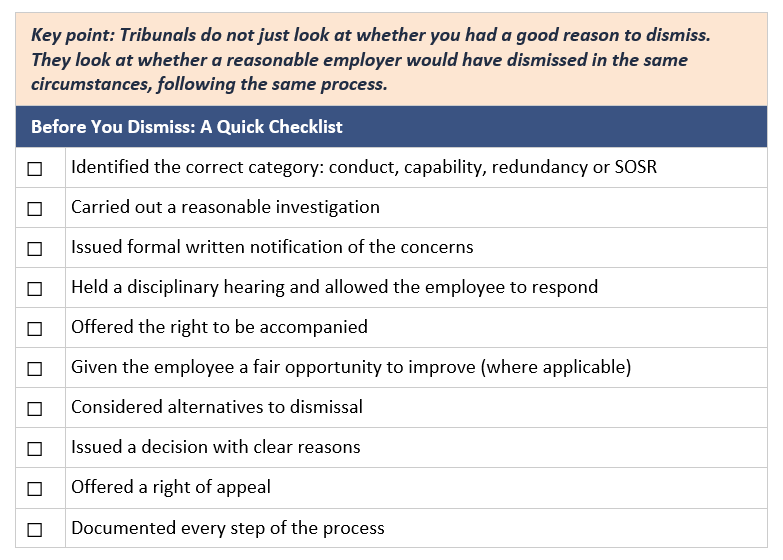
When to Get HR Support
Not every dismissal is complicated, but most benefit from an experienced eye before you commit to a course of action. Getting it wrong costs more in time, stress, and legal exposure than getting it right from the start.
If you are dealing with a situation where dismissal might be on the table, the Employee Situation Check on the Magenta HR Consulting website is a good starting point. It takes a few minutes and gives you a clearer picture of where you stand.
You can also reach Samantha Newton FCIPD directly on LinkedIn, or visit magentahrconsulting.co.uk to find out more about practical HR support for owner-managed businesses across Oxfordshire, Berkshire, Wiltshire and beyond.
Frequently Asked Questions
Q: Can I dismiss an employee without a formal process?
A: In most cases, no. Even with a clear reason to dismiss, failing to follow a fair process can result in an unfair dismissal finding at tribunal, even if the underlying reason was valid.
Q: What is the qualifying period for unfair dismissal?
A: Employees need two years of continuous service to bring an unfair dismissal claim in most circumstances. However, some dismissals carry day-one rights regardless of service, including those related to whistleblowing, pregnancy, or protected characteristics.
Q: How long does a dismissal process take?
A: It depends on the circumstances. A straightforward conduct case with clear evidence can be concluded in a few weeks. A performance or absence case may take several months if proper process is followed.
Q: What is the maximum award for unfair dismissal?
A: The maximum compensatory award changes annually. It is capped at the lower of one year’s gross pay or the statutory maximum. Where the ACAS Code has been breached, a tribunal can uplift any award by up to 25 percent.
All images created using Ai
About the Author: Samantha Newton