
Many people who practice yoga will have likely heard of sūrya namaskāra (sun salutations), and perhaps practiced them alone or when guided by a teacher. They often form quite an integral, and energising part of most people’s practice, especially if they are a follower of aṣṭāṅga yoga. However, not many have heard of, or indeed practiced, chandra namaskāra (moon salutations), which are very different to sūrya namaskāra, not least because where sūrya namaskāra would typically be practiced in the morning as the sun rises, chandra namaskāra, would typically be practiced in the evening as the moon rises.
Chandra namaskāra is also practiced with much less rigour than sūrya namaskāra, inviting introspection, allowing us to build an inner sense of calm, observe the balance of our emotions, and discover a more gentle approach to our personal yoga practice. As opposed to energising the body and mind, in order to prepare us for the day ahead.
I personally find the beauty in practicing chandra namaskāra is that, unlike sūrya namaskāra, we do not move forwards and backwards on our yoga mat, but rather from one side to the other, almost as if we are embodying the different phases of the moon. And it is in this rather meditative practice that we are able to foster a deeper connection to a much slower pace, in a very fast paced world.
Since I began teaching chair based yoga practices, I realised that salutations of all kinds could easily be omitted, and I do love to give myself a challenge, so why not make chandra namaskāra accessible for a chair based yoga practice? It is important to note that there is no “right” or “wrong” way of practicing salutations of all kinds, only honouring how your body feels in the moment, so this is my interpretation of an accessible chandra namaskāra practice.
Remember, one movement one breath, and if something doesn’t feel good don’t do it. Come back to your happy shape whatever that feels like for you, and if you’re not sure what your happy shape is, feel free to try mine, which is sukhāsana (easy pose); seated, with my feet in contact with the ground beneath me, my hands resting on my thighs, palms up.
Step by step (feel free to follow the visual as well):
- Inhale, raise the arms above the head, and let the palms meet, for urdhva hastāsana, keeping the feet close to each other
- Exhale, create space between the feet, lowering the arms and bending them at the elbow, palms facing forwards, for utkata konāsana (goddess pose)
- Inhale, bring your left forearm to rest on your left thigh, as you raise your right arm over the head, keeping your left leg bent and extending your right leg, for utthita parsvakonāsana (side angle)
- Exhale, lower your left hand down to your block (using the short thin edge to bring the ground closer to you), and raise your right arm up to the sky, for trikonāsana (triangle pose)
- Inhale, turn to set your gaze over your left leg, keeping the position of both legs, and raising both arms to the sky above the head, for ashta chandrāsana (high lunge)
- Exhale, shift your weight backwards, lowering your right arm down to your right leg and raising your left arm up towards the sky, lifting through your chest, for skandāsana (gate pose)
- Inhale, and shift your position to face in the opposite direction
- Exhale, shift your weight backwards, lowering your left arm down to your left leg and raising your right arm up towards the sky, lifting through your chest, for skandāsana (gate pose)
- Inhale, set your gaze over your right leg, keeping the position of both legs, and raising both arms to the sky above the head, for ashta chandrāsana (high lunge)
- Exhale, lower your right hand down to your block (using the short thin edge to bring the ground closer to you), and raise your left arm up to the sky, for trikonāsana (triangle pose)
- Inhale, bring your right forearm to rest on your right thigh, as you raise your left arm over the head, keeping your right leg bent and extending your left leg, for utthita parsvakonāsana (side angle)
- Exhale, centre yourself and create space between the feet, repositioning the arms, bending them at the elbow for utkata konāsana (goddess pose)
- Inhale, raise the arms for urdhva hastāsana, keeping the feet close to each other
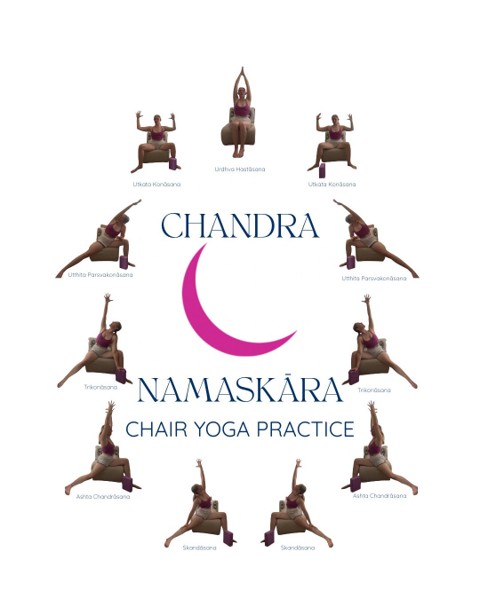
This is half of one round. A full round is complete once you have gone back the other way. The amount of rounds you complete is not important. What is important is that you take your time, remembering that perfection is never the aim in yoga, rather allowing yourself to feel into the āsana, noticing how each one feels in your body.
Key Benefits of Chandra Namaskara:
- Encourages introspection and helps to develop a deeper sense of self awareness
- The meditative nature of chandra namaskāra supports a deeper sense of mindfulness within us
- Since chandra namaskāra is practice slowly, and in time with the breath, it activates the parasympathetic nervous system, further supporting the mind and body’s shift out of fight, flight, freeze or fawn, and into rest and digest
- This helps us learn how to self regulate in times of stress, anxiety, overwhelm, and restlessness
- Because we move from side to side as well as up and down, chandra namaskāra has the potential to improve flexibility, co-ordination, and balance
Practice with me
Scan the QR code to practice with me online.

Main – Photo by Miriam Alonso
About the Author: Samantha Black