

If I had to identify the single factor that most consistently determines whether an employer wins or loses an employment tribunal claim, it would not be the reason for dismissal, the severity of the conduct, or even the quality of the legal representation. It would be the quality of the documentation.
Business owners often think HR documentation is admin for the sake of it. In reality, it is the difference between a defensible decision and an expensive lesson.
Why Documentation Matters in Employment Law
Employment tribunals assess employer decisions on the balance of probabilities. They are asking: did this employer act reasonably, follow a fair process, and have evidence to support their decision? Without written records, the employer’s account is just one version of events.
An employee who raises a tribunal claim will tell their story clearly. If you cannot produce written evidence of the conversations you had, the warnings you issued, the targets you set, and the support you offered, you are relying entirely on verbal recollection. That is a very weak position.

The Professional Services Business That Learned the Hard Way
I worked with a small professional services firm in the Cotswolds where the director had managed a long-running performance issue informally for almost a year. He had spoken to the employee regularly, flagged concerns clearly, and genuinely believed the employee understood the situation.
When the employee was eventually dismissed, they brought an unfair dismissal claim. The director was confident. The tribunal asked for evidence of the performance concerns, the conversations that had taken place, and any written warnings. There was none. Every conversation had been verbal. Every concern had been raised in passing. Not a single email, not a single file note, not a single written warning.
The tribunal found the dismissal unfair. Not because the employee had not been underperforming, but because there was no evidence of a fair process. The cost, including legal fees and the award, was significant. It was entirely avoidable.

What You Should Be Documenting
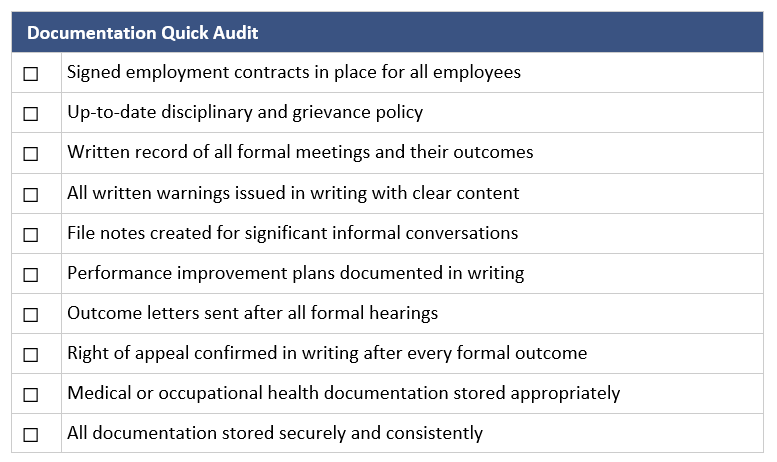
You do not need to create bureaucratic systems that take hours to maintain. But you do need a consistent habit of writing things down. The documents that matter most in employment disputes are:
- The employment contract, signed and dated
- Any written policies you rely on, particularly the disciplinary and grievance procedure
- Letters or emails inviting the employee to meetings
- Notes from formal and informal conversations
- Written warnings, including the expected improvement and the consequences of not improving
- Outcome letters from disciplinary and grievance hearings
- File notes of informal conversations that relate to performance or conduct
- Occupational health reports and medical evidence where relevant
- Performance improvement plan documentation
The Five Documents Every SME Should Have
In an earlier article in this series, we covered the five documents every SME must have to stay legally safe. If you have not read that one, it is worth going back to. The documents covered there form the foundation that everything else builds on.
Without a written disciplinary procedure, you cannot run a fair disciplinary process. Without a written contract, you cannot point to the terms you are relying on. Documentation is not decoration. It is the structure that holds everything up.
Making Documentation Manageable
The reason most documentation gaps happen is not that employers do not understand the importance. It is that writing things up takes time, and in a small business, time is always limited.
The solution is simplicity. A brief email to yourself summarising a conversation, sent the same day, is better than a detailed report written three weeks later. A template letter for issuing a written warning, used consistently, takes minutes to complete and creates a reliable paper trail.
It does not need to be elaborate. It needs to exist.
The Cost of Getting It Wrong
An unfair dismissal award can reach thousands of pounds. Add legal fees, management time, and the reputational cost in a small community where business owners know each other, and the number climbs quickly.
The cost of creating simple documentation habits is a few minutes per conversation. The cost of not having them can run to five figures. That is a straightforward commercial calculation.
If you want to understand whether your current documentation is good enough to protect your business, the Employee Situation Check at Magenta HR Consulting is a useful starting point.
Samantha Newton FCIPD provides practical HR support for SMEs across Oxfordshire, Berkshire, Wiltshire and beyond, helping business owners protect themselves with the right processes and documentation.
Frequently Asked Questions
Q: How long should I keep HR documentation?
A: As a minimum, employment records should be kept for the duration of employment plus six years. Some records, such as payroll data, have specific retention requirements. Take advice if you are unsure.
Q: Does verbal communication count for anything in a tribunal?
A: Verbal accounts can be given as evidence, but they are far harder to establish than written records. If there is a written record that contradicts a verbal account, the written record will usually carry more weight.
Q: Can file notes taken after the event still be useful?
A: Better late than never, but the closer to the event the better. Notes created significantly after the fact carry less weight and may be challenged as self-serving.
Q: What if my HR policies are out of date?
A: Using an out-of-date policy is better than having none, but it creates risk if the policy does not reflect current legal requirements. Review and update policies regularly, ideally annually.
All images created using Ai
About the Author: Samantha Newton