There is something we often forget when we think, reflect or even write about a notion, and that is, not everyone knows what we know. When something is so embedded in us, it's easy to overlook that it's not true for everyone else. We naturally tend to skip that thought and without checking, we get started on a topic unaware that in front of us, our counterpart may not have the slightest clue of what we're on about. For instance, I am familiar with the concept of "eating the frog" and while I was recently referring to it, it didn't cross my mind when mentioning it, some business people or consultants had never heard of it before.
Personally, I always thought that the choice of words was amusing because I am French and as you probably know (or not for that matter), back in the days French used to have a reputation for eating frogs. But I digress.
What is this frog story about?
Though the initial idea didn't come from him, in 2001 Brian Tracy wrote a short book called "Eat that Frog!" and in a nutshell it boils down to this: "It has been said for many years that if the first thing you do each morning is to eat a live frog, you can go through the day with the satisfaction of knowing that that is probably the worst thing that is going to happen to you all day long. Your "frog" is your biggest, most important task, the one you are most likely to procrastinate over if you don't do something about it now. It is also the one task that can have the greatest positive impact on your life and results at the moment".
Hence, "Eat that frog" is what we could label as a modern productivity metaphor that was popularised by Brian Tracy to encourage people to tackle their most important, most dreaded task first thing in the morning. His book, in a way, cemented the phrase in productivity culture.
Before I pursue the topic further, the fair question that I asked myself originally was whether the concept in and of itself had legs (no pun intended) and supportive evidence. And as it is for most things, it's nuanced. In my personal view, if the most important task isn't done first, it should at least be done at some point that day. As an example, the morning peak energy assumption doesn't hold equally for everyone — night owls, for instance, may find their cognitive peak later in the day. So though the concept has genuine research backing; the exact implementation I believe needs to be adapted to how your own brain, energy and rhythm work.
For full disclosure, I have read the book and instead of a summary, I decided to share with you what I feel are the most important aspects and I'll mix them up with my own therapist's view of this strange non-French Frog analogy.
The initial but fundamental point about "Eat that frog" is that it is a learnable skill that you can acquire through repetition to develop the habit of starting on your most important task, before anything else. Said differently, it's a capability, an aptitude that needs to be learned; it's not innate. Which means, you'll have to work at it until it becomes natural. Just like driving. As Brian Tracy emphasises, you train yourself, through repetition and practice (and therefore dedication and time) as practice is the key to mastering any skill – of which "Eating that frog" is one.
This means overall that you'll need to cultivate certain qualities and that there is a lot more behind that frog than what it seems when we first glance at it; starting with a definiteness of purpose: the knowledge of what one wants and a burning desire to achieve it. In other words, it's first and foremost a matter of priority which means that you need to know what matters the most to you and you need to have clarity over vagueness or confusion.
Why?
Because it's important to be able to make a distinction between low-value tasks (the trivial many) vs. high-value tasks (the frog you need to prioritise) and this differentiation will be directed by your main goal(s).
Alex MacKenzie wrote, "Action without planning is the cause of every failure" whilst Brian Tracy mentioned the six "P" formula: "Proper Prior Planning Prevents Poor Performance" to emphasise the importance of planning. This is counter intuitive for some people but there is true wisdom in the idea of a thought-out plan versus throwing yourself mindlessly into any kind of action. I should clarify that though Tracy's book is definitely geared towards business, this actually holds true for any area of life.
"Eat that frog" is also a practice that, in addition to some principles, stands on a few rules. One of them is to resist the temptation to clear up small things first. It's so easy to get busy with small meaningless tasks that don't move the needle and don't bring us any closer to what's important to us. We have the illusion and sometimes the self-satisfaction of feeling we have been productive where in essence we haven't progressed an inch.
That's why "Eat that frog" is also about time management, which is really life management or personal management. As Brian Tracy puts it, "Time management is control over what you do next. And you are always free to choose the task that you will do next. Your ability to choose between the important and the unimportant is the key determinant of your success in life and work." And as Goethe said, "The things that matter most must never be at the mercy of the things that matter least." It's obvious that it's not about having everything done, it's about being on top of your most important tasks (frogs). The others will just have to wait.
At the barest level: Eat that frog is about taking the right action(s) based on the fact that it's the most important one(s), and do so even if that's the hardest one(s), because this is what will be the most positively impactful. Brian Tracy talks about the quality of "action orientation" or being action orientated. In my article last month, I pledged for action over passivity and I feel it segues nicely into this month's subject. More than action orientated, I often talk about the importance of being solution orientated. What I want to highlight in this instance is that, this too is a learnable skill that needs practice; especially if we aren't wired this way from the get go. It is worth, through repetition and practice (again), learning to become action and solution orientated; it's a life skill.
And this leads onto two other valuable notions: consequences orientation and future orientation. Without any detour, Brian Tracy writes, the mark of the superior thinker is his or her ability to accurately predict the consequences of doing or not doing something. The potential consequences of any task or activity are the key determinants of how important it really is to you, your goal, your project. Consistently considering the potential consequences of your choices, decisions, and behaviours is one of the very best ways to determine your true priorities in your work and personal life. This way of evaluating the significance of a task is also how you determine what your next frog is.
This goes hand in hand with another rule of the book stating that long-term thinking improves short-term decision making. Because something that is important has long-term potential consequences. Something that is unimportant has few or no long-term potential consequences. Hence before starting on anything, you should always ask yourself…
"What are the potential consequences of doing or not doing this task?"
Before rolling out the plan of action, it's worth identifying your main constraints or limiting factors within which you operate. Not only is it important to be lucid about what they are, it also matters to find out if they can be alleviated and how. It's also good to keep in mind that the factors that are holding you back from achieving your goals can be internal or external. So when analysing your constraints, you can ask the question, "What is it in me that is holding me back?". In itself this is part of taking responsibility for your desired outcomes.
When it finally comes to execution of the plan, responsibility, self-discipline and steadiness become paramount. Brian Tracy is opting for a very hard line when he says, your job is to form the habit of putting the pressure on yourself and not waiting for someone else to come along and do it for you. You must choose your own frogs and then make yourself eat them in their order of importance. It's the harsh truth in part, but what's also true is that you can get some support with this. Not necessarily from a therapist, but maybe from a coach for instance. Elbert Hubbard defined self-discipline as "the ability to make yourself do what you should do, when you should do it, whether you feel like it or not." Again, it's true but most people will need some support, at least to get themselves to a level where they can be aligned with this statement. For most, it takes a huge amount of personal work and third-party support. So I would nuance here and would say: know where you stand in the face of self-discipline. There is no shame in recognising that you might need some help before you can be your own engine pulling the train behind you.
Finally, let's talk about focusing. The idea when "Eating that frog" is that you concentrate single-mindedly on your most important task, and by doing so, being able to reduce the time required to complete it by 50 percent or more. According to Brian Tracy, it has been estimated that the tendency to start and stop a task, to pick it up, put it down, and come back to it, can increase the time necessary to complete the task by as much as 500 percent. Even though in principle I agree, I am under no illusion that we live in a world of constant distraction, interruption and notification from which it becomes harder and harder to escape. Do you have any idea how many times I looked at my phone while writing this and had to retro-pedal to regain my flow to be able to finish this article?
Focusing is also practice and self-discipline.
Which sort of sums this overall metaphor. Good practices are built with and on good practices. It's a subtle melange requiring a lot of willingness and perseverance because it's neither easy nor fast to get there. In other words, it demands a lot of different qualities, skills and hard work, it can be challenging and can create friction. Dennis Waitley, who is a motivational speaker, says, "Failures do what is tension relieving while winners do what is goal achieving." By now you know on which side of the fence those who consistently "Eat that frog" stand.
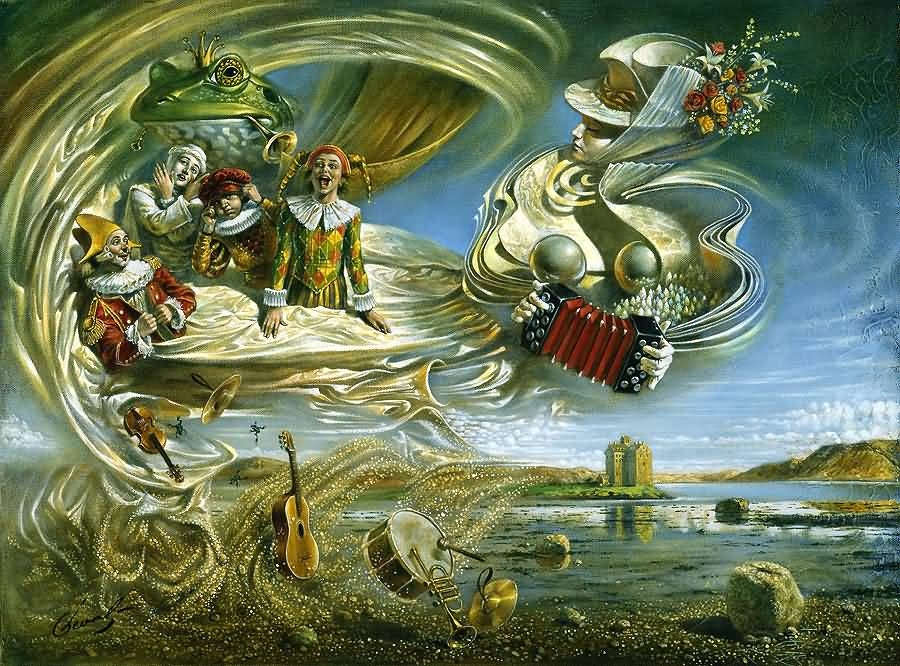
Main – Photo by Michael Cheval
About the Author: Mahé Léa