

(Sooner Than You Think)
One of the most consistent patterns I see in my work with owner-managed businesses across Oxfordshire and beyond is this: by the time a business owner asks for HR support, the situation is already significantly more complicated than it needed to be.
That is not a criticism. Business owners are busy, and most problematic employee situations start small. What begins as a minor concern can escalate quickly, and the moment it crosses a threshold where it starts affecting the rest of the team, the owner’s headspace, or the business’s bottom line is often several weeks or months before help is sought.

Here are five situations where early HR support consistently leads to better outcomes.
1. An Employee Who Has Just Been Signed Off Sick for More Than Two Weeks
Two weeks is not a long time, but it is the point at which a structured absence management approach starts to pay dividends. The decisions you make in the first few weeks of a long-term absence, including how you communicate with the absent employee, whether you obtain medical evidence, and whether you start documenting the situation, shape your options significantly further down the line.
A bodyshop owner I worked with waited four months before seeking support on a long-term absence situation. By that point, the employee had been off twice, the team was stretched, and there was no documented evidence of any absence management having taken place. Had we been involved at the two-week point, the situation would have been resolved in a fraction of the time.
2. A Performance Issue That Has Been Rumbling for Three Months
Three months is roughly the point at which an informal approach has either worked or it has not. If you have spoken to an employee about their performance, given them feedback, and things have not improved, you are at the natural transition point from informal management to formal process.
Waiting beyond this point means you are potentially managing the same situation informally for another quarter before you start a formal process that should have started sooner. That delay has a cost: in management time, team morale, and the commercial output the business is not getting from that employee.
3. A Team Conflict That Is Splitting the Group
Two people who do not get on can be managed. Two people whose conflict is drawing others in, affecting team dynamics, and starting to affect client service is a different problem and one that rarely resolves without intervention.
Team conflict that is left unmanaged tends to fester. People take sides. Conversations happen outside of formal channels. The conflict becomes embedded in the team culture. Early mediation, whether formal or informal, is significantly more effective than attempting to resolve a conflict that has hardened over months.
4. An Employee Who Has Made a Comment That Could Be a Grievance or a Protected Disclosure
Sometimes employees say things that are ambiguous: a comment to a manager about feeling unfairly treated, a remark about a colleague’s behaviour, or a suggestion that something is not being done properly. Business owners often are not sure whether these are casual comments or the early signs of something more formal.
Getting advice at this stage, before the employee has put anything in writing, gives you the opportunity to understand your exposure and to handle the situation in a way that reduces the likelihood of escalation. Once a formal grievance or whistleblowing disclosure has been made, your options narrow considerably.
5. Any Situation Involving a Protected Characteristic
Situations involving pregnancy, disability, religion, race, age, sex, or any other protected characteristic under the Equality Act 2010 carry additional legal risk and require additional care. If you are dealing with an employee issue where a protected characteristic is in the picture, whether or not it is directly connected to the situation, that is a reason to seek specialist support early.
The legal exposure in discrimination cases is significantly higher than in standard unfair dismissal cases. Compensation is uncapped. The reputational consequences in a small business community can be significant. Getting it right from the start is always the better investment.
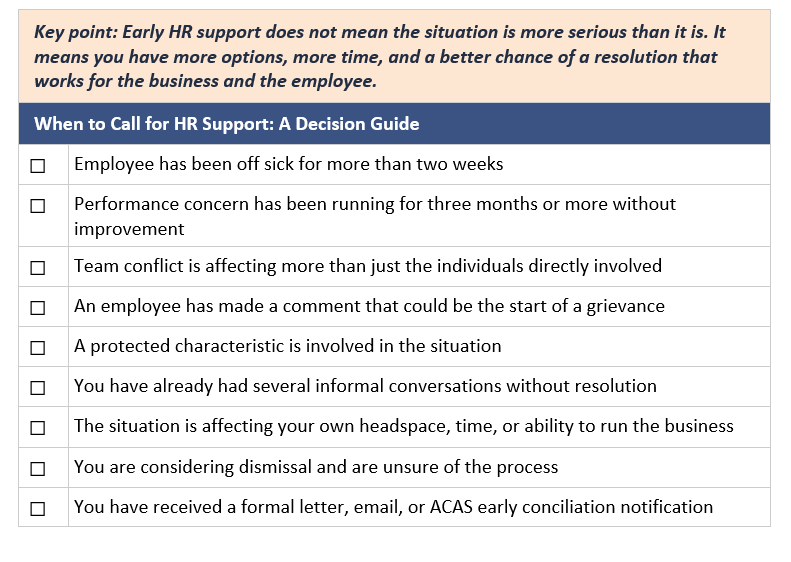
If any of these situations sounds familiar, the Employee Situation Check at Magenta HR Consulting will help you understand where you stand in minutes. It is designed for busy business owners who need clarity, not corporate-speak.
Samantha Newton FCIPD provides specialist employee relations support for SMEs across Oxfordshire, Berkshire, Wiltshire, Gloucestershire and Hampshire. The earlier you get in touch, the more options you have.
Frequently Asked Questions
Q: How do I know if my situation needs HR support or legal advice?
A: HR support is usually the right starting point. An experienced ER consultant can assess your situation, advise on process, and tell you when a solicitor is needed. Many situations never reach that point.
Q: Is HR support expensive for a small business?
A: It depends on the level of support. A single advisory session to understand your situation and your options is very affordable compared to the cost of getting it wrong. Many businesses find that a fixed-fee diagnostic session is the most cost-effective first step.
Q: Can I handle most employee situations myself?
A: Yes, especially straightforward ones. The situations where professional support adds the most value are the ones with legal complexity, significant financial exposure, or where the business owner is too close to the situation to be objective.
Q: What does ’employee relations support’ actually involve?
A: Practical advice on managing employee situations fairly and legally, help with process and documentation, support through formal hearings, and guidance on when and how to escalate. It is commercial risk management, not HR administration.
All images created using Ai
About the Author: Samantha Newton