

Do Athletes Need Carbs? – Part 1
The first time I ran a marathon was in Nottingham, UK, the land of Robin Hood and his merry men.
My training was…lacking. I showed up on race day with more hope than preparation, which quickly caught up with me around mile twenty. Suddenly, my legs decided to stage a full-on rebellion. Cramping so badly I thought my muscles were undergoing medieval torture. Moving forward was less running and more pleading with my own body to cooperate.
I somehow crossed the finish line, feeling elated and utterly defeated.
I swore there and then I would never again get into that position, preparation was key and one huge part of this was my diet.
That's when I stumbled upon the work of Tim Noakes MD — the legendary South African scientist and adviser to the South African rugby team, leading them to victory in the 1995 and 2007 world cup. Tim Noakes flipped conventional sports nutrition on its head by championing a low-carb, high-fat approach for endurance athletes and curing his own type 2 diabetes. Noakes argued that we don't need to rely on endless carbs for athletic performance and we can train our bodies to use fat — a nearly limitless fuel source.
"The marathon is less a physical event than a spiritual encounter. In infinite wisdom, God built into us a 32-km racing limit, a limit imposed by inadequate sources of the marathoner's prime racing fuel — carbohydrates. But we, in our human wisdom, decreed that the standard marathon be raced over 42 km."
— Tim Noakes MD, Lore of Running

Photo by Wesley Tingey on Unsplash
How Your Body Manages Glucose Supply During a Marathon
Your body can hold 400-500g of glycogen.
In a marathon we typically use 600-900grams of glucose
That means you have 200-400g of glucose to find.
Each energy gel that marathon runners take contain around 25g of carbs, typically athletes consume from four to six of these. This requires timing to ensure the glucose is absorbed and to avoid gastric upset.
You are still left with a glucose deficit of 50-250g.
You have now run out of glucose and your body now needs to switch to another fuel source, namely fat and ketones.
Fat and ketones can replace glucose as the substrate for ATP (energy) production in the batteries of our cells, called the Mitochondria, in processes called fatty acid oxidation and ketolysis. For this to happen there must be aerobic (with oxygen) conditions, this is when you are operating at a moderate intensity and your oxygen intake does not exceed your requirement. Usually we run at an aerobic intensity during a marathon, barring a few beastly hill climbs (there were a couple in Nottingham) where we may need glucose for anaerobic production of ATP. The anaerobic portion of a marathon is just 5-10% of the race.
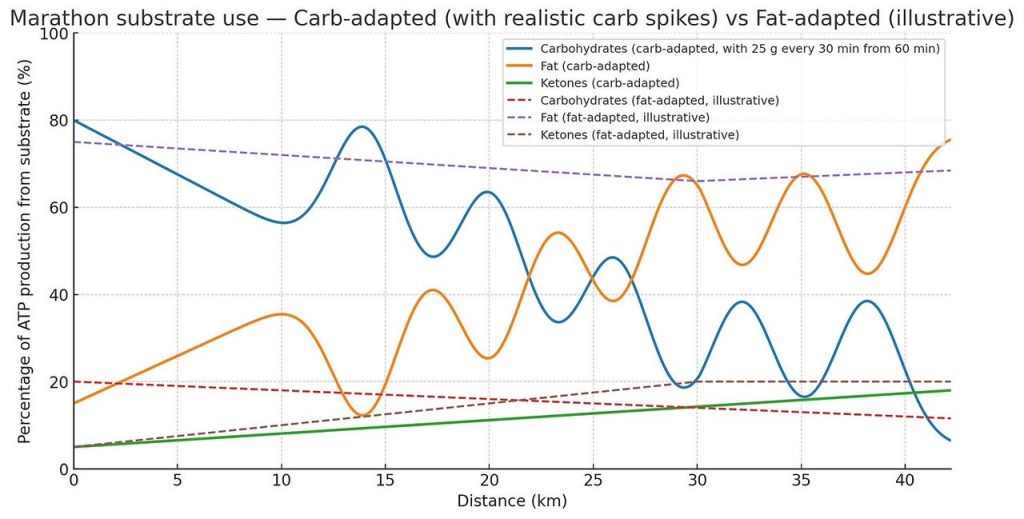
How efficiently you are able to use fat and ketones as an ATP substrate will depend on how well you are adapted to it (I'll show how you can adapt later in this article). If you are not fat adapted, your ATP production will slow and will eventually be insufficient for your output.
The Carb Adapted Athlete
Uses glycogen/glucose for the majority of their energy requirement.
Glycogen/glucose is used quickly.
When glycogen/glucose is depleted the body switches to using fat and ketones as the ATP substrate as they are so used to using gylcogen/glucose. They have less mitochondria and lower mitochondrial function than a fat adapted athlete and lack the number of enzymes that are needed for the conversion process.
As a result the change to using fats and ketones is slow and inefficient. This inefficiency means that carb adapted athletes ATP requirement exceeds their ability to create it.
Fat Adapted Athlete
Uses Fat or Ketones for the majority of their energy requirement with sparing glucose/glycogen use when needed.
Glycogen/glucose is used slower.
Their ability to use fat and ketones as an ATP substrate is very efficient. As fat contains 3,500 calories per pound it means means that fat adapted athletes have tens of thousands of calories available for production of ATP and way beyond that which would be used in a marathon effort (typically no more than 3,500 calories).
Wall avoided.

Photo by Nathan Dumlao on Unsplash
Training Tips for Keto Athletes
Follow a Ketogenic Diet
Aim for <50g carbs per day, with moderate protein (1.2-1.4g per kg) and the rest from healthy fats. This will help your body to create more fat-burning enzymes and improve mitochondrial function. Just remember this adaptation takes weeks, not days.
Practice Fasted Cardio
Training in a fasted state (morning runs before your first meal) teaches your body to tap into fat and ketones sooner. Start with lower intensity sessions and build from there.
Zone Running & Sprints
Ensure you remain in zone 3 (aerobic) during your long runs. If you struggle to do this then a good way to reduce your heart rate and effort are sprints which raise your VO2 max, drop your heart rate and also increase mitochondrial efficiency (helping them to use fat as an ATP substrate. Sprints are anaerobic and so these sessions should not be done while you are fasting so that you have sufficient glycogen levels to fuel them.
Skip the Pasta Party
Fat adapted athletes are able to maintain glycogen levels with much lower carb intakes, so there's no need for a pasta party the night before your race. Instead, eat moderate carbs in the week leading up to the event. Pasta is also often sprayed with glyphosate and while it is high in energy, lacks nutrient density.
Taper Strategically
Reducing training load in the final week lowers your glucose demand, allowing your glycogen stores to fill naturally.
Supplemental Ketones (optional)
The performance benefit of exogenous ketones is mixed, most studies show little to no improvement however none have been done specifically on long-term fat-adapted athletes — the group most likely to benefit. Given the high price tag and the fact that your body can make all the ketones you need if you're fat-adapted, I skip them.
For endurance sports, fat should be your primary source of fuel. Carbohydrates still have their place but mainly for anaerobic activities. As endurance sports like marathons are 90-95% aerobic, the need for carbohydrates is minimal.
Main – Photo by Giuseppe Argenziano on Unsplash
About the Author: Nicholas Walton-Cole (NA. Dip)