

What Are the Benefits?
Could the way you’re breathing be affecting how you feel?
A lot of the time, we breathe without even noticing. We rush from one thing to the next, not thinking about the way our bodies are pumping oxygen through our arteries or expelling carbon dioxide out into the atmosphere. But have you ever considered how you are breathing? And in what way does this affect our health?
Nasal Breathing Vs Mouth Breathing
Your nose is beautifully designed for breathing.
As air passes through the nasal passages, it is warmed, humidified and filtered. The nasal passages and sinuses also play a role in airway defence and the movement of mucus. So when we breathe through our mouths, this natural defence is eliminated.
Let’s bring nitric oxide into the picture now.
What is Nitric Oxide?
Nitric oxide – or NO – is a signalling molecule produced naturally throughout the body. It has a variety of roles, including helping regulate blood vessels and supporting processes within the respiratory and immune systems.
One particularly interesting thing about nitric oxide is that large amounts are produced in the paranasal sinuses, the air-filled spaces around your nose.
These sinuses act as an important reservoir of nitric oxide which, as we breathe, can enter the nasal airflow.
So nasal breathing does not simply filter the air before it reaches your lungs, it also allows for the interaction with this nitric-oxide-rich environment.
What does this mean for your health?
Research suggests that nitric oxide may contribute to local blood-vessel regulation and pulmonary function, improving circulation and oxygen absorption in the body.
This doesn’t mean that nasal breathing is a cure-all, or that simply breathing through your nose will transform your health overnight.
But it does give us another reason to become curious about something we do thousands of times every day.

Image created by Rosa Sawer using AI
Connection to the Nervous System
This is where I find nasal breathing particularly interesting.
The breath sits somewhere between the automatic and the conscious systems of the body.
You don’t have to tell yourself to breathe – your body takes care of that for you. But you can also consciously change the pace, rhythm and quality of your breathing.
That makes the breath a useful opening into body awareness.
Rather than trying to force yourself to breathe in a particular way, you can simply begin by noticing a few different things:
- Am I breathing through my nose or my mouth?
- Is my breath fast or slow?
- Am I holding my breath without realising it?
For me, this is where breathwork overlaps beautifully with somatic movement and practices such as Yin Yoga.
It’s not about controlling the body, but about becoming curious enough to listen to it.
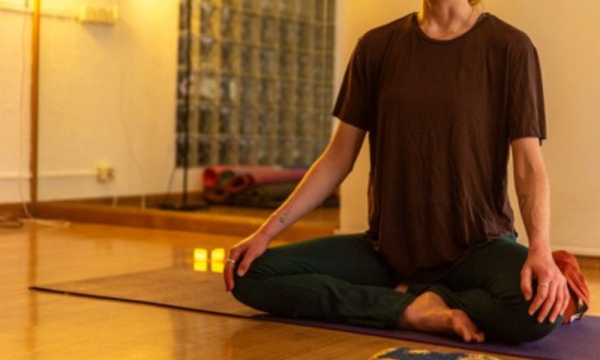
Photo by Jesús Galván
Try It For Yourself
As you’re reading this, take a moment to notice how you’re breathing.
Try not to change anything initially.
Simply observe yourself and your pace of breathing.
Then, if it feels comfortable, allow your mouth to gently close and breathe softly through your nose. You don’t need to take a deep breath or change the pace, but be as effortless as you can.
- Notice the sensation of the air moving through your nostrils.
- Notice your ribs expanding. Perhaps your belly moves.
- Notice whether you can allow the exhale to become just a little longer.
And then pause.
Has anything changed?
Perhaps nothing, perhaps there has been a slight shift in your mood or thoughts.
The goal isn’t to create a particular sensation or force yourself into a state of relaxation – the goal is simply to find awareness.
Breathing Doesn’t Need To Be Perfected
I don’t tell you this so that breathing becomes another thing to add to the list of things to “get right”, but rather to give you another area of your body and health that you can explore.
Think of nasal breathing as an opportunity to find some more ease, space and energy without much effort on your part.
A simple hack, but one that you can do anywhere, at any time.
And notice how you feel – this always is the most important part of any new self awareness technique.
Because most of the time, wellbeing doesn’t begin with doing more.
It actually begins with noticing what’s already happening.
So breathe…
And as always, if you have any questions or comments just let me know!
With love,
Rosa
Main – Image created by Rosa Sawer using AI
About the Author: Rosa Sawer