
Lessons from a Welsh occupational wellbeing pilot with people working in emotionally demanding roles
What happens when a wellbeing intervention is acceptable, interesting, and often relaxing, but the people it is designed to support are already struggling to find time to recover? A small Welsh pilot combining Infra-Low Frequency Neurofeedback with heart-rate-variability and temperature monitoring produced an unexpectedly practical lesson: supporting wellbeing is not only about what we offer, but whether it can fit into real life.
Why this project began
People working in domestic abuse, safeguarding, crisis, and other emotionally demanding services can spend much of their working day listening to distress, managing risk, making difficult decisions, and supporting other people through highly challenging circumstances. The working day may end, but the nervous system does not necessarily switch off at the same time.
That question of “switching off” was one of the starting points for a pilot we developed in Wales through Celtic Neurofeedback Ltd in collaboration with Thrive Domestic Abuse Services. We wanted to explore whether a structured programme combining Infra-Low Frequency (ILF) Neurofeedback with simple biofeedback measures could be delivered in a way that people found acceptable, manageable, and worthwhile.
The project was deliberately designed as a feasibility and service evaluation. It was not a clinical trial and it was not intended to prove that neurofeedback treats occupational stress, anxiety, or burnout. The more modest question was important in its own right: can this kind of programme be delivered in a real-world occupational setting, how do people experience it, and what would we need to change before attempting a larger and more rigorous study?
That distinction matters. New approaches to health and wellbeing can be interesting without being “breakthroughs,” and small pilots are most useful when they help us ask the next question better rather than encouraging us to make claims that the evidence cannot yet support.
Neurofeedback & biofeedback, in plain English
Neurofeedback and biofeedback are related, but they are not the same thing.
Biofeedback makes normally less visible aspects of our physiology easier to observe. Depending on the system, this might include breathing, muscle tension, skin temperature, heart rate, or heart rate variability (HRV). HRV refers to the natural variation in the time between heartbeats. It can provide useful information about autonomic regulation, but it is influenced by many factors and should not be treated as a simple “stress detector.”
Neurofeedback applies the feedback principle to electrical activity recorded from the brain. Sensors placed on the scalp record EEG activity, and a computer processes aspects of that signal to provide immediate visual or auditory feedback. The sensors are recording sensors. They do not send electrical stimulation into the brain.
The approach used in our pilot was Infra-Low Frequency Neurofeedback. During a session, a participant could sit comfortably and watch visual material while the neurofeedback system provided subtle feedback based on ongoing brain activity. The person was not asked to consciously control a particular brainwave or to perform a demanding mental task.
Alongside this, we used HRV-derived monitoring and peripheral hand temperature. These measures were not treated as diagnostic tests or proof that someone was or was not stressed. Their purpose was more exploratory: to give participants another perspective on their physiological state and to compare that with how they felt subjectively.
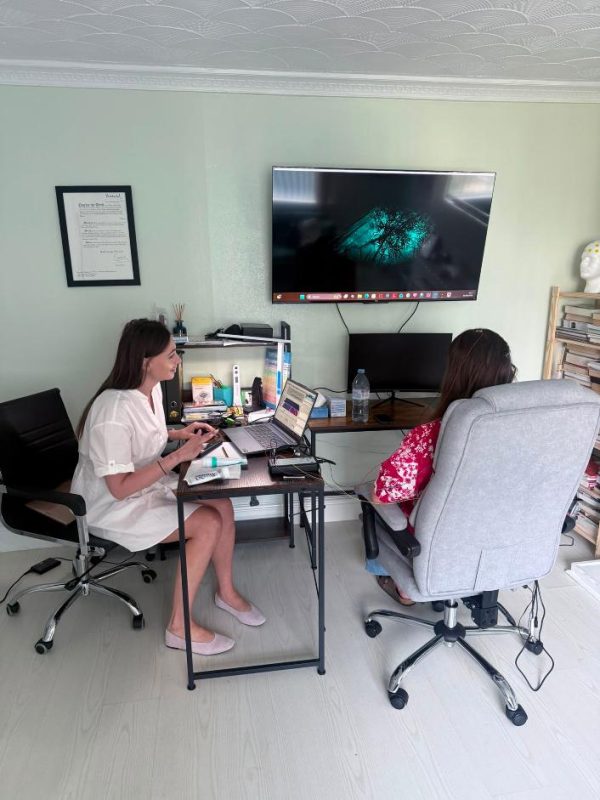
Daniela Nedelcu
What we did
The original plan was more ambitious. After an introductory presentation, there was considerable interest, and we initially hoped to recruit approximately eight people to an intervention group and another eight to a comparison group.
Then the realities of everyday life became visible.
The programme involved sessions across five consecutive weekends. Once people had to translate “I am interested” into actual Saturdays and Sundays, work commitments, travel, childcare, family responsibilities, and personal plans reduced the number who could realistically take part. Five people entered the original working cohort, and the planned comparison group could not be sustained. One participant later withdrew because fitting the programme around weekends and other responsibilities was becoming overwhelming and was perceived to affect energy during the working week. Supplementary participants also contributed shorter periods of involvement.
Rather than hiding this as a recruitment failure, we treated it as data. Feasibility is partly about whether people want an intervention, but it is also about whether they can realistically access it.
Participants completed brief ratings before and after sessions, including perceived stress, anxiety, mood, mental clarity, and relaxation. We also used HRV-derived and hand-temperature monitoring, recorded unwanted effects, and invited participants to give detailed feedback about their experience of the programme.
What did people experience?
The most consistent theme was relaxation. Across later sessions, post-session relaxation ratings were commonly high, and participants frequently described the sessions as an opportunity to become calmer, create mental space, and temporarily disengage from work-related demands.
Some participants felt that the experience extended beyond the session itself. They described perceived changes in their ability to manage stressful situations, switch off after work, concentrate, sleep, or notice physical tension. Others were more cautious, reporting that the immediate sense of relaxation did not always last. That variation is important. A positive experience during a session is not the same as evidence of a lasting clinical effect.
The end-of-programme questionnaires illustrate this balance. Among the four respondents included in the main synthesis, the average ratings were 8.75 out of 10 for acceptability, 9.75 for perceived worthwhileness, and 9.75 for willingness to use ILF Neurofeedback again. Yet the average rating for fitting the programme around work, family, and other responsibilities was only 6 out of 10.
In other words, people could value the intervention while still finding the way it was delivered difficult to sustain.
The pilot also reminded us that individual responses are not uniform. One later session showed an increase rather than a reduction in reported stress and anxiety. Headache or migraine experiences were reported on a small number of occasions, although their relationship to neurofeedback was uncertain and other contextual explanations were present. No serious adverse event was documented in the available records. In a small pilot, that supports cautious language about tolerability, not a broad claim that safety has been established.
When how you feel & what your body shows do not match
One of the most interesting parts of the project came from combining subjective experience with physiological monitoring.
People do not always experience stress in a way that neatly matches a device reading. At times, a participant could report feeling relatively settled while a physiological measure suggested a different pattern. At other times, someone who expected their body to show the impact of high perceived stress was surprised by a more regulated-looking physiological picture.
We did not regard either side as “wrong.” A questionnaire captures the person’s experience. A physiological signal captures one aspect of a complex biological state under particular measurement conditions. Neither provides the whole story.
For some participants, this mismatch was useful because it encouraged curiosity. Rather than simply asking, “How stressed am I?”, they could begin to ask, “What am I noticing in my mind and body, and do those signals always tell me the same thing?”
That may be one of the most useful roles for biofeedback in future work: not as a machine that gives a definitive stress score, but as a way of supporting physiological awareness and reflection.
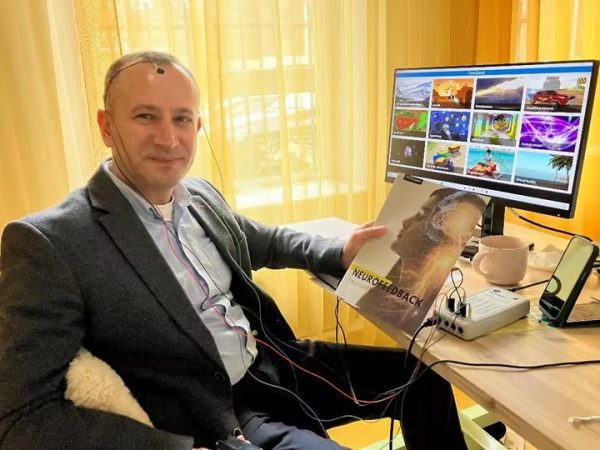
Dr Nistor Becia
A different experience from talking
Some participants had previous experience of counselling, CBT, or other psychological support and described neurofeedback as noticeably different. Talking therapies can involve actively discussing thoughts, feelings, and experiences. Neurofeedback, by contrast, was experienced by some as an opportunity to sit, settle, and engage with a non-verbal process without having to explain or analyse what had happened during the day.
This should not be interpreted as neurofeedback replacing psychological therapy. Participants themselves could see value in different approaches for different purposes.
However, the distinction is worth exploring. People in emotionally demanding professions may spend much of their working life talking, listening, analysing, and responding to the needs of others. It is reasonable to ask whether some people may also value forms of wellbeing support that do not require another period of intensive verbal processing. That remains a question for future research rather than a conclusion from this pilot.
The unexpected finding: wellbeing has to fit real life
Perhaps the most important lesson was not technological at all.
The strongest practical difficulty was the schedule. Two appointments every weekend could compete with family time, social plans, domestic responsibilities, travel, catching up with work, and, ironically, the very recovery time that a wellbeing programme is supposed to protect.
This creates an important distinction between intervention acceptability and delivery acceptability. Someone can find a session comfortable, relaxing, and worthwhile, yet still decide that the overall programme asks too much of their life.
That lesson has relevance well beyond neurofeedback. When we design wellbeing programmes for busy professionals, it is easy to focus on the intervention itself: the technique, the equipment, the number of sessions, and the outcome measures. But the person does not experience the programme in isolation. They experience it alongside school runs, caring responsibilities, deadlines, travel, tiredness, and the need for unstructured time.
A future programme should therefore be more flexible. Evening or weekday appointments, fewer consecutive weekend commitments, alternative locations, and possibly one session per week may improve accessibility. The practical design of a wellbeing intervention is not an administrative detail. It is part of the intervention’s feasibility.
What can we conclude?
This was a small, self-selected and uncontrolled service evaluation. It cannot tell us whether ILF Neurofeedback is an effective treatment for occupational stress, anxiety or burnout, and it cannot establish that the changes participants noticed were caused by neurofeedback.
What it can tell us is that the approach was generally acceptable to the people who continued; that immediate relaxation was a recurring participant-reported experience; that combining subjective and physiological information created useful opportunities for reflection; and that the main implementation problem was fitting an intensive schedule into already busy lives.
The next step should not simply be to repeat the same programme with more people. A stronger study would use a prospectively defined comparison condition, validated measures of stress, wellbeing, sleep and occupational functioning, standardised physiological procedures, formal adverse-event monitoring and follow-up after the programme. It should also build flexibility into the design from the beginning.
For me, that is the value of a feasibility pilot. Its purpose is not to provide a dramatic final answer. It is to reveal what works practically, what does not, what participants actually experience, and what needs to be tested properly next.
A wider wellbeing question
Technology can sometimes dominate conversations about innovation in health. Yet the human lesson from this project was simpler.
People who spend their working lives supporting others may need opportunities to notice their own state, to recover and to switch off. Neurofeedback and biofeedback may be worth investigating as part of that wider conversation, but they should be studied carefully, transparently and without being presented as substitutes for good working conditions, appropriate staffing, supervision, evidence-based mental-health care or organisational responsibility.
Our Welsh pilot was a small first step. Its most useful contribution may be that it moved the conversation from “Does this sound interesting?” to more practical questions: Who can access it? What do people experience? What gets in the way? How should we measure it? And how can the next study be designed better?
Those questions are less dramatic than declaring a breakthrough. They are also the questions that responsible health innovation needs us to ask.
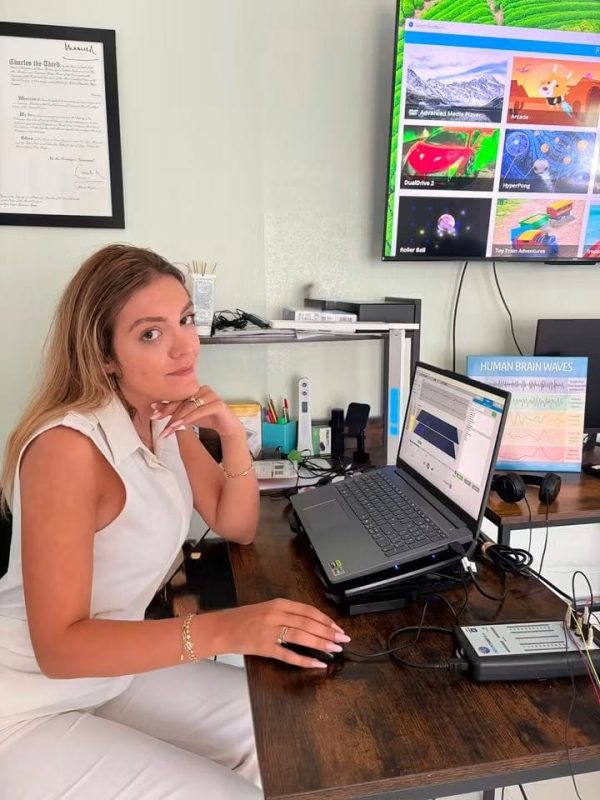
Sabina Serban
At a glance
- This was a feasibility and service evaluation, not a clinical effectiveness trial.
- Participants generally found the neurofeedback and monitoring procedures acceptable and manageable.
- Relaxation and the ability to switch off were prominent participant-reported experiences.
- Physiological measures did not always mirror subjective stress, highlighting the value and limits of multimodal monitoring.
- The biggest implementation challenge was practical: repeated weekend attendance had to compete with work, travel, family life, and recovery time.
- A larger controlled study is needed before conclusions about effectiveness can be drawn.
About the project
The project was coordinated by Dr Nistor Becia MBE, a Clinical Psychologist and project lead, with Daniela Nedelcu and Sabina Serban, Neurofeedback Practitioners, through Celtic Neurofeedback, in collaboration with Thrive Domestic Abuse Services in Wales. The ILF Neurofeedback protocol, equipment, and practitioner training were provided through BEE Medic; biofeedback equipment and clinical space were provided by Celtic Neurofeedback. No financial funding was received for the pilot, and practitioners and participants gave their time voluntarily.
Further reading
Bazzana F, Finzi S, Di Fini G, Veglia F. Infra-Low Frequency Neurofeedback: A Systematic Mixed Studies Review. Frontiers in Human Neuroscience. 2022;16:920659.
Schmidt C. The potential of infra-low frequency neurofeedback training in peak performance: The first double-blinded placebo-controlled longitudinal study in healthy adults. Journal of Psychiatric Research. 2024;175:280-286.
Lehrer PM, Gevirtz R. Heart rate variability biofeedback: how and why does it work? Frontiers in Psychology. 2014;5:756.
Cantone E, Urban A, Perra A, et al. Enhancing wellness: a systematic review of biofeedback interventions for healthcare professionals. Frontiers in Psychiatry. 2026;17:1761371.
Social Care Wales. Have Your Say workforce survey 2025: full report and summary of responses.
Editorial note: This magazine feature is adapted from the longer professional report, “Feasibility, Safety, and Acceptability of Infra-Low Frequency Neurofeedback in a Welsh Occupational Wellbeing Programme for Staff Working in Emotionally Demanding Roles: A Mixed-Methods Service Evaluation.” It is written for a general health and wellbeing audience and intentionally avoids claims of clinical effectiveness.
All images by Dr Nistor Becia
About the Author: Dr Nistor Becia