
Why Getting It Wrong Creates Risk
Here is a mistake I see regularly. A business owner has an employee who is consistently missing targets, producing poor-quality work, and causing friction in the team. The owner decides enough is enough, initiates a disciplinary process for misconduct, and then wonders why things have gone sideways.
The problem is not the decision to act. The problem is the category. Performance and conduct are not the same thing, and in employment law, they require different processes. Using the wrong one creates risk even when the underlying reason for action is completely legitimate.
What Is the Difference?
Conduct relates to how an employee behaves. Dishonesty, persistent lateness, inappropriate behaviour, and failure to follow reasonable instructions are all conduct issues. The employee knows what is expected of them and is choosing not to meet that standard.
Capability relates to whether an employee can do the job. Poor performance, inability to meet targets despite genuine effort, and health-related issues affecting work are all capability issues. The employee may be willing but is unable to reach the required standard.
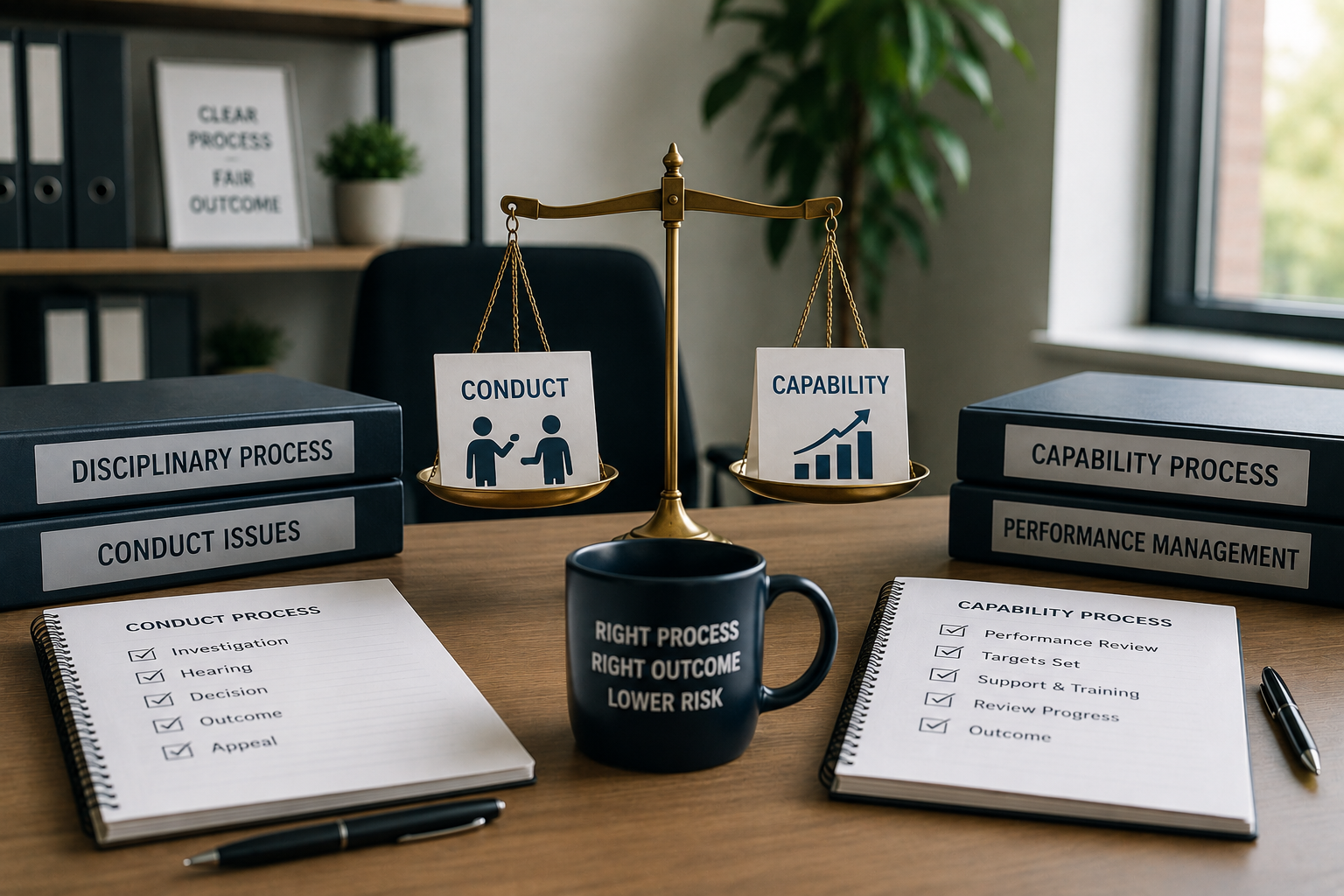
The distinction matters because the process you need to follow is different. A conduct process focuses on the behaviour and whether it justifies disciplinary action. A capability process focuses on identifying the problem, providing support, setting targets, and giving the employee a genuine opportunity to improve.

Why Employers Get It Wrong
The confusion usually arises because poor performance can look a lot like a conduct issue, especially when the employee seems disengaged or uncooperative. A member of staff who is producing substandard work, missing deadlines, and getting defensive when challenged might well be behaving badly, but the root cause could equally be a capability issue: lack of skills, unclear expectations, or something affecting their ability to perform.
I worked with a Wellbeing business in Oxfordshire where a member of staff had been underperforming for several months. The quality of their work had deteriorated significantly. The manager treated it as a conduct issue and issued a formal written warning. The employee’s union representative immediately pointed out that no performance management process had been followed, no targets had been set, and no support had been offered. The disciplinary process had to be unwound and restarted. What should have taken three months took six, and the business had to navigate a grievance in the middle of it.

What Does a Capability Process Look Like?
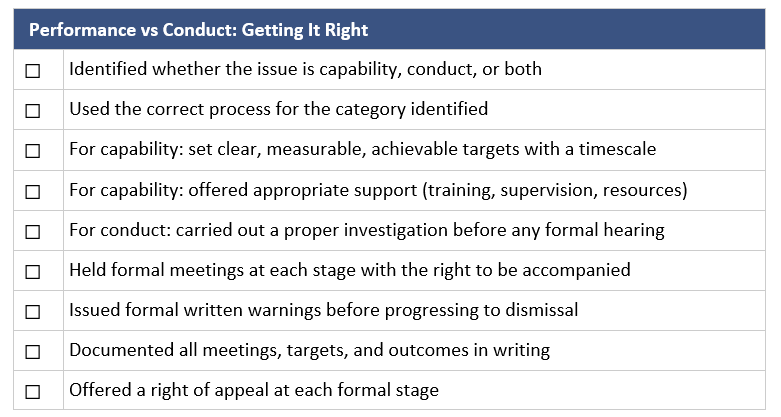
A fair capability process generally involves: a clear explanation of the performance concerns, specific measurable targets for improvement, a realistic timescale (typically four to twelve weeks depending on the role), regular review meetings, practical support such as training or supervision, formal written warnings if improvement is not sustained, and ultimately dismissal if the required standard is not reached.
At each stage, the employee must have the opportunity to respond, be accompanied at formal meetings, and understand the consequences of not improving.
What Does a Conduct Process Look Like?
A conduct process is more focused on the specific behaviour and whether it justifies a sanction. It involves an investigation of the facts, a formal disciplinary hearing, the opportunity to respond and be accompanied, a proportionate sanction (verbal warning, written warning, or dismissal depending on severity), and a right of appeal.
For serious misconduct, such as theft, violence, or gross insubordination, dismissal can be appropriate at the first stage. For lesser conduct issues, a warning is usually the starting point.
Can It Be Both?
Yes, occasionally. An employee might have conduct issues and performance issues running concurrently. In that case, it is usually cleaner to address them separately, using the right process for each.
Mixing the two together tends to make the process harder to defend and easier to challenge. Keep it clean, keep it documented, and make sure you are using the right framework.
The Commercial Consequence of Getting It Wrong
Using the wrong process does not just create legal risk. It delays the outcome, consumes management time, and signals to the rest of the team that the business does not know what it is doing. Handled well, performance and conduct processes send a clear message that standards matter and are taken seriously.
If you have an employee situation where you are not sure whether you are dealing with a conduct or capability issue, the Employee Situation Check at Magenta HR Consulting will help you get clear quickly.
Visit Magenta HR Consulting to find out how Samantha Newton FCIPD supports owner-managed businesses across Oxfordshire and beyond with practical employee relations expertise.
Frequently Asked Questions
Q: Can I dismiss for poor performance without following a process?
A: No. Even if performance is clearly inadequate, you must follow a fair capability process. Dismissal without process is likely to result in an unfair dismissal finding at tribunal.
Q: How long should a performance improvement plan last?
A: There is no fixed period, but four to twelve weeks is typical. The timescale should be long enough to give the employee a genuine opportunity to improve.
Q: What if the employee says their poor performance is due to illness?
A: This shifts the category. You would need to consider whether the Equality Act applies, explore reasonable adjustments, and potentially suspend the capability process while the health situation is assessed.
Q: Can I use informal conversations before starting a formal process?
A: Yes, and it is often advisable. Informal conversations that are documented can be useful context. However, they should not replace a formal process once the threshold for formal action has been reached.
All images created using Ai
About the Author: Samantha Newton