

What Small Businesses Need to Know Before They Start
Redundancy is one of the most misunderstood areas of employment law for small business owners. Many assume it is a straightforward process: business needs change, a role disappears, and you let someone go. The reality is considerably more complex, and the mistakes employers make in redundancy situations are among the most costly.
Whether you are facing a restructure, a downturn in work, a business closure, or simply a decision to operate with fewer people, getting redundancy right matters. Getting it wrong can mean unfair dismissal claims, discrimination allegations, and significant financial exposure.
What Redundancy Actually Is
Redundancy is a specific legal concept. It occurs when the employer has reduced, or intends to reduce, the need for employees to do work of a particular kind. It is not a catch-all reason for dismissal when you want to remove someone from the business. Using redundancy as a way to manage out a difficult employee, when the real reason is performance or conduct, is one of the most common and most expensive mistakes employers make.
A genuine redundancy situation exists when a role is disappearing or reducing, not when the person in the role is the problem.
Collective Consultation: When the Rules Change
If you are making 20 or more employees redundant within a 90-day period, collective consultation obligations apply and the rules are significantly more demanding. These include a legal obligation to notify the government (using HR1 form), minimum consultation periods, and obligations to consult with employee representatives.
This article focuses primarily on individual redundancies, which is the situation most owner-managed businesses with under 60 employees will face.

The Individual Redundancy Process
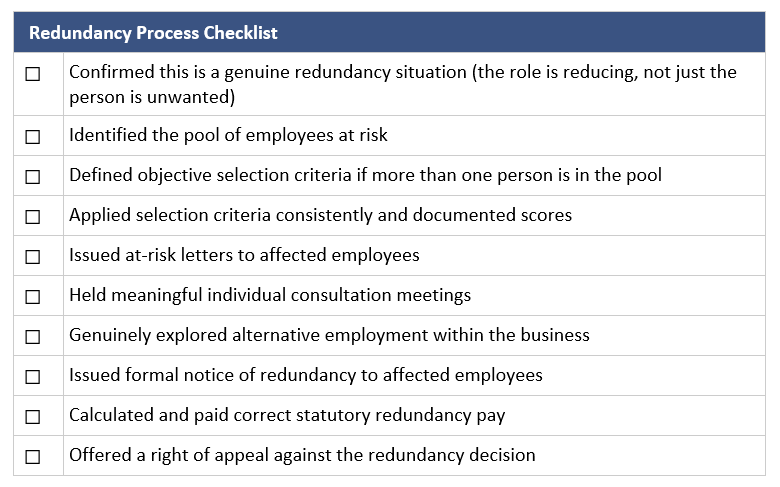
A fair individual redundancy process has several key elements. At risk notification tells the employee formally that their role is at risk of redundancy. Consultation means genuine, meaningful discussions about the proposed redundancy before any final decision is made. Selection criteria must be objective and consistently applied if more than one person is in the pool for potential redundancy. Alternative employment requires the employer to consider whether any suitable alternative roles are available.
Crucially, consultation must happen before the decision is finalised. An employer who has already made up their mind before the consultation meeting, and who uses the meeting simply to inform rather than consult, has not followed a fair process.

Selection Criteria: Getting This Right
Where there are multiple employees doing similar work and you cannot retain all of them, you need to select who is at risk using objective criteria. Common criteria include skills and qualifications, performance (based on documented evidence), attendance record, and disciplinary record.
Criteria that could indirectly discriminate, such as length of service alone, require care. Criteria that pick out employees who have recently had maternity leave or raised protected disclosures can result in discrimination claims on top of unfair dismissal.
Statutory Redundancy Pay
Employees with two or more years of continuous service are entitled to a statutory redundancy payment. The amount depends on age, length of service, and weekly pay (subject to a statutory cap). Employers who fail to pay statutory redundancy pay, or who get the calculation wrong, face additional claims at tribunal.
Common Mistakes to Avoid
The mistakes that cost employers most in redundancy situations are: dismissing someone for redundancy without following any consultation process, selecting on criteria that are subjective or potentially discriminatory, failing to consider alternative employment, using redundancy to remove someone the employer actually wants gone for a different reason, and failing to pay the correct statutory redundancy entitlement.
Redundancy situations are ones where early advice is particularly valuable. If you are considering redundancy in your business, speaking to someone with specialist ER experience before you start will almost always reduce the risk and the cost. Use the Employee Situation Check at Magenta HR Consulting to get an initial view of your situation.
Samantha Newton FCIPD provides practical redundancy support for owner-managed businesses across Oxfordshire and beyond. Visit Magenta HR Consulting to find out more.
Frequently Asked Questions
Q: Do I need to follow a formal process for one redundancy?
A: Yes. Even where only one role is being made redundant, a fair process including at-risk notification and genuine consultation is required.
Q: What is the minimum notice period for redundancy?
A: The statutory minimum is one week per completed year of service, up to a maximum of 12 weeks. Contractual notice may be higher. Check the employment contract.
Q: Can I make someone redundant during maternity leave?
A: With extreme care. Employees on maternity leave have additional protection, including priority rights to any suitable alternative vacancies. Taking advice before proceeding is strongly recommended.
Q: What is ‘suitable alternative employment’?
A: A role that is broadly comparable to the redundant role in terms of status, pay, location, and skills required. There is no obligation to create a role that does not exist, but any genuine vacancies must be actively considered.
All images created using Ai
About the Author: Samantha Newton