

Settlement agreements are one of the most useful tools available to employers looking to resolve a difficult employment situation cleanly and without the risk of a tribunal claim. They are also one of the most misunderstood.
Business owners often come to me knowing they have heard of settlement agreements, and suspecting they might be useful, but unsure about what they actually involve, when they are appropriate, and how to get the process right. This article covers the essentials.
What Is a Settlement Agreement?
A settlement agreement is a legally binding contract between an employer and an employee in which the employee agrees to waive their right to bring employment tribunal claims in exchange for an agreed financial payment. In order to be valid, the employee must take independent legal advice on the agreement before signing it, and that advice must be provided by a qualified adviser.
Settlement agreements used to be called compromise agreements. The name changed in 2013, but the purpose remains the same: a clean exit, agreed by both parties, with no risk of a future claim.
When Are Settlement Agreements Used?
Settlement agreements are used in a wide range of situations. They are common where an employment relationship has broken down and both parties would prefer a managed exit over a prolonged formal process. They are also used to conclude formal disciplinary or performance processes where dismissal is the likely outcome and a negotiated departure is preferable to the alternative.
Other common scenarios include restructuring where an employer wants to offer an enhanced payment in exchange for certainty, situations where there is a potential discrimination or whistleblowing element and the employer wants to limit exposure, and mutual separations where both the employer and employee recognise the relationship has run its course.

What Does a Settlement Agreement Include?
A standard settlement agreement will include: the financial terms (what the employer is paying, and whether any element is tax-free), the claims being waived (usually a comprehensive list of potential employment law claims), confidentiality obligations on both sides, any agreed reference wording, and the conditions for the agreement to be valid.
The employee must take independent legal advice before signing. It is standard practice for the employer to contribute toward the employee’s legal fees for this purpose, typically a fixed sum of a few hundred pounds.

Protected Conversations
An employer can initiate a conversation about a potential settlement agreement using what is known as a protected conversation, under Section 111A of the Employment Rights Act 1996. This allows the employer to make an offer of a settlement agreement without that conversation being used as evidence in an unfair dismissal claim, provided the conversation is conducted properly and without any improper behaviour.
Protected conversations do not protect against discrimination claims, whistleblowing claims, or other automatically unfair dismissal claims. Understanding what is and is not protected is important before having this kind of conversation.
How Much Should a Settlement Agreement Be Worth?
There is no formula. The value of a settlement agreement depends on the circumstances, the employee’s legal position, the strength of any potential claims, the cost and risk of the alternative process, and what both parties consider to be a fair resolution.
As a starting point, most settlement agreements will at minimum cover the employee’s notice entitlement, any accrued holiday, and statutory redundancy pay if applicable. The additional payment is the negotiated element that reflects the value of the certainty the employer is buying.
What a Settlement Agreement Cannot Do
A settlement agreement cannot waive claims that have not yet arisen. It cannot stop an employee from whistleblowing to a regulator. It cannot prevent the employee from discussing the fact that a settlement agreement exists, only the terms of it. And it cannot override statutory rights such as the right to a reference confirming dates of employment and job title.
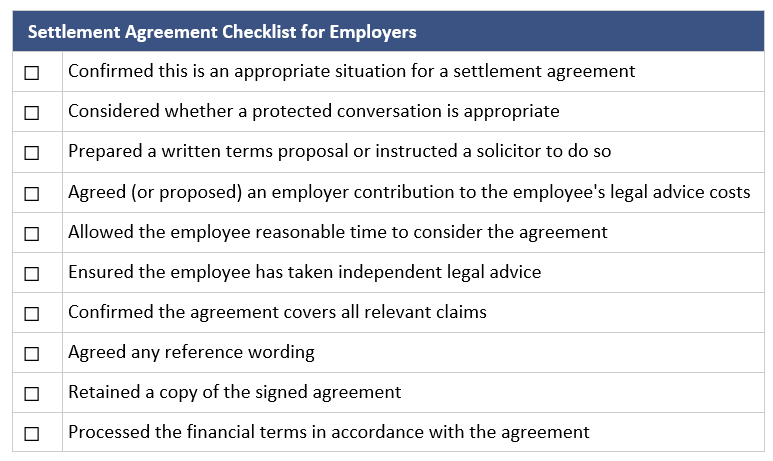
Settlement agreements are a specialist area and the approach matters as much as the terms. If you are considering a settlement agreement or want to understand whether it is the right option for your situation, contact Samantha Newton FCIPD at Magenta HR Consulting for a confidential conversation.
You can also use the Employee Situation Check to get an initial view of whether a settlement agreement might be appropriate in your circumstances.
Frequently Asked Questions
Q: Can an employee refuse to sign a settlement agreement?
A: Yes. An employee cannot be compelled to sign. However, if they refuse and the alternative is a formal process that results in dismissal, they may end up worse off than under the agreed terms.
Q: Is a settlement payment taxable?
A: The first £30,000 of a genuine ex-gratia payment made on termination of employment can be paid free of income tax and National Insurance in most circumstances. Payments representing notice pay or holiday are taxable. Take advice on the tax treatment before finalising the terms.
Q: How quickly can a settlement agreement be concluded?
A: A straightforward settlement can be concluded within a week or two. More complex situations, or where the employee wants to negotiate, may take longer.
Q: Does a settlement agreement affect state benefits?
A: Potentially, depending on the terms. Employees who receive a settlement payment may have a waiting period before they can claim Jobseeker’s Allowance. This is worth mentioning to the employee as part of the process.
All images created using Ai
About the Author: Samantha Newton