
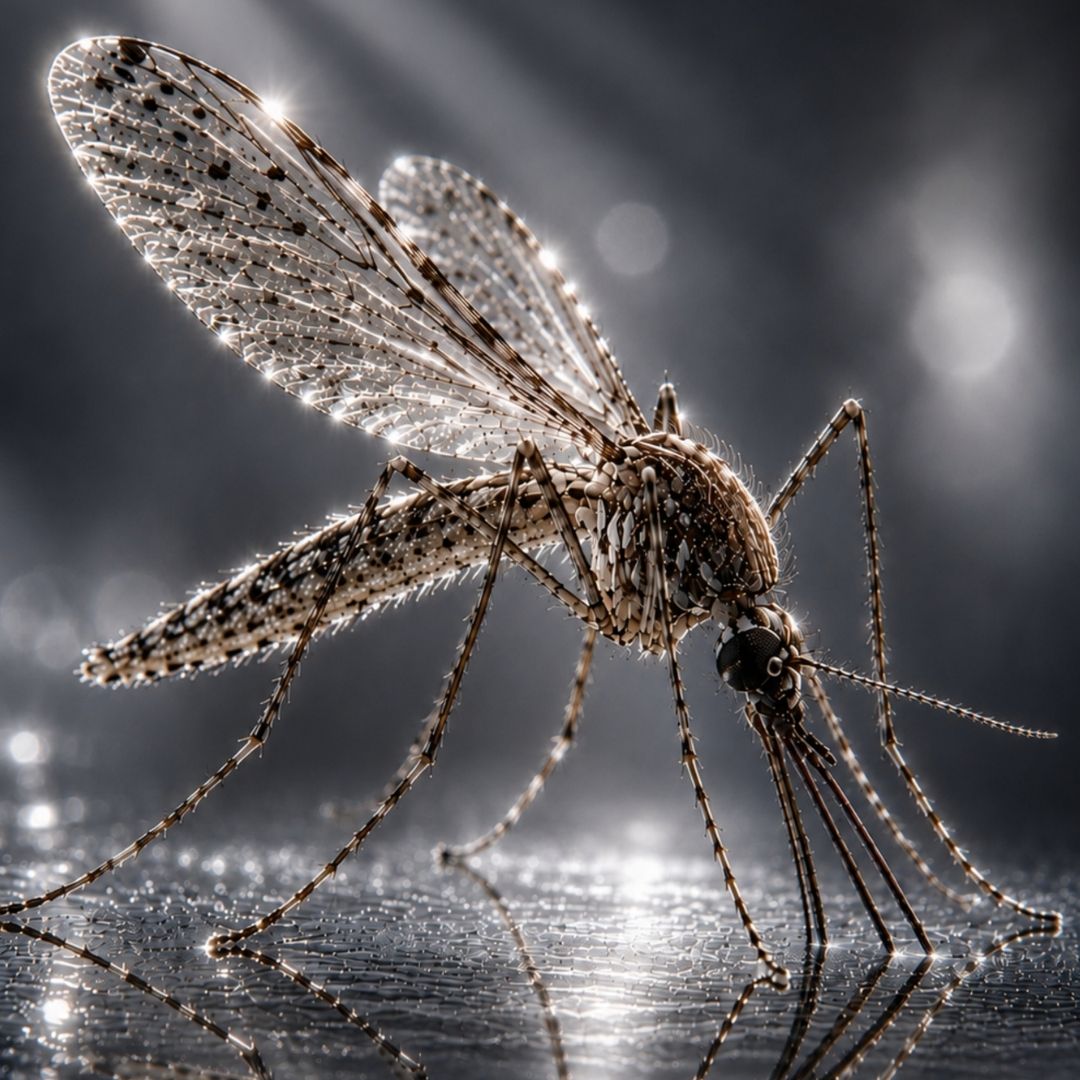
Ronald Ross, one August afternoon, and what it costs to believe something before anyone else believes it.
It is not the shark.
It is not the lion, or the bear, or the snake you are picturing right now.
It is the mosquito.
Roughly half of every human being who has ever lived is thought to have died of malaria. Half. Not from war, not from famine. From something that weighs less than a raindrop.
For most of human history nobody knew why.
The word malaria comes from the Italian: mal aria. Bad air.
That was the theory. Swamp vapours. Night mist. Something in the atmosphere that settled into the lungs of people who slept with their windows open.
Doctors believed it for centuries. Whole cities were designed around it.
They were wrong, and being wrong killed more people than almost any error in human history.
In 1897 a British Army surgeon named Ronald Ross was stationed in India, dissecting mosquitoes in his off hours.
His superiors thought it was a waste of his time. The heat ruined his slides. He bought his own equipment. Most of the medical establishment had already decided the question was settled.
He had no proof. He had a suspicion he could not put down.
On the twentieth of August, he found it. A parasite, in the stomach wall of a mosquito.
Photo by Lisa from Pexels
The first thing he did was write a poem.
Not a paper. A poem.
He had been alone with it for so long that when the answer finally came, what he reached for was not the language of science. It was the language of relief.
I think about him more than you would expect.
Not because what I do resembles what he did. It does not.
He proved a mechanism. It could be photographed, replicated, argued over, and eventually turned into drainage ditches and bed nets and millions of lives that went on instead of ending.
What I think about is the shape of the years before that August afternoon.
The part where you can see something clearly and no one else can yet.
Where you keep showing up to the same table, with the same instruments, and the people around you have quietly decided you are wasting your time.
Where you hold the thing steady inside yourself without applause, without confirmation, sometimes without anyone asking how it is going.
That part is not scientific. It is not spiritual either.
It is just what it costs to believe something before it is believed.
Ross did not own his discovery.
He could not have. Mosquitoes and parasites belong to no one.
Within a few years, others were building on his work, refining it, applying it in places he would never see. Some made more money than he did. Some are better remembered.
He won the Nobel Prize in 1902 and spent much of the rest of his life in disputes over credit, which is a sad ending for a story that began with a poem.
Here is what I take from it.
Being first does not protect you from being copied.
Nothing protects you from being copied.
The only thing that is truly yours is that you were the one who sat there in the heat, year after year, when it was still only a suspicion.
That cannot be taken. It can only be spent.
There is work I do that I believe will spread, and I want to say plainly what it is.
You have a trip coming up. Not a vacation. A wedding, a funeral, a work thing you cannot get out of.
The dread starts weeks before the date. You are not thinking about the trip. You are thinking about leaving your dog.
Do you board him? Do you pay someone to sleep in the bed? Do you hide the suitcase so he does not see it and start grieving three days early?
You have tried the phone. You have tried FaceTime, talking into a screen while he tips his head at a voice with no body attached to it. You have tried the camera that tosses treats.
You will do all of it. It will not be enough. It has never been enough.
So you stop going places. You shorten the trip. You decline the invitation. You limit your entire life to the distances you can bear to be away.
That is what I built the answer to. A true solution. A true connection.
The Shared Connection Method™ supports the animal and their person at the same time, live and in real time over Zoom. Your pet remains in their own familiar environment. You join from wherever you are while away. A hotel room. An airport. A conference room between meetings. Reiki is offered to both, simultaneously, within the same energetic moment.
Presence without proximity.
Then I realised it was so much bigger than a suitcase.
The insight underneath it is that an animal and their person are one system. Whatever is happening is happening to both. Every other practice treats them as separate.
I spent years rehabilitating horses. Even if you are lucky enough to have a horse in your own backyard, even if you spend three hours a day with them, do the math. You are a fraction of that animal’s life. This deepens the bond between a horse and their owner, their rider, their trainer, in a way the hours alone never could.
Then there is the one I did not see coming.
An animal at the end of their life, and the person who loves them, right there in the room, drowning. The anticipation. The guilt about timing. The question of whether it is too soon or already too late.
That session is not about distance. It is about presence, and bond, while there is still time.
Photo by Evelyn Hale
There are sessions for the person alone, because your state is part of your animal’s state, and because you deserve support in your own right.
I have curated a collection of physical pieces, each prepared in its own Reiki session, because sessions end and the presence should not.
Prepared once. Present always.
I give away a library of writing on separation, boarding, travel, hospice, and grief, free to anyone, because people are frightened about an animal at two in the morning and there is nowhere credible to land. I also write as The Reikist, personal stories of how this philosophy and this work came to be. This is one of them.
I believe other practitioners will take from it and offer some or all of it as their own. Some will do it beautifully. Some will do it carelessly.
None of them will have sat where I sat while it was still just an idea I could not put down.
Ross published anyway. He knew he could not own it. He wrote it down and let it go, and the world took it and built drainage ditches and bed nets and hundreds of years of lives that went on instead of ending.
All I can do is be the first and the best.
I am putting it out as mine, as my own, and I hope people see the value and the worth in that.
Light, Reverence and Connection — Reimagined.
Ross found his answer on an August afternoon and immediately wrote a poem about it, because there was no one else in the room to tell.
Some part of every practice is like that.
You are alone with the thing you have found, long before it belongs to the world.
Then one day it does.
Published in recognition of World Mosquito Day, observed annually on August 20, commemorating Sir Ronald Ross’s discovery that mosquitoes transmit malaria.
About the Author: Carrie K Kelley