

In today's world, stress often never fully arrives nor fully leaves. We face extended workplace pressure and constant digital distractions. Add to this an extended emotional strain from an illness, divorce, bereavement or custody battle and it is no wonder that 20-30% of the population report symptoms of extended periods of stress that last beyond 6 months.
Chronic stress acts as a powerful amplifier of cardiovascular disease, metabolic dysfunction, autoimmune and inflammatory conditions, hormonal imbalance, mental health disorders, immune suppression, and cognitive decline.
Our bodies are ill-prepared for this.
A difficult custody battle is probably equivalent to a near-fatal bout of cancer.
Dr Jordan B Peterson
The HPA (hypothalamus-pituitary-adrenal) axis is a feedback loop that regulates many of the hormones in our body. Its primary role is to speed up or slow down our metabolism and cardiovascular system in response to threats, helping us survive danger.

Photo by Zachariah Aussi on Unsplash
When you experience stress, the body responds immediately. The hypothalamus releases corticotropin-releasing hormone (CRH), which signals the pituitary gland to release adrenocorticotropic hormone, prompting cortisol production from the adrenal glands. Cortisol mobilises energy, speeds up the heart rate, and dilates blood vessels to prepare for action. Once cortisol levels rise sufficiently, the hypothalamus senses the feedback and stops producing CRH. The system returns to baseline, the stress response fades.
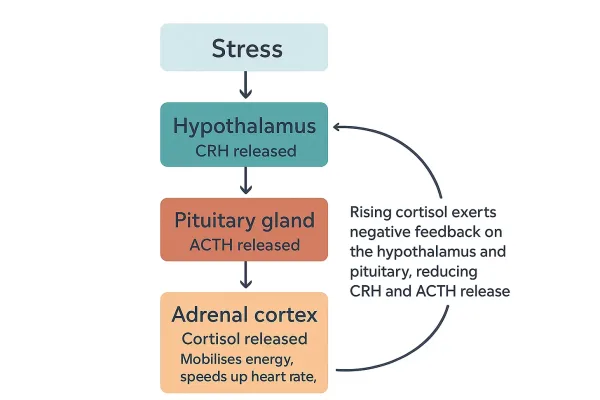
Image created by Nick Walton-Cole
The HPA is perfectly balanced to handle short bursts of danger, not extended low grade stress and uncertainty. This constant activation means hypothalamic cortisol receptors are flooded for extended periods, and over time, they desensitise. The result is cortisol levels remain high, the stress response is prolonged, and the HPA axis struggles to reset. Eventually, the hypothalamus can become exhausted and unable to regulate CRH effectively. This is what is commonly referred to as adrenal fatigue.

Photo by Esra Afşar on Unsplash
The stages of adrenal fatigue begin with the alarm stage, which includes increased heart rate, elevated blood sugar, heightened reliance on caffeine, and a feeling of being "wired but tired".
The resistance stage is where the body attempts to regulate the adrenal response, sometimes for years. Symptoms include increased caffeine dependency, self-soothing behaviours like humming or talking to oneself (no, you're not going mad), lower resistance to illness, inflammation, irritability, and reduced focus and motivation.
In the adrenal fatigue stage, cortisol receptors become unresponsive, the system is flooded with cortisol, and the brain experiences fog, emotional flatness (anhedonia), low motivation, and difficulty getting out of bed. Tyrosine reserves are consumed for chronic cortisol production, reducing neurotransmitter availability. To prevent progression, we need a circuit breaker.

Photo by Troy Bridges on Unsplash
Blue & Red Light Exposure
The sun rays produce a spectrum of colours as they pierce the earths atmosphere they are filtered depending on the atmosphere's density.
When the temperatures are cooler in the morning this gives a chance for dust and pollution to settle, thinning the atmosphere. This thin atmosphere allows for blue light to be scattered easily.
This blue light is absorbed by our eyes through to the suprachiasmatic nucleus (SCN). The SCN is located in our hypothalamus, it is our internal alarm clock and controls when we are wakeful and asleep (circadian rhythm).
The more blue light the SCN receives, the more it suppresses CRH, leading to increased cortisol and stimulation.
Inversely, in the evening, the earths atmosphere is now thicker and red light rather than blue light is dispersed.
This reduction of the blue light means our SCN sends a signal to our pineal gland to release melatonin. Red light also decreases inflammation and oxidative stress and so it begins the important process of healing as we sleep.
Set your circadian rhythm each day. Take your daily walk in the morning, without sunglasses on and get 2-30 minutes of blue light exposure.
Remove all screens two hours before bedtime. Go outside, absorb the red light and allow your cortisol levels to decrease, melatonin to increase and your body to begin its healing process.

Photo by Adrian Swancar on Unsplash
Running
What better way to satisfy a fight or flight reflex than actually running, or for those who can't a fast-paced walk will suffice. When we run it produces endorphins, these have a morphine like effect on the brain, giving us a new perspective about our problems, while also lowering CRH, and cortisol. Zone 2 running is plenty, we don't want to over exert ourselves which can over-stress the body and increase cortisol.
Omega-3
Omega-3 fatty acids EPA and DHA have been shown to help reduce cortisol because they modulate the body's inflammatory and stress-response pathways at a cellular level. When cortisol rises, inflammation tends to rise with it, and the two feed each other in a loop. Omega-3s interrupt this loop by lowering pro-inflammatory cytokines (such as IL-6 and TNF-α), so reducing the need for the body to produce stress hormones. Consume two organic portions of oily fish a week (think S.M.A.S.H: salmon, anchovies, sardines, herring).
Magnesium
Magnesium dampens the response of the pituitary reducing ACTH and in turn lowering cortisol levels. Magnesium has been shown in this study to lower cortisol production in doses of 350mg per day.
Remove refined carobhydrates from your diet
By focusing on whole, fibre-rich foods such as vegetables and a few berries as your choice of carbohydrates, including a quality source of protein and fat, your blood sugar remains steadier. Reducing the need for repeated cortisol bursts. Over time, this supports energy stability, improves mood, and protects against inflammation and metabolic strain.
Caffeine
Being from Yorkshire I am more than partial to my cup of team in the morning . Caffeine gives and it takes away, providing (wonderful) temporary relief and yet in the long term further dis-regulating blood sugar and increasing cortisol levels. Try to keep it to one to two cups a day.
Existential Crises
During major life events—illness, loss, divorce, or other challenges that we simply can't escape—it becomes even more important to stick to your foundational habits. As the feeling of feeling of "wired but tired" appears, run through a mental checklist: Did I get some movement today? How's my diet? Am I managing my caffeine intake?
Use your evenings away from screens to connect with friends or loved ones. Share your routine, let them know what you're working on, and ask them to hold you accountable if you slip.
Main – Photo by Vitaly Gariev on Unsplash
About the Author: Nicholas Walton-Cole (NA. Dip)