

Vitamins, minerals, herbal products and dietary supplements have become part of everyday life. Many people take them to support energy, sleep, immunity, weight management or general wellbeing. But “natural” does not automatically mean harmless — particularly when supplements are combined with prescription or over-the-counter medicines.
The important question is not simply “What am I taking?”, but “What happens when everything I take is combined?”
Why tracking side effects matters
Adverse drug reactions (ADRs) remain an important public-health issue. A major UK study published in the BMJ found that ADRs were associated with 6.5% of hospital admissions in two large English hospitals. The researchers estimated approximately 5,700 deaths per year from ADRs causing hospital admission at the time of the study, while noting that the total could be higher when reactions occurring after admission were included. These figures are historical estimates, not a current annual death count, but they illustrate the scale of the problem.
The UK’s Medicines and Healthcare products Regulatory Agency (MHRA) continues to operate the Yellow Card scheme, which collects suspected side-effect reports from both healthcare professionals and the public. Such reporting helps identify safety signals that may not have been apparent earlier.
Clinical trials cannot predict everything
Clinical trials are essential for establishing whether a medicine works and identifying important safety problems. But no clinical trial can reproduce every combination of medicines, supplements, foods, health conditions, ages and lifestyles encountered in everyday life.
The FDA notes that pre-approval studies generally involve relatively limited populations and that some rare or delayed adverse effects only become visible after a medicine is used by much larger and more diverse populations. This is why post-marketing safety monitoring remains essential.
The same principle matters when people add supplements to existing treatments. The NHS specifically warns that some herbal medicines can interact with prescription medicines and may either increase side effects or reduce the effectiveness of treatment.
The interaction problem
Consider someone taking several prescriptions while also using vitamins, herbal extracts, sports supplements or products for sleep or weight management. Each product may appear reasonable individually, while the combination creates a different picture.
The NIH Office of Dietary Supplements gives examples of supplements affecting medicines, including St John’s wort altering the effectiveness of several medicines and vitamin K interfering with warfarin.
This makes systematic tracking important. Keeping a record of what you take, when you started it, the dose, and changes in physical or mental wellbeing can provide valuable information for conversations with a doctor or pharmacist.
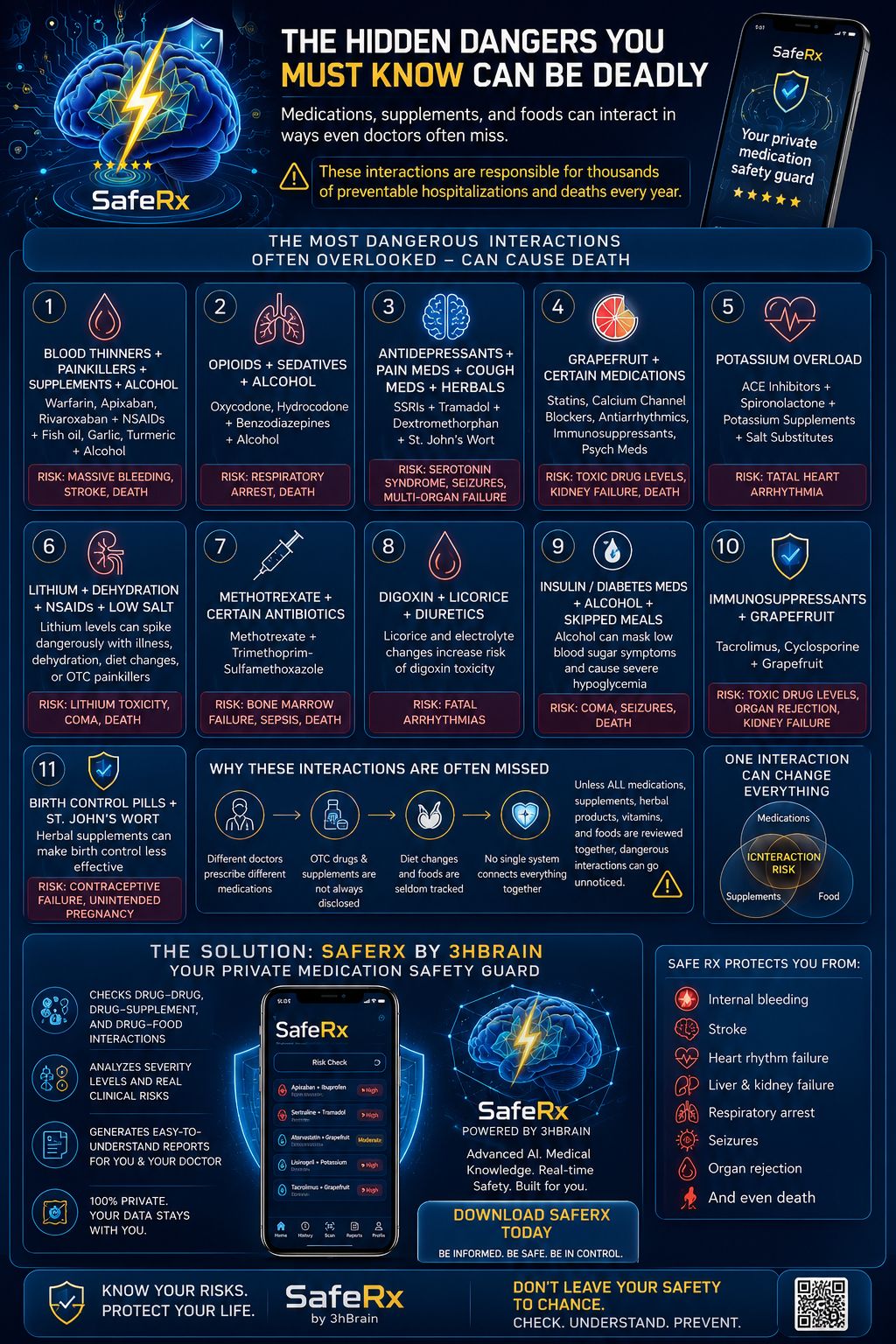
A new approach: SafeRx
SafeRx by 3hBrain, LLC on the Apple App Store is designed to make this process easier.
Rather than looking only at medication-to-medication interactions, SafeRx allows users to create a personal profile containing prescription medicines, over-the-counter medicines, vitamins, supplements and herbal products. Its AI-assisted interaction analysis is designed to identify potential drug–drug, drug–supplement, and drug–food interactions and present the findings in a simple safety report.
The app also keeps an interaction history that can be useful when discussing medications and supplements with a healthcare professional.
SafeRx is not intended to replace a doctor or pharmacist, diagnose a condition, or tell someone to start or stop treatment. Its purpose is to provide another layer of health information and awareness – helping people notice potential interactions and ask better questions.
In an increasingly complex wellness environment, knowing what we take is only the first step. Understanding how those substances may interact – and tracking changes in how we feel – may be just as important.
References
National Health Service. (2026). Herbal medicines and complementary therapies. NHS.
About the Author: Evgenia Leonova