
Most business owners are surprised when they receive a formal grievance. Not because the business has been doing something obviously wrong, but because formal complaints have a way of arriving at the worst possible time and raising issues that seem to come from nowhere.
The truth is, grievances rarely come from nowhere. They are usually the end point of a longer story that has been playing out quietly underneath the surface. By the time someone puts something in writing, they have often already decided they are not going to let it go.
What Is a Grievance?
A grievance is a formal complaint raised by an employee about something at work. It might relate to how they have been treated by a manager or colleague, working conditions, a perceived breach of contract, discrimination, or a breakdown in the working relationship.
Employees have the right to raise a grievance, and employers have a legal obligation to deal with it fairly and in a reasonable timeframe. Ignoring a grievance, or handling it poorly, is one of the most reliable ways to find yourself on the losing end of an employment tribunal claim.
Why Grievances Are Often Symptoms, Not Causes
A grievance is rarely just about what it says it is about. I worked with a veterinary practice in the south of England where a senior nurse raised a formal grievance about her working hours. On the surface, it looked like a simple scheduling complaint. When we looked more carefully, the real issue was a long-running team dynamic problem where the nurse felt consistently overlooked in favour of newer, less experienced colleagues. The grievance was a symptom of that deeper issue.
Understanding what is really driving a grievance matters, because addressing the surface-level complaint without tackling the underlying problem means you will be dealing with something similar again in a few months.

The Grievance Process: What Employers Must Do
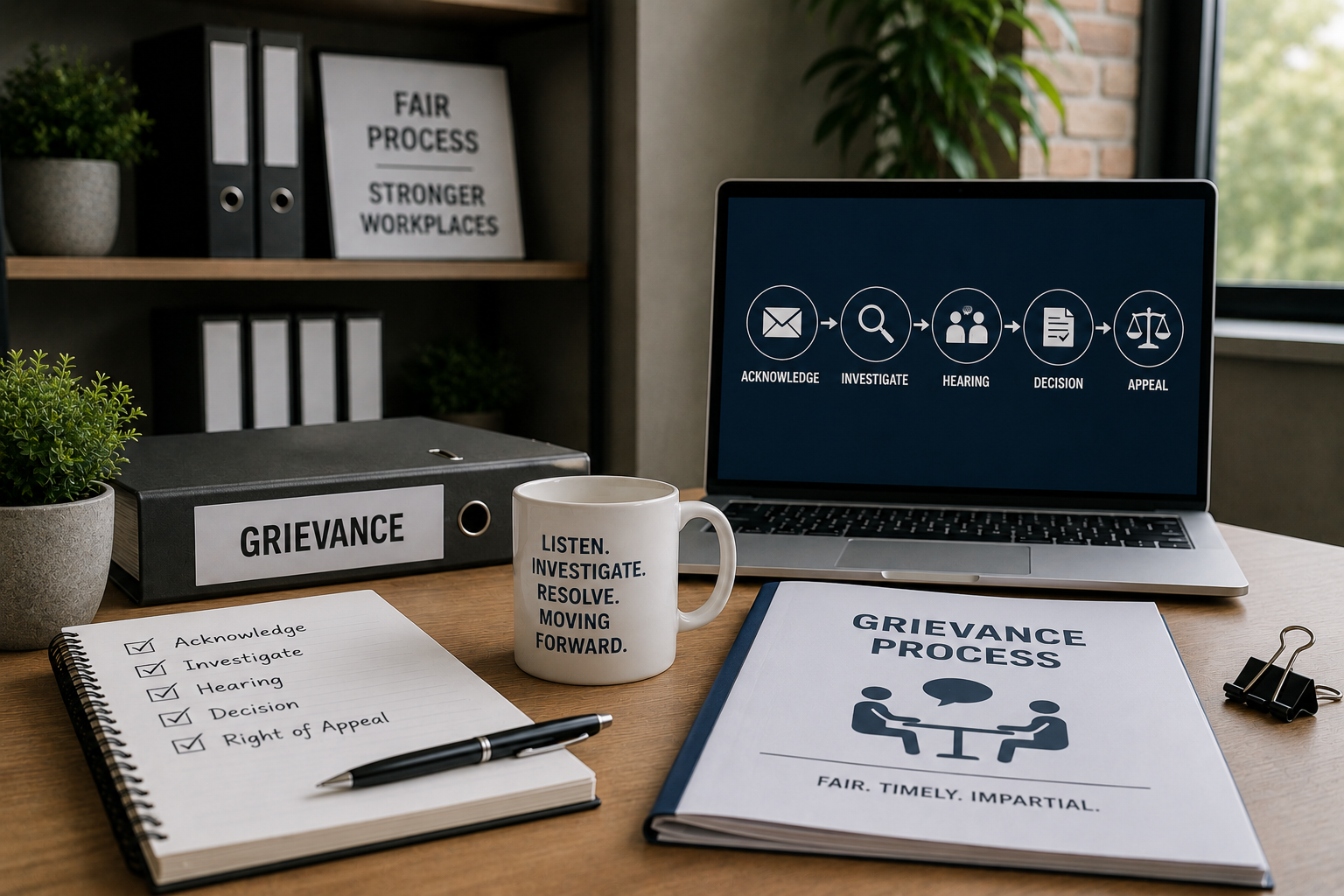
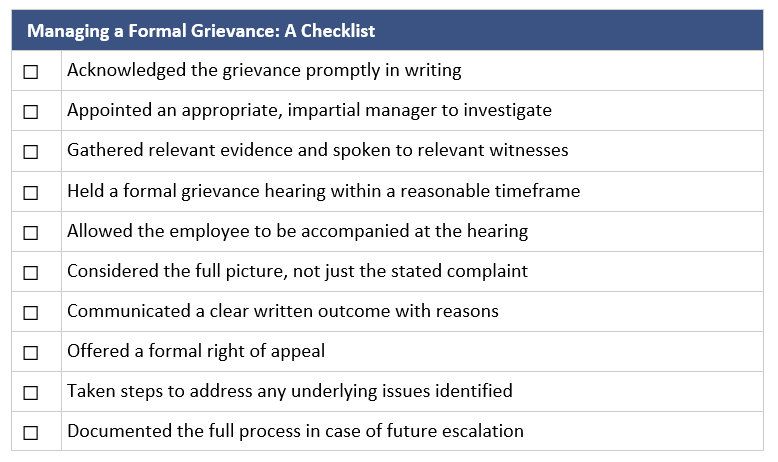
The ACAS Code of Practice on Disciplinary and Grievance Procedures applies to grievances just as it does to disciplinaries. The minimum standard an employer is expected to meet includes: acknowledging the grievance promptly, investigating the complaint properly, holding a formal grievance hearing, allowing the employee to be accompanied, communicating a clear decision with reasons, and offering a right of appeal.
Timescales matter too. Sitting on a grievance for several weeks without acknowledgement is not a neutral act. It signals to the employee that you are not taking it seriously, and it weakens your position significantly if the matter later escalates.

The Link Between Grievances & Disciplinaries
One pattern that catches employers off guard is the grievance raised mid-disciplinary. An employee who is the subject of a disciplinary process sometimes raises a grievance as a way of stalling or complicating the original issue.
The standard approach is to complete the disciplinary process and handle the grievance separately, unless the grievance is directly connected to the disciplinary matter in a way that makes separation impractical. Each situation is different, and how you handle the sequencing matters.
When Grievances Signal Bigger Team Issues
Sometimes a single grievance is the visible tip of a wider team problem. If the same themes keep coming up, or if you have had multiple complaints in a short period, that is worth taking seriously as an indicator of something systemic.
In the veterinary practice example above, the investigation that followed the formal grievance revealed that three other members of staff had similar concerns they had not put in writing. Addressing only the formal complaint while ignoring what the wider team was experiencing would have been a missed opportunity and a commercial risk.
Preventing Grievances Before They Happen
The most effective grievance management happens before a grievance is ever raised. Regular one-to-ones, clear and consistent communication, managers who deal with issues as they arise, and a culture where people feel heard all significantly reduce the likelihood of formal complaints.
That does not mean grievances can be eliminated entirely. But it does mean that when one does arise, it is more likely to be a genuine outlier than a symptom of a broken culture.
If you have received a formal grievance and are not sure how to handle it, or if you are concerned that a team situation is heading in that direction, the Employee Situation Check at Magenta HR Consulting is a good starting point.
Samantha Newton FCIPD provides specialist employee relations support for owner-managed businesses across Oxfordshire, Berkshire, Wiltshire and beyond.
Frequently Asked Questions
Q: Does every grievance have to go through a formal process?
A: Not always. Informal resolution is often faster and less damaging to the employment relationship. However, once an employee has raised a formal written grievance, the formal process should be followed.
Q: Can I ask a line manager to handle a grievance about themselves?
A: No. The investigating manager must be independent of the complaint. Using the subject of the grievance to investigate it is one of the most common procedural errors and will undermine any outcome.
Q: What if the grievance is about something that happened a long time ago?
A: Timing matters but does not automatically disqualify a complaint. The reason for the delay will be relevant context. Address it properly regardless of when the events occurred.
Q: Can I discipline an employee for raising a false grievance?
A: Proceed very carefully. Disciplining someone for raising a grievance, even a malicious one, carries significant legal risk. Take advice before taking any action in response to a grievance.
All images created using Ai
About the Author: Samantha Newton