
An Unfortunate Pricing Strategy
Derek liked Tom.
Tom was his neighbour. Tom watered Derek’s tomatoes when he went on holiday. Tom once spent forty-five minutes helping Derek retrieve a wheelie bin that had somehow become lodged in a hedge. Tom was, by all accounts, an excellent human being.
So, when Tom qualified as an osteopath and Derek developed a neck that made noises like a pirate ship, booking with Tom seemed the obvious choice. Then Derek looked at Tom’s prices.
£45.
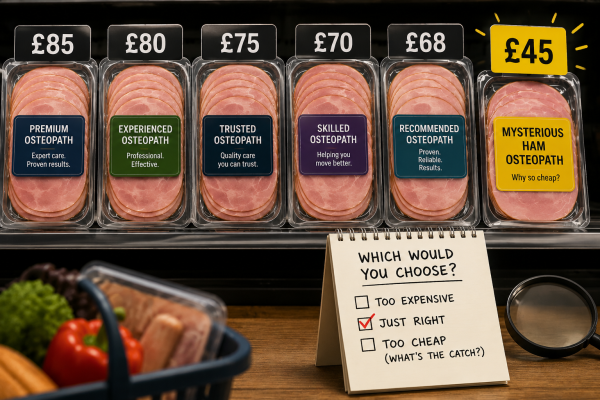
Derek frowned. That seemed… low. Not pleasantly low. Not “good value” low. More “there must be a reason” low. Being a man with both a neck problem and access to Google, Derek checked a few other osteopaths nearby: £85, £80, £75, £70, £68. And then there was Tom: £45.
Tom wasn’t slightly cheaper. Tom was so much cheaper that he looked less like an osteopath and more like a pricing error. Derek stared at the screen. He knew Tom was qualified. He knew Tom had trained for years. He knew Tom wasn’t secretly adjusting spines after watching three YouTube videos and a couple of TikToks. But his brain refused to cooperate.
Because brains are weird. They don’t always think: “Wow, what a bargain.” Sometimes they think: “Why is this ham 73% cheaper than the other ham?” Nobody wants the mysterious ham. The mysterious ham may be perfectly fine. The mysterious ham may be superior ham. But the discount itself becomes the story.
The same thing happened with Tom. The low price made Derek wonder whether Tom knew something everyone else didn’t. Or worse. Whether everyone else knew something Tom didn’t. So Derek did what thousands of clients do every day. He booked with the osteopath charging £75. Not the most expensive. Not the cheapest. About third from the top: the Goldilocks osteopath. Not greedily expensive. Not suspiciously cheap. Just right.
And that’s why practitioners should never let imposter syndrome decide what they charge. Imposter syndrome is essentially a drunk bloke at a wedding giving financial advice. It is confident. It is loud. And it has absolutely no idea what it’s talking about.
As a rule of thumb, look at the ten nearest practitioners within about three miles and rank them by price. For most practitioners, sitting around third from the top sends a useful message: well qualified, credible and competent.
Because clients aren’t just buying your treatment.
They’re buying the story they tell themselves about it. And nobody wants to feel like they’ve resorted to the mysterious ham of osteopathy.
Until next time,
Sarah
GROW Accredited Coach
Join the GROW Practitioner Support Space, built for self-employed therapists who know their stuff but were never taught how to get clients. Inside, you’ll find live Q&As, masterclasses, GROW e-learning, on-demand business coaching and more, to help you GROW a thriving practice.
All images created using AI
About the Author: Sarah Attwell