
We’re heading towards the end of the month of July and it’s the time of the year for a lot of people to slow down and maybe go on holiday. Which essentially translates as taking a break away from something. I am mentioning this because that’s exactly the direction I want to take with this article: leading a reflection towards what we need a break from or more specifically what we need to break from.
This idea itself, of taking a break, can seem trivial; it can even be colloquial in some ways, depending on the context. But we forget that the ability to voluntarily and consciously choose to distance ourselves from something or someone is a uniquely human capacity.
By virtue of our noetic dimension (a notion developed by Viktor Frankl), we aren’t subject to the necessity of the stimulus/response cycle. Unlike animals, we are able to suspend the “reflex response”[1]. From a logotherapy and existential analysis perspective, this is possible thanks to our faculty of self-detachment, which allows us to step back, as well as self-distancing, which in turn allows us to reflect without giving in to impulsive reactions – both of which are technically two attributes of the noesis.
It’s as if our noetic dimension (which makes us “specifically human”) provides us with a pause button which, when used, gives us a space, a distance that interrupts the “reflex response”. It operates like a buffering system that gives us an opportunity to choose our response versus to react impulsively in the moment.
You can appreciate that the ability to distance oneself is actually a complex and valuable competency and one that we must practice to be able to regulate and adjust our relationship to the world and to others[2]. It goes hand in hand with being aware. Hence, to pursue the metaphor: to press the pause button mentioned above, you first have to remember it’s there.
That’s where therapy is worth its weight in gold. A good therapist will help you to see and notice what would otherwise continue to be unconscious or denied. Your own understanding, discernment and accurate perception will sharpen which in turn will give you more freedom and responsibility towards your actions. All to say that it’s a good vehicle to support you with what or whom you need to practice distancing.
Why insist on the therapy angle? Because we all love to see ourselves as self-aware and self-attuned. But in reality, there are certain things about ourselves that need to be pointed out to us. If possible in a skillful, caring and constructive way – which is why even our well intended friends are not necessarily the best people for the job but our therapist is.
Circling back to holidays and taking a break. That usually involves swapping one dynamic for another, and the trade-off isn’t always a winning one. It might involve time with friends, time with family and distant relatives. In some cases, it’s something we look forward to; in others, it’s a complicated or even unhealthy relationship dynamic we dread. Optimistically, we hope things will be different this time and I am here to tell you that it’s unlikely.
The good news is that it takes two to tango and you can do something about your side of things. You may have heard of Stephen Karpman’s drama triangle (Persecutor/Rescuer/Victim) which highlights the roles we can play in conflict-ridden, difficult and manipulative relationships. Each dynamic is like a game which will solicit our “reflex response”. By distancing ourselves, we are walking away from the expected move. At which point, there is no tango to dance, because we’ve opted out, we’re no longer playing.
Sidenote: please be warned that this is not easy, however it can be hugely gratifying and do wonders for our self-esteem and it can also trigger the hell out of the other person.
We could say that each relationship interaction asks the question: what position am I invited to occupy? You have a choice in the answer. As explained, you can choose not to participate, or at least not right now and not in the same way you used to.
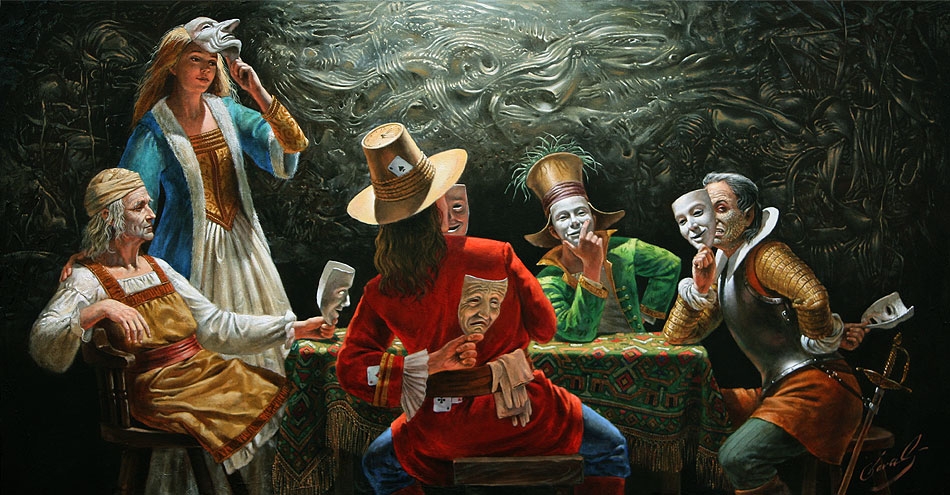
That’s because you can see through the game play where certain masks are worn by certain people (including yourself) in certain circumstances. A mask one can see is a mask one can remove. For this to happen, you now understand why you need to activate what we mentioned so far: the pause button and the awareness (in whichever order).
In reality at this point nothing has changed yet, only how you see it. This clarity is the beginning of the real transformation for you, based on how you’re going to engage from this point on and what you’re going to do. This is where your responsibility lies; you’re the driving force in your process. To your advantage, self-distancing leads the way towards detachment (in the sense of affective disinvestment), which allows your emotions to regulate more easily. You’re essentially getting a breather.
It’s not so much that you let go of something, it’s rather that you let something (someone) be, without engaging in ways you used to. They do they, you do you. To your benefit and in full consciousness, you’ve changed the rules of engagement without, in some cases, even saying anything.
In case you need reassuring, know that this doesn’t mean you no longer care or love. Strangely, it’s often the opposite, it’s because you do that you put in the effort. Not everyone will have the wisdom to see it this way, but you can.
Self-distancing, in many respects, is part of self-care and wellbeing. It’s conceptually simple and highly underused. The more you apply yourself to it, the less triggered you’ll be and less polarised too. As you see situational dynamics for what they are and the roles people play in them, you might even at times find it humorous, which in itself can be very therapeutic. Self-distancing, beyond being a skill, is a way of cultivating boundaries. It’s like installing a security perimeter or choosing not to swim where you know the current will take you into dangerous waters. Ultimately it promotes inner peace and serenity, something we can all do with a little bit more of.
On this note, I wish you a beautiful summer. Be kind to yourself and give yourself permission to take a step back or aside where required.
References
[1] Georges-Elia Sarfati – Manuel d’analyse existentielle et de logothérapie – 2e éd.
[2] Georges-Elia Sarfati – Manuel d’analyse existentielle et de logothérapie – 2e éd.
Main – Photo by Michael Cheval
About the Author: Mahé Léa