
I had started to watch the second season of the series Dark Matter when it came out and I found myself borrowing a line just like I did in the first one. As far as I am concerned, that’s about the only thing the two seasons have in common since I dropped out after just a few episodes, but not before catching this scene where one of the main characters asks the other for the safe word, which happens to be “patience”. For full disclosure, I am not the embodiment of patience and this is a running joke between me and myself and the people who know me well. So I suppose it makes me particularly suited to write about it since it doesn’t come easy to me, far from it.
Of course, no one wakes up one day feeling inspired to write about patience. At least, I would hope not. I’d say that circumstances contribute a great deal to the impulse, along with a good line from a poor series to really set you off.
So you’ve gathered correctly that I loathe being asked, subtly or not, by someone or not, to be patient. It almost feels like an insult or a punishment of some sort and I have to work extra hard to remind myself that there is a tiny possibility (usually a substantial one in fact) that this might be for my highest good and the wisest move, I just don’t know it yet and I probably won’t know why either.
So patience, in my case, is a process which I am learning to trust and which I thought I’d share with those of you who struggle with it too. Because though we live in a world where everything seems to move way too fast, we are constantly faced with having to be patient and unfortunately we can’t go around screaming and losing our sh** when life and others’ timing don’t agree with ours. Unless you’re Portuguese of course, but I digress. Add to that the obvious fact that therapists don’t have the luxury of being impatient or, even worse, of letting it show. But unsurprisingly, there are times when we boil inside and want to tell our clients: Come on now! Do something! Do the right thing! Thank God, we never say it out loud.
When patience is required, this usually means that things aren’t going our way and that we’re not in control. That’s a given. There is a tension between what we want and what we get, and when and how we get it. From there, we have two main choices really:
- We comply (I hate that word, I can’t believe I am writing this), we settle, we wait, we accept, we make peace with the situation.
- We push back or through, we don’t take “no”, “not available” or “not right now” for an answer, we look for another solution (if there is one).
Now here is the tricky point. It is totally impossible to say which one you should choose until you’re in the situation because everything will be contextual and different for every single one of us. By that, I also mean that you should not respond like a Buddha under your tree every single time, because being patient won’t always be the right answer. And we are rarely reminded that situational intelligence prevails over pseudo-principles.
Having said that, whether we opt for 1 or 2, we can do so graciously (for ourselves and others) or we can be a nuisance, splashing our frustration onto everyone, complaining and acting like victims. Pretty self-explanatory; yet how often do we observe ourselves and question our own behaviour in these moments?
That brings us to a notion that I would call inner timing. This argument is backed by nothing but experience, but I truly believe that when basic common sense and absolute emergencies aren’t what we are talking about, you benefit from feeling into and intuiting what’s being asked of you. For instance: “Is now the right moment for… (fill in the blank)?” Not according to the market, a specialist or an expert, not according to your mum, even less, dare I say, your therapist (though sometimes we are right). But according to your gut feeling, your inner compass, or whatever you want to call it. That thing inside you that says yes or no, and when you don’t listen to it, everything goes south.
It can be difficult and feel elusive. For me it’s a push/pull sensation. It’s a “do I go or not”, “do I enter the ring or not” (mostly metaphorically). It’s like tapping into a part of ourselves most people aren’t accustomed to using. But I trust that we have a sense of timing, we’re just not used to using it.
Hence, questioning rather than reacting forces us to slow down, distance ourselves from events, maybe widen the picture and dig deeper inside ourselves and our perceptions, beyond what’s labelled as logical. In this lapse of time, which imposes a delay, something important to know might come up which we would have otherwise missed. Nowadays we tend to rush into and out of everything. But there is always a risk in going too quickly. We want everything straight away but struggle to admit this doesn’t necessarily serve us. In fact, if we think about it for a second, much of what we value most in life has taken, or still takes, time and patience. As much as we’d like to be in charge of the timeline, we can only accept that we aren’t.
For the sake of argument, let’s assume that you’re in a scenario that is totally beyond your control and you have to wait and be patient, e.g. your flight is rerouted to a different airport and you don’t land at your original destination, where you were supposed to attend something critically important and time-sensitive (true story by the way). Now what? It’s like an unwanted space has been created and it’s up to you (to an extent and all based on circumstances of course) what you’re going to fill it with. In other words: what are you going to do while you wait? That isn’t a small question. And if you’ve followed me so far, you know that there isn’t a specific answer either. You’ll have to go find it and make your way through it. It’s both an inner and outer job. Try not to skim past it.
What may be harder to grasp, or counter-intuitive for some, is that you can wait and at the same time retain or find meaning in this period rather than losing it or never finding any (which would make the overall experience feel a lot worse). So though it can feel like your freedom has been hijacked and what’s happening is unfair, what I am trying to say is that you can still exercise your free will within this situation and take responsibility for yourself (which goes hand in hand with your freedom – the two are interrelated).
I don’t think this will sound so wonderful to read but if we apply ourselves to this, we’ll be less miserable for it. An opportunity, something different or even better than what we had foreseen, might arise. Maybe not. Maybe much later. But at least we haven’t closed the door on ourselves, locked it and thrown the key away, so to speak. Like an ally, patience can simply be a value we cultivate, call upon and use to help us get through when we need to. It’s not straightforward for some but it can undoubtedly have its purpose. Sometimes I feel like patience is holding the hand of resilience, like two best friends; yet we can be better at one than the other.
A few years ago, I came across The Virtues Project™, which, in its research over the past thirty years, has identified over six hundred virtues common to cultures and faith communities around the world. One of them of course is “patience”. I have a deck of cards and this is what it says about patience:
Patience is quiet hope and faith that things will turn out right. We trust the process of life. We are not hasty. We do not rush or allow ourselves to be overcome by pressure. Patience helps us to endure things we cannot control with a peaceful heart. We respond to mistakes or delays not with judgment but gentleness. We recognise the lessons that come through waiting, and receive them as gifts unfolding with Divine timing. Patience brings acceptance. It calls us to be still in the moment, to be restful and to listen deeply. Patience soothes our souls.
The practice of patience:
- I am hopeful and expectant.
- I do not rush.
- I am gentle with myself and others when we make mistakes.
- I accept things I cannot control with humour and grace.
- I am confident that my life is unfolding as it should.
- I live fully in the present moment.
I am thankful for the gift of patience. It helps me to keep my peace.
I felt like sharing this quote from the card (which is lovely and also not quite my style overall) to bring some balance to the overall argument and conversation, in which I hope you’ll find something to reflect on, and to guide you the next time life commands “patience” as the safe word of the moment.
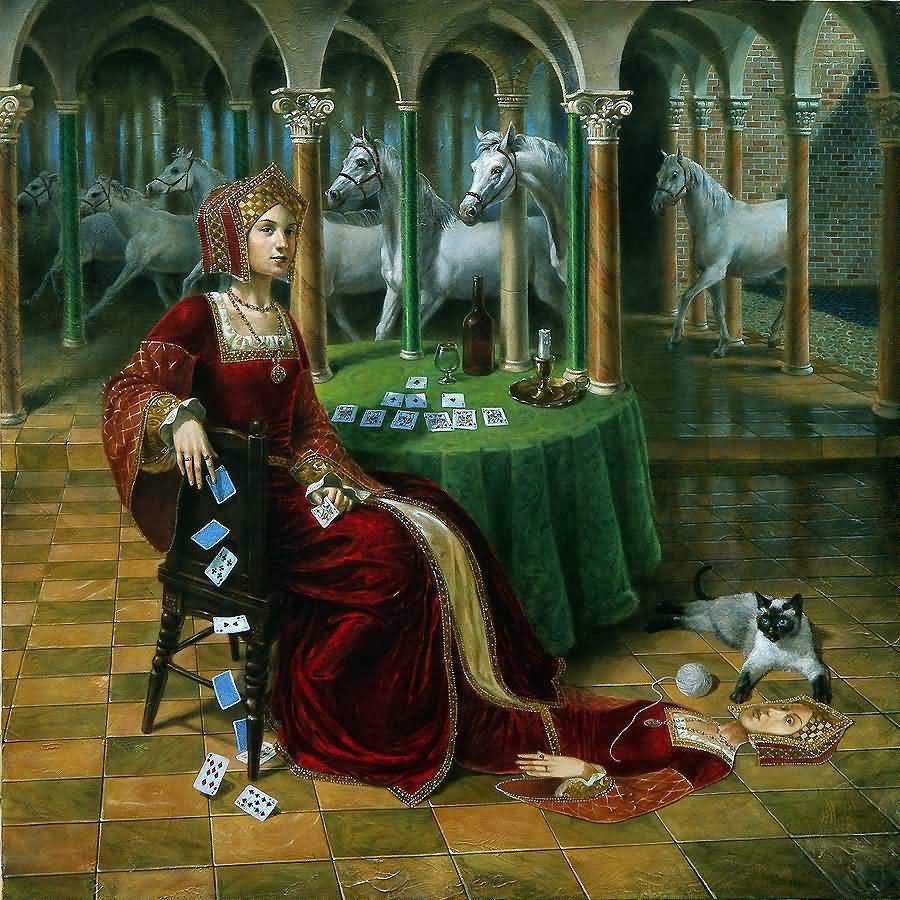
Main – Image by Michael Cheval
About the Author: Mahé Léa