
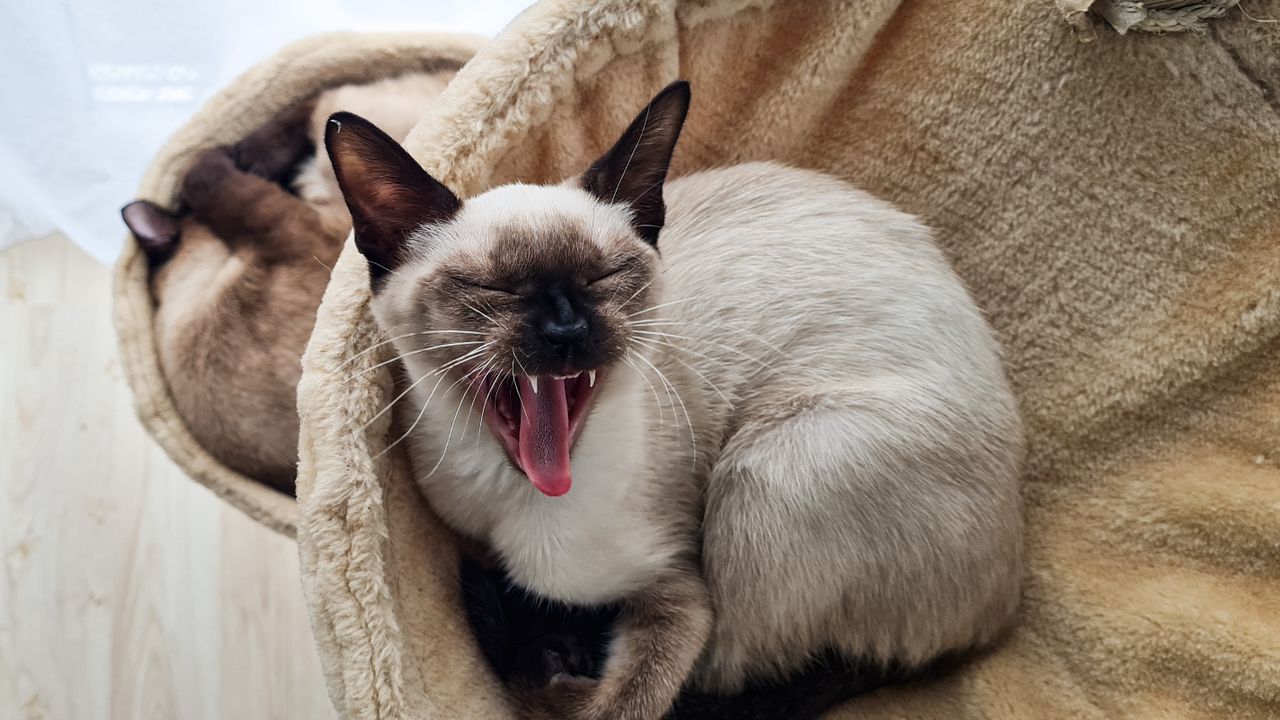
Your cat is talking to you constantly. Here is how to understand what is being said.
Would you like to understand your cat better than you do right now?
Would you like to know, early, when something is wrong, instead of finding out weeks later at the vet?
Would you like to be the person who can look across a room and read a cat the way other people read a text message?
You can. By the end of this, you will be able to tell a relaxed cat from a cat who is quietly bracing, you will know why your cat hides and what to do about it, and you will know the one sign that means you get in the car tonight.
Here is the good news first. Your cat is talking to you constantly. All day, every day. The conversation is already happening.
Now the part that stings.
Earlier this year, researchers in Italy showed 12 short video clips of cats to 1,950 people and asked one question: is this cat relaxed, tense, or frightened?
With 3 choices, guessing alone gets you a third of them right. People scored 54%.
The direction of the errors is what matters. When people got it wrong, they almost always got it wrong the same way. Tense cats were called relaxed 39% of the time. Frightened cats were called relaxed 22% of the time.
A stressed cat is routinely seen as a cat who is perfectly fine.
I have spent more than 30 years around animals, most of it in rescue, along with years in veterinary practice with both small and large animals. I have watched kind, attentive owners stand beside a cat who was telling them something, and miss it completely. Nobody was careless. The cat was simply speaking a language nobody taught them.
So let me teach you some of it.
Why cats are so hard to read
Start with why cats are so hard to read, because it explains everything that follows.
Dogs come from animals that lived in groups, where communication kept the group working. Cats, with the rare exception of lions, are solitary. For an animal that hunts alone and sleeps alone, showing weakness is how you become something else’s dinner. A limping cat is a cat that gets picked.
That program did not switch off when cats moved in with us. People have been living with cats for at least 9,500 years, and almost nothing about the cat changed. Your cat is still running the same software on your sofa. Hiding discomfort is not deception. It is instinct, and instinct does not check whether anything in the room is actually hunting.
Cats also refuse to put the whole message in one place. A cat speaks with its posture, its ears, its eyes, its tail, and its breathing, all at once. Read one part on its own and you will frequently get the opposite of what is being said.
The loaf & the fear crouch
Here is the clearest example I know, and the first thing I promised you.
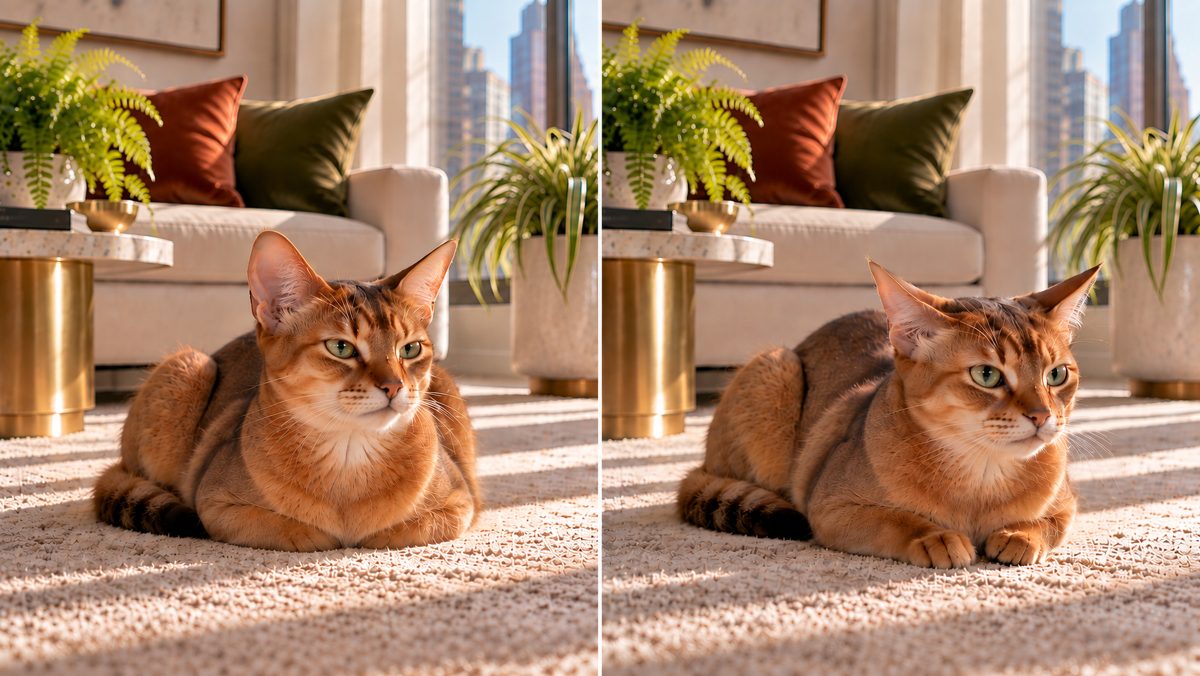
A loaf is soft. A fear crouch is braced.
You already know the loaf. Paws tucked underneath, body settled on the floor like a loaf of bread. The eyes are half closed or softly open. The ears sit in a natural, neutral position. The body itself looks soft, almost spread out at the edges. That cat is resting, and it is in no hurry to be anywhere else.
Now picture a cat who feels unsafe and cannot leave the room. That cat also makes itself small and low to the ground. From across the room, the outline is almost identical.
Everything that tells them apart is in the tension.
A frightened cat holds its weight over its feet instead of tucking them away, because tucked paws cannot run. The body is held tight and pressed low rather than settled. The tail wraps hard along the body instead of curling loosely around it. The ears rotate backward or flatten. The eyes stay wide and open, and they keep tracking whatever worries them.
A loaf is soft. A fear crouch is braced.
Once you can see it, you cannot unsee it, and you will spot it in other people’s cats for the rest of your life.
“She was so good. She didn’t make a sound”
This brings me to the misreading I see most often, and the one that causes real harm.
Behaviour researchers describe cats as having different coping styles. Some cats meet stress actively. They move, they struggle, they yell, they lash out. Nobody has trouble reading those cats.
Other cats shut down. They freeze. They go completely still. Stressed cats have even been observed pretending to sleep.
You have heard the result of this at a vet clinic. “She was so good. She didn’t make a sound”. That cat was not being good. That cat was frozen on a steel table, doing the only thing available to it.
A still cat looks like a calm cat, which is usually the moment somebody reaches for it.
Ease and stillness are not the same thing. A relaxed cat is loose, with soft eyes and ears in a neutral position. A frozen cat is held tight, eyes open, watching everything, breathing fast.
What I learned from a dog
Which brings me to hiding, and the thing I most want you to take from this.
I learned it from a dog.

Dazzle, in the light.
Last year I brought home a rescue, the smallest dog in the place. Her name at the shelter was Bitty. She was born under a house and lived there for the first 6 months of her life, then spent about a year in a travel crate inside a caravan. She had already been adopted once and returned in less than 18 hours, because she was too frightened for anybody to touch her. That is exactly why I chose her. Even through all of that fear, I could still see her light, so I renamed her Dazzle.
Everything in me wanted to pick her up and tell her she was safe now. That would have been for me, not for her.
Instead I made her a quiet place she could go whenever she felt overwhelmed, and then I did the hardest thing, which was nothing at all. I let her decide. In the beginning she would let me pet her for about 20 seconds, then quietly trot back to her own corner.
Then one night she got up on the bed. A while later she was sleeping closer. These days she falls asleep while I am petting her and stays exactly where she is, and I still find that remarkable every time it happens.
None of that came from me reaching for her. All of it came from giving her somewhere safe and letting her come out on her own schedule.
Cats are no different, and there is research to prove it.
At a Dutch animal shelter, researchers gave newly arrived cats a simple hiding box and compared them with cats who had none. The cats with a box settled to a low, steady stress level by their second day. The cats without one took until day 9.
One box. Seven days.
So when your cat disappears under the bed after a move, a houseguest, or a trip to the vet, the kindest thing you can do is leave it there. A cat who is hiding and watching you is a cat gathering evidence that the world is safe again. Reaching under the bed to comfort it takes away the only strategy it has.
The same goes for height. A cat on top of the wardrobe surveying the room is not in distress. A cat who feels in control feels safe, and a cat who feels safe can relax.
Most of what worries you is normal
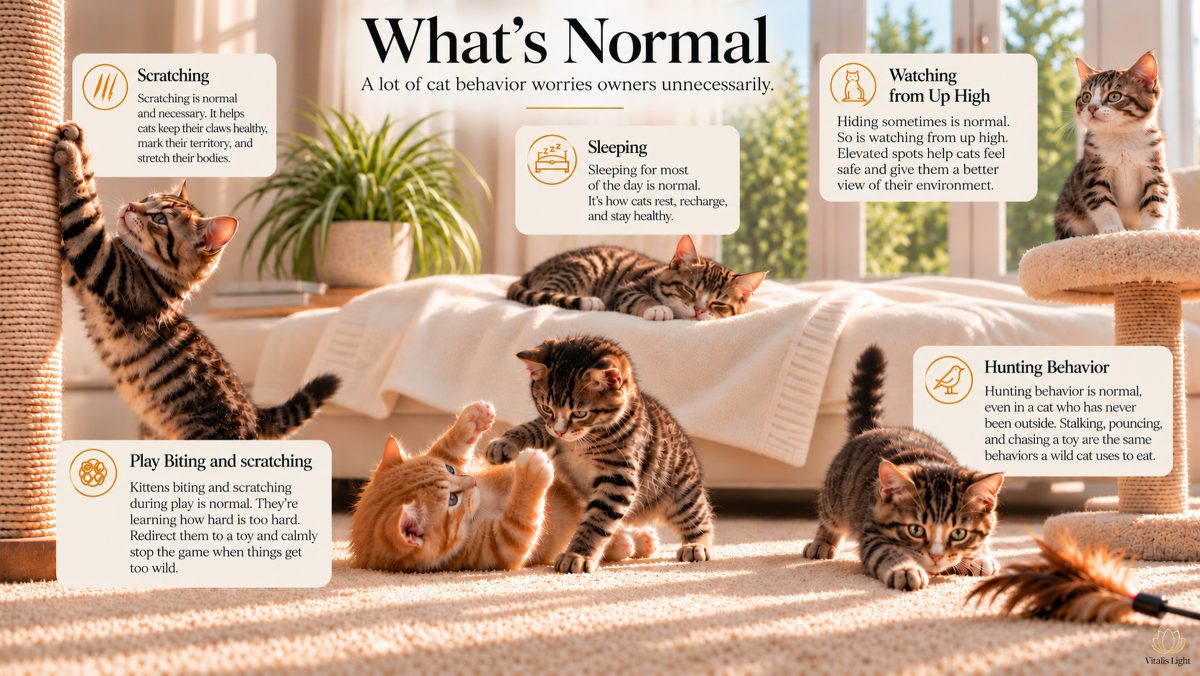
A lot of cat behaviour worries guardians unnecessarily.
Now let me take some weight off your shoulders, because none of this means watching your cat for problems all day.
Most of what worries cat owners is completely normal, and nearly all of it traces back to hunting.
Scratching is not vandalism. It pulls the worn outer sheaths off the claws to keep them sharp, it leaves both a visible mark and a scent signature from glands in the paws, and it gives a cat a full-body stretch from shoulder to spine. A cat who stops scratching is a worry. A cat who scratches is a cat doing its job.
Sleeping most of the day is not laziness or depression. Hunting is expensive. Stalking takes patience, the pounce takes an enormous burst of energy, and most attempts fail. A predator that spends itself that way has to rest between efforts, which is where all that sleeping comes from. Your cat still runs the same energy budget whether dinner arrives in a bowl or not.
Kittens biting and scratching during play is normal too. They are learning how hard is too hard, which is a lesson they would otherwise learn from their littermates. Redirect them onto a toy and calmly end the game when it gets too wild.
Let the hunt finish
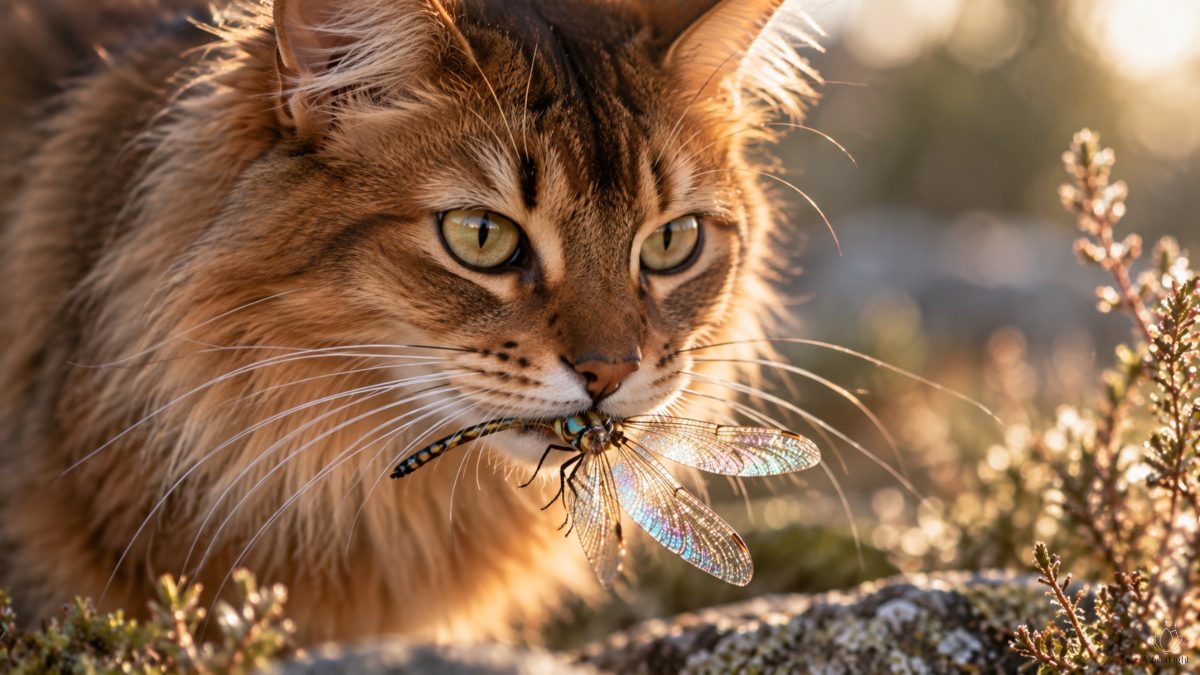
The best games end with a catch.
Which brings me to the single best thing you can do for an indoor cat.
Watch a cat with a toy and you will see a hunt, in order and complete. The stare. The crouch. The wiggle of the back feet to set the launch. The pounce. The grab. The bite. Then the toy gets kicked with the back legs, which is what a cat does to an animal that might fight back.
Cats need to run that sequence. A cat who never gets to is a frustrated animal, and frustration comes out as biting ankles, tearing the couch, or waking you at 4 in the morning.
Toys that work are small, quick, and roughly mouse-sized or bird-sized, and they move away from the cat rather than toward it. Prey flees. Wand toys beat anything you throw, since you can make them behave like something alive.
Laser pointers are the one to be careful with. A cat can chase a dot forever and never catch it, and a hunt that never ends in a catch leaves a cat wound up rather than satisfied. If you use one, finish the game by landing the dot on a real toy or a treat, so the hunt has an ending.
The best games end with a catch, and ideally a meal. Hunt, catch, eat, groom, sleep. That is the natural order of a cat’s day, and following it is one of the simplest ways to settle a restless cat.
Change is the signal
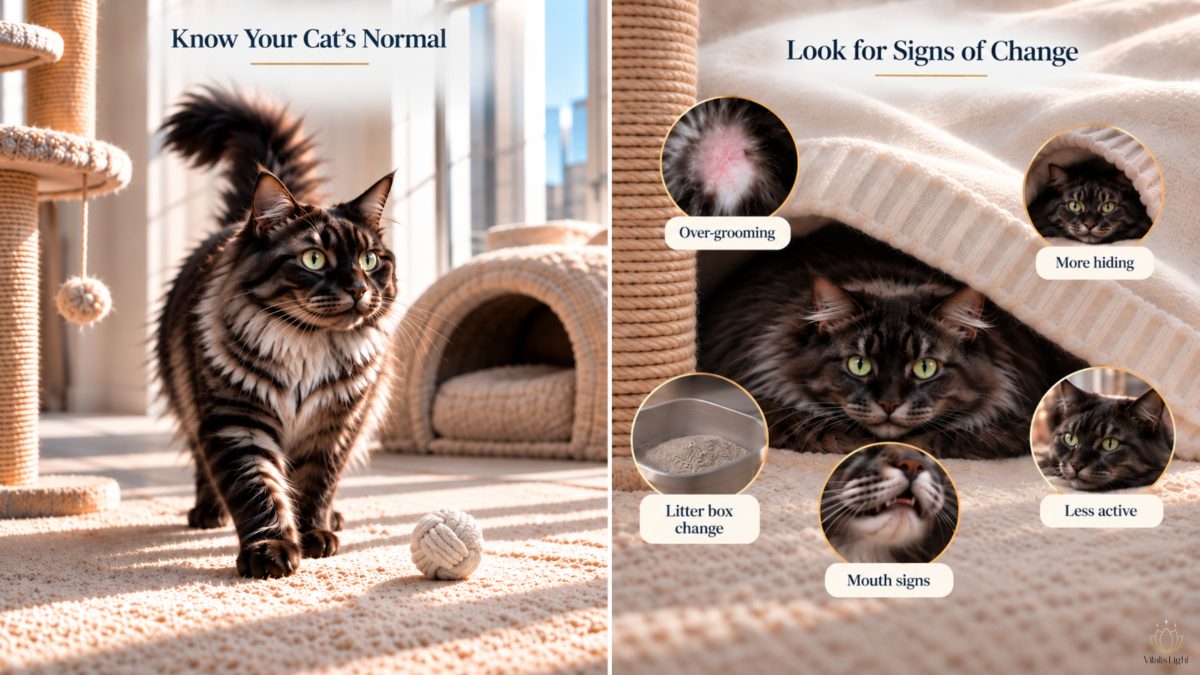
Know your cat’s normal, then watch for change.
What matters is not any single behaviour. What matters is change.
A cat who always met you at the door and now does not. A cat who stops grooming, or grooms one patch bald. A cat who stops using a litter box it has used happily for years. A cat who hides when hiding was never its thing.
Change is the signal, and change goes to a veterinarian first, every single time. A cat urinating outside the box may have a urinary infection, bladder stones, or kidney disease. A cat who suddenly swats may be in pain somewhere you cannot see. A cat who stops grooming may have a sore mouth or stiff joints.
Behaviour is frequently the only language a cat has for a physical problem.
ONE SIGN NEVER WAITS
A cat straining in the litter box and producing little or no urine has a urinary blockage until proven otherwise. It happens most often in male cats, whose urethra is narrower and blocks more easily.
Watch for a cat going in and out of the box repeatedly, squatting and straining with nothing to show for it, crying out while trying to go, or licking at itself persistently. There may be a few drops of urine, sometimes with blood, or nothing at all. Many cats then start vomiting, hide, go off their food, and become lethargic. A blocked cat’s belly is painful to touch.
This is a true emergency. Without treatment, a blocked cat can die within 24 to 48 hours. If you see these signs, go to a veterinarian or an emergency animal hospital immediately, at any hour.
The most encouraging thing in the Italian study
I want to leave you with the most encouraging thing in that Italian study.
The people who scored highest were the ones who had lived with cats. Experience made a measurable difference.
This is a skill, and skills improve. Your own cat has been running the class for years.
Watch her on an ordinary afternoon when nothing is happening. Where she sleeps. How she holds her ears when she is content. What her face does when she is completely at ease. That is your baseline, and everything else gets read against it.
Your cat is talking to you constantly. Almost none of it is loud.
Photo by Ny Zoltán
About the Author: Carrie K Kelley