Welcome, to Health & Wellbeing Magazine's Spirit Keeper monthly column. This is the place where you will discover tips and practices for creating, developing and maintaining a personalised self-care practice as a Spirit Keeper. If you are new to this month's Spirit Keeper column, I recommend reading past articles to find out what a spirit keeper is and subjects already covered around self-care practices.
Since July 2025 I have been expanding upon different exercises (rituals) which are spirit centred, mind centred and body centred. Each month comes with a monthly challenge. The idea is to prove to yourself and your own clients' the power of specific exercises (rituals) in integrating mind, body and spirit. After all, in order for there to be change within the world, we need to be the ones who are embodying it and grounding it.
This is what you can look forward to in the months' ahead.
- Body centred practice – massage and detoxification
- Body centred practice – dancing and spiritual connection
- Body centred practice – body and nutrition
In this month's column we will be focusing on the focusing on the body centred practice of movement and spiritual connection.

Metaphorical Story Demonstrating the Power of Movement to create Spiritual Connection
In the Kingdom of Stone, the people believed holiness and spiritual connection was found only by sitting in stillness. They sat in rigid rows, spines locked like frozen pillars, trying to think their way toward the divine. They called this "The Great Quiet," but in the silence, a different noise grew, the chatter of the Ego.
The Ego was a librarian who lived in their minds, constantly filing away worries, cataloguing judgements, and whispering, "Am I doing this right? Am I holier than the person next to me?" The more the people tried to be still, the louder their inner librarian talked and eventually shouted.
The Awakening of the River
Yasmina, a weary student of the Stone Kingdom, found herself one day by a mountain stream. She watched how the water never struggled to be "holy" it simply moved and did what it did. The stream didn't think about the rocks in its path, it simply flowed around them. She stood up and, for the first time, stretched towards the sky and started to move her arms letting her arms drift like the current. She began to sway, not to a song, but to the rhythm of her own breath.
Bypassing the Librarian
As Yasmina moved, something miraculous happened. Back in her mind, the librarian (the Ego) became flustered. The mind-librarian couldn't file "a swirl of the hips" or "a reach toward the sky." The movement was too fluid for its rigid Dewey Decimal System. By engaging her body, Yasmina had bypassed her ego entirely. She wasn't thinking about being present; she was presence and present.
The Flow of Boundless Energy
Yasmina closed her eyes and felt the flow of energy, a golden thread which started in the soles of her feet and wound its way up her spine. In the old ways of stillness, she felt like a stagnant pond. Now, as she moved and flowed with natural rhythm and grace, she felt like a conduit.
The mental chatter of her mind faded into the background, replaced by the humming vibration of her own muscles and the rush of air against her skin. The sounds of the gurgling mountain stream, the calls of birds and other wild creatures, created a symphony of movement which stirred her Soul deeply. She felt connected to the divine, she felt peaceful and as though she was guided by an unseen hand.
The movement acted as a pump, clearing the silt of old anxieties and letting a fresh, vital force circulate through her mind, body and spirit. This was embodied presence: the realisation her spirit wasn't a ghost trapped in a machine, but that the machine itself was a sacred temple in motion.
The Dance of the Many
Yasmina returned to the town square and began to move during the time of contemplation and meditation. One by one, others joined her. They didn't follow a choreographed routine; they simply let their bodies to move with the breath and with the sounds of nature. The people allowed their bodies to speak.
As they moved together as a group, a shift occurred. The invisible walls between them – the "I" and the "You" – began to dissolve. There was no longer a group of separate people; there was a feeling of being part of a collective unity. They became a forest of bodies swaying in the same wind, a single organism breathing in unison. In the synchronised rise and fall of their chests, they found a connection to their community and to the divine which words have never been able to bridge.

Seeking Wisdom from the Sage
Yasmina was keen to learn more about the history of movement and divine connection as well as a ritual which could be shared with her community. She went to visit Dhrona, the sage, at the mountain top.
Yasmina approached Dhrona and asked if she could stand next to him. Dhrona, the Sage motioned for her to join him on the stone. Near them stood an old, rusted iron lantern. As they stood companionably watching the vista and life unfolding down the mountain side and into the valley, a deer joined them in watching the sun rise and bring a new day. The three of them observing the colours, the sounds, the movement of life as it went about its daily existence.
"I and my community have recently found the benefit of movement in contemplation and meditation as a tool to feel connected to each other and the divine, " Yasmina said. "Dhrona, I was wondering what the history is of movement in spiritual practice and whether or not there is a specific ritual I and my community could use alongside still meditation techniques."
Dhrona smiled at Yasmina. "Movement has been used by all traditions in different ways to create a sense of community and connection with the divine. There are walking meditations, ritual dances, yoga, tai chi and liturgical gestures. And it is good you are seeking to use other types of techniques for spiritual connection because the physical body was designed for movement, not just stillness. Each has a place in the journey towards integrating the mind, body and spirit."
As they both sat there in comfortable companionship watching the scene of life unfold in the valley below, Yasmina thought about how she hadn't moved much in her life. So much of modern-day living was tied up sitting still for spiritual practice or sitting at a desk during the day for long hours.
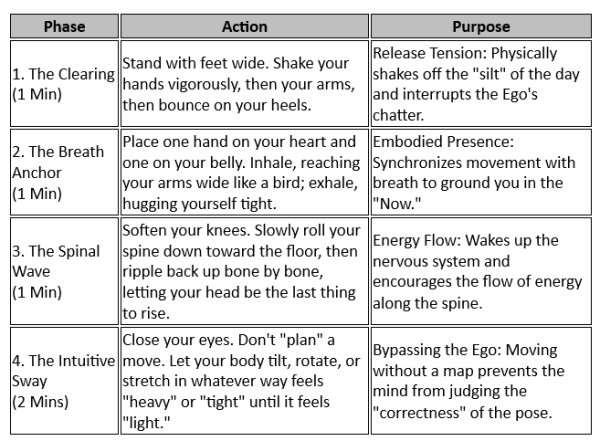
Dhrona continued speaking, "Spirit is not a destination we sit and wait for; it is a current we choose to swim in. This sequence is designed to help you "bypass the mind-librarian" and shift from your head into your body. You don't need a yoga mat or special clothes, a few feet of space and 5 minutes. This exercise is known as the 'river of flow' sequence. Dhrona explained the sequence as follows:
Tips for Success
Dhrona said, "Yasmina regular practice is what creates true success. Little and often compounds into greater things. However, I also recommend the following tips when it comes to the river of flow sequence."
- Eyes Closed or Softened: This pulls your awareness inward, away from how you "look" and toward how you "feel."
- The "No-Form" Rule: If a movement starts to feel like a "workout," change it. Keep it fluid, circular, and effortless.
- Listen to the Humming: Notice the slight tingling in your fingertips or the warmth in your chest as you finish—that is your energy circulating.
Dhrona requested Yasmina practice several rounds of the sequence with him so she could return to her people and show them how it is done. After four rounds of practice, Yasmina thanked Dhrona for his help and began walking down the mountain side back to the village of her people.
The Lesson of the Stone Kingdom
The people realized that while stillness has its place, movement is the language of the soul in flight. They learned that to find the Divine, they didn't have to lock themselves in a cage of quiet; they could simply dance until the cage disappeared. They also learnt that the best way to connect with the divine and each other was a balance between stillness and movement. Each are important as a practice for integrating mind, body and spirit.
Movement Throughout Religious History
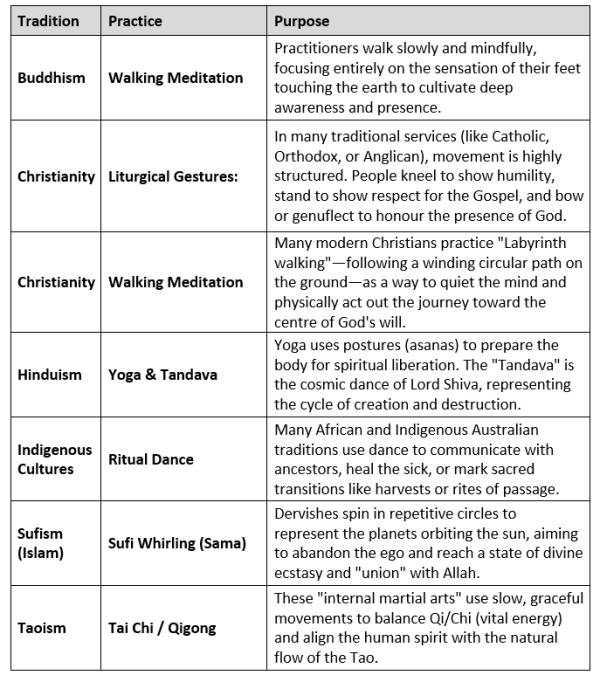
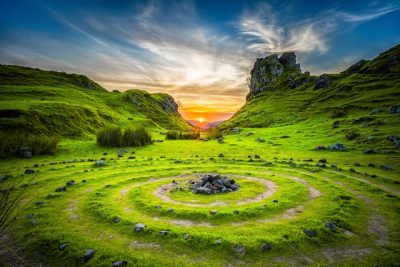
Photo by Robert Lukeman on Unsplash
When we talk about breath being a "bridge," it's not just a poetic metaphor—it's a physical and linguistic reality found across almost every spiritual tradition.
The Linguistic Bridge: Breath = Spirit
In many ancient languages, the word for "breath" and the word for "spirit" or "life force" are exactly the same. When people moved with their breath, they felt they were moving with the very essence of the divine:
- Chinese: Qi (Vital energy / Breath)
- Greek: Pneuma (Spirit / Breath)
- Hebrew: Ruach (Wind / Spirit / Breath)
- Latin: Spiritus (Spirit / Breath)
- Sanskrit: Prana (Life force / Breath)
The Biological Bridge: Taking the Wheel
Breath is unique because it is the only bodily function that is both automatic (happening while you sleep) and voluntary (you can choose to hold it or slow it down).
- The Calm: Slowing the rhythm and pace of your breathing signals the brain to move from "survival mode" (stress) to "rest and digest" (peace). This biological shift creates the "quiet space" needed for spiritual meditation and reflection.
- The Switch: By consciously changing the rhythm and pace of your breathing while you move, you are literally taking control of your nervous system.
The Rhythmic Bridge: Presence through Pulse
Co-ordinating movement with breath (like inhaling as you reach up and exhaling as you fold forward) creates a steady rhythm. Repetitive movement with a specific rhythm is known to be hypnotic.
- The Anchor: This rhythm acts as an anchor for the mind. It is very difficult for the brain to worry about the future or regret the past when it is strictly focused on matching a physical movement to a specific inhale and exhale (e.g. yoga postures or tai chi or qi gong or trance dance).
- The Flow: The synchronisation of breath and movement is what often triggers the "flow state"; where the boundary between "you" and the "movement" starts to blur.
How Movement Releases Stored Emotions
When we don't fully process a stressful or emotional event, our muscles can stay in a state of "bracing" or tension. Over time, this becomes a "holding pattern." Movement acts as a physical key to unlock these patterns:
- Breaking the "Brace": If you've been "holding your heart" tight due to grief, gentle chest-opening movements can physically signal to your nervous system that it is safe to let go of that protective tension.
- The Power of Shaking: Have you ever noticed an animal shake its whole body after a scare? Humans have a similar "tremoring" mechanism. Shaking or jumping can help discharge the literal physical energy (like adrenaline) that gets stuck when we feel a "fight or flight" response.
- Somatic Release: As you move into a part of the body which has been "numb" or "locked," it is common for the stored emotion to surface as a sudden sigh, a tear, a yawn or a sense of deep relief.
Mental & Emotional Benefits of Movement
- Cognitive Quiet: By focusing on the "felt sense" of a movement, you give your analytical mind a break. This can reduce rumination, the habit of looping over the same stressful thoughts.
- Emotional Release: Many people hold emotional trauma or "unspoken" feelings in their muscles (like tight hips or shoulders). Spiritual movement provides a safe container to let these emotions surface and move through the body.
- Sense of Awe and Flow: Reaching a "flow state" through movement can trigger feelings of deep connection or "awe," which are scientifically linked to increased life satisfaction and lower levels of inflammation.
- Stress Transmutation: Intense or rhythmic movement can help "shake off" stagnant energy or the physical tension caused by stress, moving you from a state of "fight or flight" into a more grounded presence.
Moving your body can be a powerful way to quieten the "thinking" mind and open a door to the spiritual experience. By focusing on breath and rhythm, movement often becomes a "moving meditation" which allows for a direct experience (physically and emotionally) of something larger than yourself.
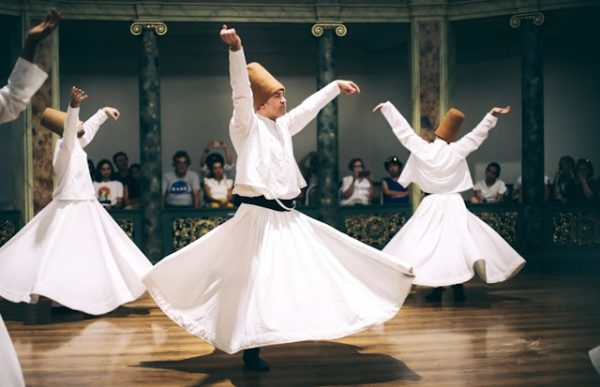
Benefits of Movement as a Spiritual Practice
- Bypassing the Ego: Repetitive or fluid movement can help quieten your "inner critic" voice and allowing you to move past intellectual barriers and connect with your intuition or the divine.
- Collective Unity: Moving in rhythm with others (like in a circle dance) can create a sense of "collective effervescence," where the boundaries of the individual sense of self seem to dissolve into a group connection.
- Embodied Presence: While static meditation focuses on the mind, movement with meditation grounds you in the present moment through physical sensation, making spirituality a tangible, direct lived experience.
- Energy Flow: Many traditions believe movement clears "blockages" in the body and energy body, harmonising your physical self with your spiritual essence.
Summary & Conclusion
When movement is used as a spiritual practice, it shifts from being a physical chore to a way of processing emotions and quietening the mind. The body and mind are deeply interconnected. Physical rhythms can directly influence and enhance your internal state and can be combined with chanting and drumming.
Monthly Challenge
If you are an active practising healing practitioner, I would recommend having a specific time where you spend 5 to 15 minutes centering and grounding yourself through movement. The benefits are huge as it brings you into the present moment and fills you with the grace of presence.
Next month …
In next month's column we will be focusing on the body centred practices of massage and detoxification. Both of which are a powerful tool in the Spirit Keeper's toolbox as well as being one of the keys to unlocking the wisdom of the body and strengthening the energetic body.
Until next month. From one kindred spirit to another – be safe, be well, be authentically you.
In gratitude
Kathleen
About the Author: Kathleen Ginn