
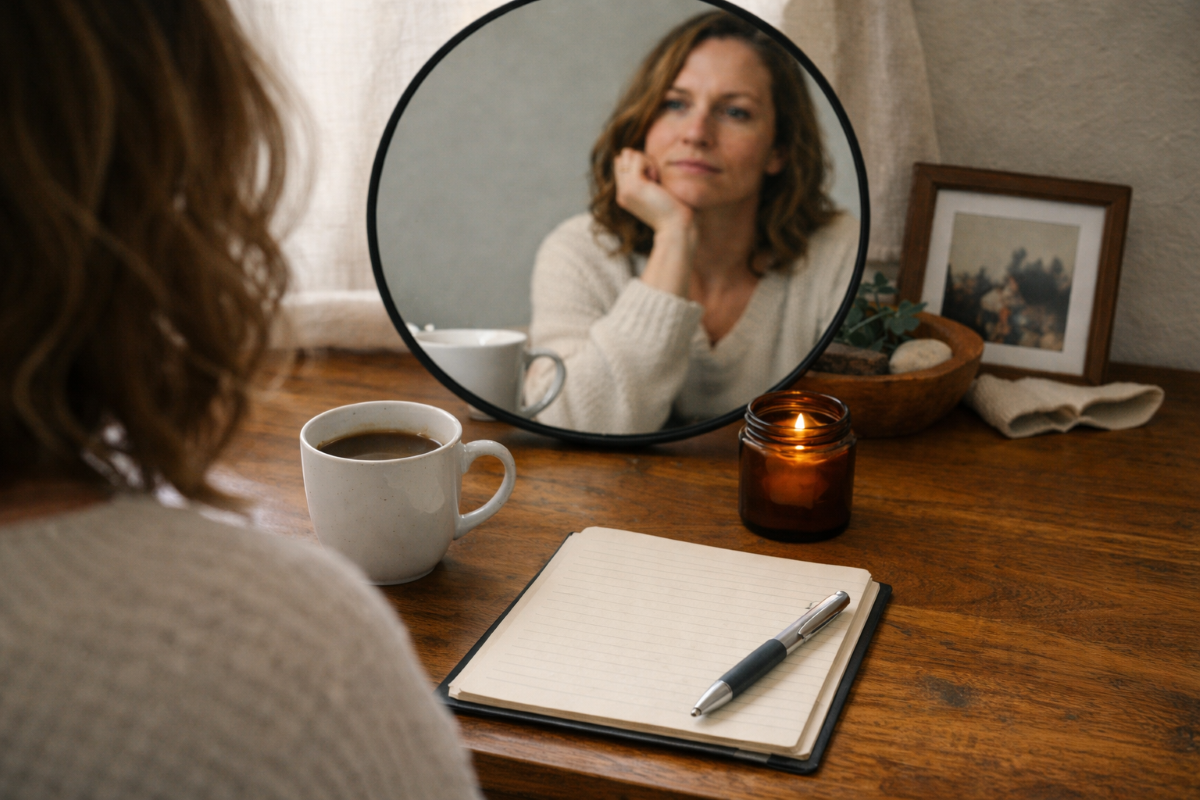
Why the way you speak to yourself shapes your self-worth, your relationships & your emotional wellbeing.
When we talk about confidence, we often think about things outside of us:
Success.
Achievements.
Recognition.
How other people see them.
Yet one of the most powerful influences on confidence is much quieter.
It's the relationship you have with yourself.
The way you speak to yourself when something goes wrong.
The pressure you place on yourself when you feel you should be doing better.
The expectations you carry without even realising it.
The tone of your inner voice when you make a mistake.
For many women, confidence is not only shaped by what happens around them. It's deeply shaped by the way they relate to themselves.
This relationship quietly shapes much more than confidence alone:
It shapes how you work.
How you rest.
How you love.
How you make decisions.
How much you carry.
How much you allow yourself to receive.
Many women are deeply caring with other people but very hard on themselves. Over time this weakens self-confidence and creates emotional exhaustion.
They show patience to others and pressure to themselves.
They offer understanding to others and criticism to themselves.
They notice everyone else's needs and overlook their own until their body begins to speak more loudly.
That's often where confidence begins to erode.
Not because she's not capable.
Not because something is wrong with her.
Because she has spent years living in a relationship with herself that is built on pressure, performance and self-correction.
1. Confidence often depends on how you speak to yourself
Many women believe confidence comes from what's happening outside them.
They feel better when things go well.
They feel stronger when someone praises them.
They feel more secure when they look good, perform well or keep everyone happy.
So confidence becomes conditional.
I feel good when the to-do list is finished.
I feel worthy when someone notices my effort.
I feel successful when I'm needed.
I feel confident when no one's disappointed with me.
This way of living is very common, especially for women who learned early in life to be responsible, helpful and strong.
Yet when your sense of self-worth depends on external approval or perfect performance, confidence becomes unstable. It rises and falls with every opinion, every mistake and every difficult day.
This is why some women appear highly capable on the outside yet quietly struggle with self-confidence inside.
They've learnt how to function.
They've learnt how to perform.
They've learnt how to keep going.
What many haven't learned is how to stand on their own side.
Real self-confidence begins somewhere much deeper, in the relationship you have with yourself.
It begins when you start noticing the tone of your inner voice.
The moment you realise that even when no one else is judging you, you're still judging yourself.
The moment you see how quickly you turn a small mistake into proof that you're failing.
That's not confidence.
It is self-criticism.
Confidence grows when your inner world becomes less punishing.
It grows when you stop treating yourself like a project that constantly needs fixing.
It grows when you can make a mistake and remain connected to your own worth.
2. Why the same emotional patterns keep repeating
One of the most important things to understand about emotional patterns is this:
Patterns repeat.
Different job, same feeling.
Different relationship, same pain.
Different stage of life, same inner voice.
A woman can have different bosses and still hear the same thought inside her mind:
"I'm not good enough".
She can move through different friendships and still find herself becoming the listener, the helper, the one who carries emotional weight without asking for much in return.
She can go through different life phases and still feel the same pressure to cope perfectly.
This is where many women begin to feel frustrated with themselves or with life.
The outside situation changes but the emotional experience remains the same.
Often the relationship with others changes, yet the relationship with yourself remains unchanged.
The expectations remain the same.
The inner criticism remains the same.
The pressure to prove yourself remains the same.
So the same emotional story appears in different forms.
This doesn't mean you're failing.
It's information.
It's showing you where the relationship with yourself is still asking for attention.
Most of the ways women speak to themselves were learnt over many years.
They were shaped through childhood experiences, family roles, school environments, relationships and cultural expectations about what it means to be good, capable, responsible or successful.
A woman may have learnt that her worth comes from giving, so she gives until she feels empty.
She may have learnt that showing vulnerability is unsafe, so she becomes highly capable but disconnected from her own needs.
She may have learnt that approval brings belonging, so she over-delivers and over-thinks in the hope of finally feeling enough.
Then one day she looks at her life and wonders why she feels exhausted or disconnected from herself.
Usually there's a reason.
The pattern made sense at some point.
Seeing that often changes how you understand yourself.
When a woman stops asking: "What is wrong with me?" and begins asking "What did I learn about how I needed to be in order to feel valued or accepted?" something begins to shift.
There's more understanding.
Less shame.
More space for self-trust to grow.
That's often the moment something quiet but important starts to move.
3. Self-love is learning to stand on your own side
Self-love is often misunderstood.
Many people imagine it as confidence without doubt, calm without struggle or a life where everything feels easy.
Real self-love is much more grounded.
It's not about becoming perfect.
It's about changing sides.
It's about no longer living in opposition to yourself.
It means becoming someone who can notice:
"I am tired…"
without calling herself lazy.
Someone who can notice:
"This is too much for me…"
without calling herself weak.
Someone who can notice:
"I need help…"
without believing that asking makes her a failure.
Many women spend years waiting for others to give them what they arn't giving themselves.
Recognition.
Care.
Time.
Understanding.
Permission to rest.
They hope someone will notice how much they are carrying.
Often they haven't noticed it themselves yet.
They wish someone would say: "You've done enough".
Inside, they keep raising the bar:
One more task.
One more message.
One more thing to handle.
One more day of ignoring what their body's asking for.
The relationship with yourself becomes very real in those moments.
Do you notice your limits?
Do you protect your own time?
Do you value your own energy?
Do you speak to yourself with respect when no one is watching?
These questions matter because the way you treat yourself teaches other people how to treat you too.
When you keep abandoning your own needs, you often end up feeling unseen.
When you keep saying yes while your body says no, resentment grows.
When you keep asking life to change without changing the relationship you have with yourself, the same emotional pain often returns.
Self-love isn't performance.
It's not repeating perfect affirmations in the mirror.
It's choosing, in real life, to stand on your own side.
Sometimes that means speaking to yourself with more respect after a difficult day.
Sometimes it means resting before reaching breaking point.
Sometimes it means saying no sooner.
Sometimes it means telling the truth about how much you are carrying.
Sometimes it means offering yourself the same understanding you give everyone else.
That's where confidence begins to rebuild.
Not through perfection.
Not through performance.
Through alignment with yourself.
A Question Worth Asking
If your relationship with yourself were a person, who would that person be?
A harsh critic?
A demanding boss?
A distant roommate?
A teacher who's never satisfied?
Or someone who brings respect, balance and support?
This question can reveal a lot.
Many women would never tolerate from another person the way they speak to themselves every day.
This relationship can change.
It doesn't require a complete reinvention.
It can begin with one small shift:
One different sentence.
One clearer boundary.
One moment of pause before self-criticism takes over.
You don't need to transform your entire life this week.
You only need to begin changing the relationship you have with yourself.
A Small Shift
Confidence isn't about becoming someone else.
Self-love isn't about reaching a perfect state where you never struggle again.
It's about learning to relate to yourself in a way that supports your life instead of working against it.
It begins with noticing the patterns.
Understanding where they came from.
Changing the way you speak to yourself.
When the relationship with yourself begins to change, everything else starts to feel different.
Life itself may look exactly the same.
Your inner position within it is different.
Your inner voice becomes less critical and more supportive.
Your sense of self-worth stops swinging with every external event.
Your confidence begins to grow from something deeper.
Something grounded.
Something built from the inside out.
A Small Reflection
Take a moment and ask yourself:
How do I want my relationship with myself to feel now?
Choose two or three words.
Then ask yourself:
What's one small way I can live that today?
It doesn't need to be something huge.
Maybe it's speaking to yourself with more respect.
Maybe it's letting someone help you.
Maybe it's resting before your body forces you to stop.
Small shifts matter because they slowly change the relationship you have with yourself.
That relationship shapes far more of your life than most people realise.
A Gentle Invitation
If this article resonated with you and you recognise that the patterns in your life feel deeper than simple mindset changes, this is the kind of work I support women through in my one-to-one sessions and programs.
Together we explore the roots of the pressure, the inner voice and the emotional patterns your mind and body have been carrying for years.
Understanding those patterns is often the first step toward real change.
You can learn more about my work here or reach out if you feel ready to explore this path for yourself.
Main – Photo by created using Ai
About the Author: Anne-Marie Pereira