

(& How to Stay Calm When the Floor Disappears)
There is a moment I see again and again with adult swimmers. Someone who is perfectly comfortable in the shallow end, who can glide, kick and even swim a width, drifts past the point where their feet can touch. Nothing about the water has changed. It is the same temperature, the same pool, the same stroke. And yet their breathing quickens, their head lifts, their arms start to climb, and within a few seconds they are grabbing for the wall.
In July I wrote here about overcoming the fear of water as an adult. This piece picks up where that one left off, because deep water is the place where many otherwise capable adults get stuck. The good news is that the panic follows a predictable pattern, and once you understand it, you can learn to interrupt it.
It is more common than you think
If deep water makes you uneasy, you are in large company. Swim England’s England Swims survey found that 14 per cent of adults in white communities cannot swim 25 metres unaided, rising to 49 per cent in ethnically diverse communities. Many more can swim a length but would not describe themselves as confident out of their depth. Being able to swim and feeling safe in deep water are two different skills, and lessons rarely teach the second one directly.
What actually happens in your body
Panic in deep water is not a character flaw. It is your nervous system doing its job a little too well. When the floor disappears, your brain loses its most reliable reference point. The threat response kicks in: breathing becomes fast and shallow, muscles tense, and your instinct is to get your head as high out of the water as possible.
Each of those reactions makes floating harder. Short, snatched breaths mean your lungs spend less time full of air, and air in the lungs is your main source of buoyancy. Tense muscles make you heavier and less able to settle. And lifting your head drops your hips and legs, so you go from lying on the water to standing upright in it, which is the most tiring and least stable position there is. You then have to work harder to stay up, which feeds the alarm, which quickens the breathing. It is a loop.
Lifeguards describe the far end of that loop as the instinctive drowning response. Dr Francesco Pia, writing for the US Coast Guard’s On Scene magazine, described how a person in real trouble is upright in the water, pressing down on the surface with their arms to lift their mouth clear, and is unable to wave or call for help. He noted it may last only 20 to 60 seconds. I mention this not to alarm anyone, but because it shows clearly what the body does when instinct takes over: it climbs, and climbing does not work.
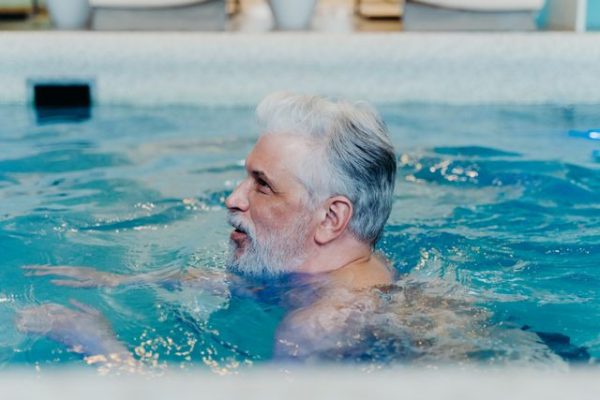
Photo by cottonbro studio
Fight your instincts, not the water
The RNLI’s Float to Live advice was designed for cold, open water, but its principle is the most useful thing I can teach a nervous adult in a pool. Professor Mike Tipton, whose research underpins the campaign, explains that the instinctive responses to sudden immersion, such as gasping, thrashing and swimming hard, increase the risk of breathing in water and tire you quickly. The RNLI’s advice is to fight your instinct and lean back, keep your airway clear and float until your breathing settles, which in cold water typically takes 60 to 90 seconds.
That is the skill. Not swimming harder, but doing less.
How I teach it
With adults who fear deep water, I never start in the deep end. We build the calm response in shallow water first, so it is already familiar before it is needed.
Breathe out slowly. A long, steady exhale is the quickest way I know to tell your nervous system that you are safe. We practise it standing, then floating, then moving, until it becomes automatic.
Learn to lie back. The RNLI’s steps are simple: tilt your head back so your ears go under, relax and control your breathing, and use small movements of the hands and legs to stay afloat. Your legs may sink a little, and that is fine; everyone floats differently. Most adults are surprised by how little effort it takes once they stop fighting it.
Practise the transition. The real skill is going from upright and worried to lying back and calm. We rehearse it at standing depth: let the feet come up, tip the head back, breathe out, and wait. Then we do the same thing a little deeper, beside the wall, with the wall always within reach.
Move out gradually. Only once the float is reliable do we spend time where the feet cannot touch, and even then in short visits. A few relaxed minutes in deep water does more for confidence than an hour of anxious lengths.
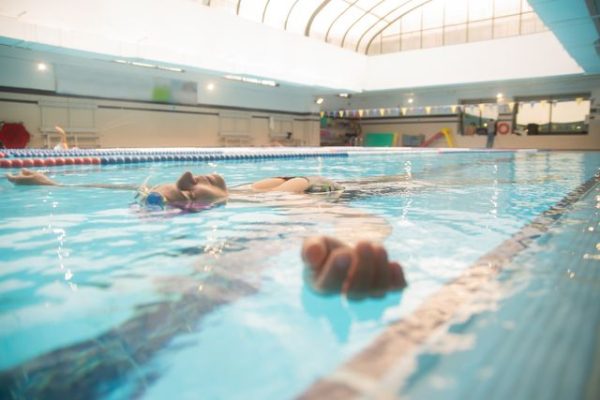
Photo by Kampus Production
A few things worth knowing
Treading water is not where to begin. It is useful, but it is effortful and asks you to stay upright, which is exactly the position panic pushes you into. Floating first, treading second.
Depth is not the danger. Two metres of water and twenty metres hold you up in exactly the same way. Once your body knows it can float, the number on the side of the pool stops mattering.
Setbacks are normal. Many adults have one good session in deep water followed by a nervous one. That is not going backwards; it is the nervous system checking that the new information is true.
If this is you
If you can swim but freeze when your feet leave the floor, you are not alone, and you have not left it too late. The calm response can be learned at any age. As the open-water season ends and lakes and seas turn colder, it is also one of the most valuable safety skills any adult can have. Start somewhere warm, with someone patient, and learn to lean back.
References
Pia, F. A. (2006). The instinctive drowning response. On Scene, US Coast Guard, Fall 2006
RNLI (2017). RNLI says ‘fight your instincts, not the water’ to help stay alive.
Main – Photo by Andrea Piacquadio
About the Author: Brian FitzGerald