

How to Start & What Actually Helps
If the thought of getting into a swimming pool makes your stomach tighten, you are in good company. A fear of water in adulthood is far more common than most people realise — and, crucially, far more fixable than it feels. In thirty years of teaching I have watched people who once would not put their face in the bath go on to swim a full length, calmly and on their own terms. The fear is real, but it is not a life sentence.
The first thing worth knowing is that adult water fear is rarely about being “bad at swimming.” It is usually about control. Water is unpredictable, it covers your ears and eyes, and it asks you to trust that you will float rather than sink. For an adult used to having both feet on solid ground, that loss of control is the real source of panic. Once you understand that, the path forward becomes much clearer: you are not learning to fight the water, you are learning to feel safe in it.
Start where you actually feel comfortable — and no further. This might mean simply sitting on the pool steps with the water around your waist, breathing slowly, for your first few visits. There is no prize for rushing. Confidence in water is built in small, repeatable wins, and every calm minute you spend in the shallow end is teaching your nervous system that nothing bad is happening.
Breathing is the single most useful tool you have. Fear makes us hold our breath and tense up, which is exactly what makes floating harder. Practise a slow breath out through your mouth, into the water if you can, making a gentle humming or bubbling sound. A long, unhurried exhale tells your body it is safe and keeps your face relaxed. If you take only one thing into the pool, make it this: breathe out, slowly, and keep breathing.
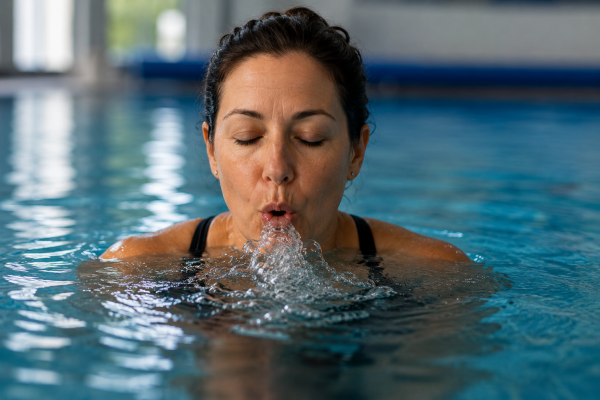
Image created using AI
Get familiar with floating before you worry about strokes. Holding the side of the pool, let your legs drift up behind you and feel how the water supports you. Then try a gentle float on your back, head resting in the water, ears submerged. It feels strange at first — many adults instinctively try to stand up the moment they tip back — but learning that the water will hold you is the moment most people’s fear begins to loosen its grip.
A few practical things make a real difference. Choose a warm, quiet pool and a quiet time of day; cold and crowds both raise tension. Wear goggles that fit well, so you can open your eyes and see clearly underwater — not being able to see is a hidden driver of panic. And go with someone calm, whether a patient friend or a teacher who works at your pace. One-to-one lessons, in particular, let you set the speed and stop the moment you need to, which is often the difference between progress and overwhelm.
Be wary of the well-meaning advice to “just jump in and get it over with.” For most fearful adults, being thrown in at the deep end — literally or figuratively — confirms the fear rather than curing it. Gradual exposure, where each step feels manageable before you take the next, is not only kinder, it works better and lasts longer.
Finally, expect progress to be uneven. Some weeks you will surprise yourself; others you will feel as though you have gone backwards. That is completely normal. What matters is that you keep returning, keep breathing, and keep noticing the small victories — the first time you put your face in, the first proper float, the first push and glide. String enough of those together and one day you realise the fear that once ruled the poolside has quietly become something you can manage.
You do not have to love the water overnight. You just have to start, gently, and let confidence catch up. It almost always does.
Main – Photo by Sasha Kaunas on Unsplash
About the Author: Brian FitzGerald